
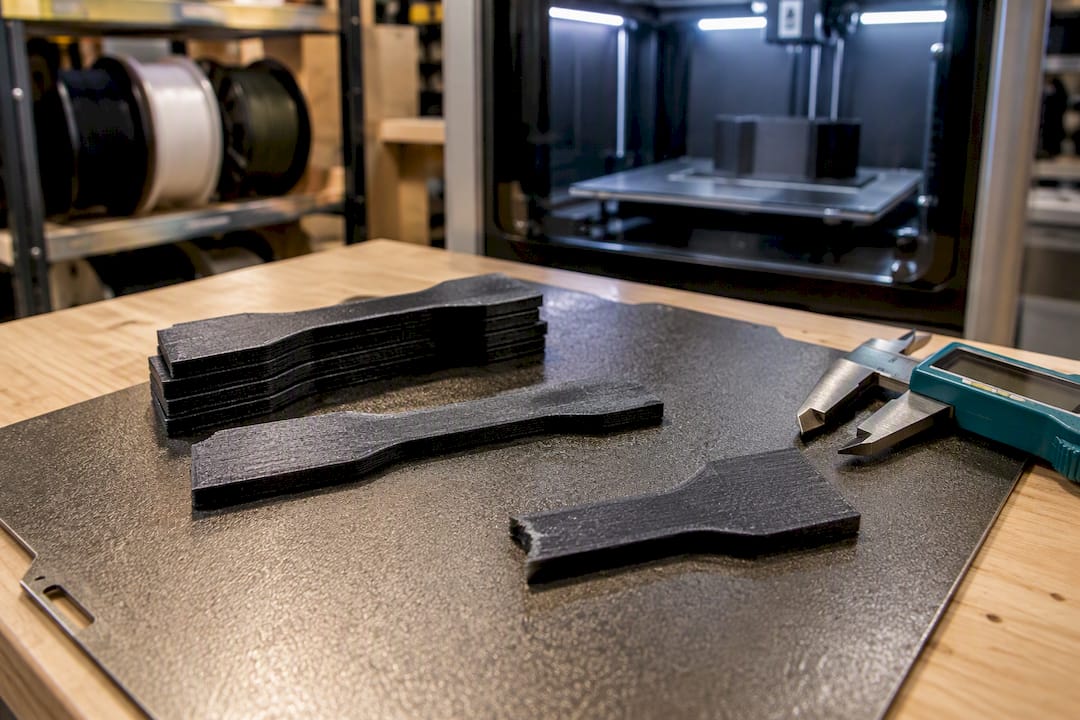
Carbon fiber reinforcement raises nylon’s stiffness dramatically and often boosts tensile strength as well, but the gains depend heavily on how the part is printed. Studies on PA6 loaded with carbon fiber report tensile strength climbing to roughly 166 MPa versus about 70 MPa for unreinforced PA6, while build orientation alone can swing printed tensile results substantially. The tradeoff: less elongation before failure and a real risk of brittle behavior if you design around the wrong axis.
TL;DR:
- Printed tensile strength of carbon fiber nylon greatly varies depending on build orientation, with XY directions achieving near twice the strength of vertical builds.
- Higher-grade fibers like T700 produce stiffer and stronger parts, but reduce impact resistance and increase brittleness.
- Moisture content in filament can reduce tensile strength by more than half, making filament drying a critical pre-print step.
- Using a small test matrix to determine optimal orientation and infill density provides more reliable strength predictions than relying solely on datasheet values.
Table of Contents
- How strong is carbon fiber nylon compared to plain nylon?
- Why carbon fiber changes nylon’s strength and toughness tradeoffs
- Printing variables that decide your part’s real-world strength
- Post-processing steps that measurably raise modulus
- Deciding when carbon fiber nylon is the right call
- How CC 3D Labs validates carbon fiber nylon parts
- The gap between datasheet numbers and printed reality
- Sources
- FAQ
How strong is carbon fiber nylon compared to plain nylon?
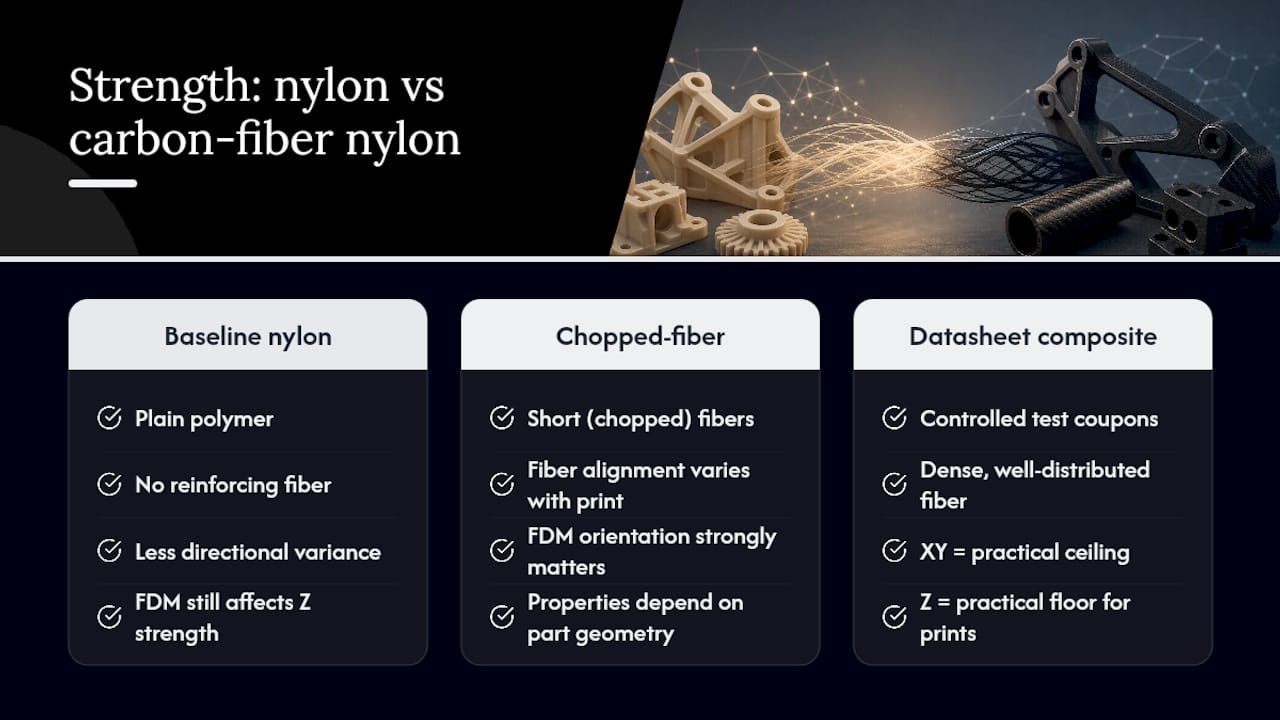
The honest answer is “it depends on which nylon, which fiber, and which direction you pull it.” A comparison across baseline nylon, chopped-fiber filaments, and datasheet figures shows why a single number rarely tells the whole story.
The spread between the best and worst rows is not noise. It is the difference between injection-molded or compounded composite (dense, fiber well-distributed) and an FDM print where layer bonding and fiber alignment depend entirely on how you orient the part on the bed. Datasheet numbers from Polymaker represent controlled test coupons, not necessarily your geometry, so treat the XY figure as a ceiling and the Z figure as a floor for real parts.
Why carbon fiber changes nylon’s strength and toughness tradeoffs
Carbon fiber does two things to a nylon matrix: it carries load that the polymer alone cannot, and it stiffens the material by resisting deformation under stress. That is why flexural and tensile numbers climb together in loaded PA6, but it also explains why elongation at break drops. Fiber ends act as stress concentrators, so once a crack initiates near a fiber tip, it propagates faster than it would through pure polymer.
- Tensile and flexural strength both rise with fiber loading, but the PA6 review documents reduced elongation at break as a near-universal side effect.
- T300 fiber tends to produce higher stiffness at a given loading than lower-grade chopped fibers, while T700 grades are typically specified where fatigue resistance matters more than raw modulus.
- PA6 generally reaches higher as-molded strength than PA12 at similar fiber content, but PA12 absorbs less moisture over time, which matters for long-term dimensional stability.
None of this is exotic materials science. It is the same fiber-matrix mechanics that governs any short-fiber composite, carbon or glass, and it means a part optimized for stiffness is not automatically optimized for impact resistance.
Printing variables that decide your part’s real-world strength
Orientation is the single biggest lever an operator controls. The Nylon 12 CF study cited above found lateral prints outperforming vertical prints by roughly 2.5 times in ultimate tensile strength, and a separate case study on carbon-fiber nylon found ZX-oriented samples reaching only about half the strength of XY or XZ prints. If your load path is known, print so the strongest raster direction lines up with it, not with whatever orientation prints fastest.
- Align the longest print axis with the primary load direction rather than defaulting to whatever orientation minimizes support material.
- Choose solid or near-solid infill for load-bearing sections; gyroid or hex patterns save time but trade off strength, a point covered in more depth in our infill guide.
- Keep melt temperature and extrusion pressure consistent, since both affect fiber orientation within each bead and how well adjacent layers fuse, detailed further in our layer adhesion guide.
- Dry filament before printing: one case study found dry samples reaching 2.4 times the tensile strength of wet samples of the same material, making moisture control arguably more important than any single print setting.
Pro Tip: Print a small 2×2 matrix, two orientations by two infill densities, then pull each coupon to failure. Four data points from your own printer and filament lot will tell you more than any published datasheet.
Post-processing steps that measurably raise modulus
Drying is the first and cheapest lever, but heat treatment after printing can do more for stiffness than any single process tweak during printing. A two-stage annealing method for short carbon fiber reinforced PA6 raised tensile modulus from 7.7 to 9.0 GPa, roughly a 16.8% gain over single-temperature annealing, by allowing fiber alignment and crystallinity to develop in two distinct thermal steps rather than one abrupt cycle.
- Dry filament to spec before printing rather than relying on post-print correction, since moisture absorbed into the matrix during printing cannot be fully reversed by later heat treatment.
- Two-stage annealing outperforms single-temperature annealing for modulus gains, but requires tighter process control to avoid warping thin sections.
- Compaction under pressure during post-heat treatment can close porosity and improve fiber-matrix bonding, but aggressive pressure or overheating risks degrading the matrix rather than strengthening it, so trial on sacrificial coupons first.
Deciding when carbon fiber nylon is the right call
Carbon fiber nylon earns its place in stiff, heat-tolerant fixtures, jigs, and brackets where unreinforced nylon flexes too much and metal is overkill on cost or lead time. It is a poor choice where impact resistance matters more than stiffness, since the reduced elongation at break makes brittle failure more likely under shock loads.
- Confirm the load case is dominated by stiffness or heat resistance rather than impact, since CF-nylon trades toughness for modulus.
- Design fillets instead of sharp internal corners, since fiber ends already concentrate stress and a sharp transition compounds it.
- Orient the print so raster direction follows the primary stress path, informed by the orientation data above.
- Print a small specimen matrix before committing to final geometry, and build in a conservative safety factor, especially near the Z-orientation lower bound, until your own test data replaces the published range.
How CC 3D Labs validates carbon fiber nylon parts
CC 3D Labs runs a Bambu Lab FDM farm capable of printing carbon fiber nylon alongside PLA, PETG, ABS, and ASA, and every functional-part job starts with a test print of your actual model rather than a quote based on assumptions. That test print becomes your orientation and infill checkpoint before committing to a full run.
For parts replacing an existing component, our professional handheld 3D scanning, accurate to about 0.1 mm, captures the original geometry for reverse engineering or scan-to-CAD work, and our CAD team can adjust wall thickness or fillet radii to reduce stress concentration before the part ever prints. This loop, test print, review, tailored quote, suits prototype validation and low-volume functional runs where getting the orientation right matters more than getting a part fast.
The gap between datasheet numbers and printed reality
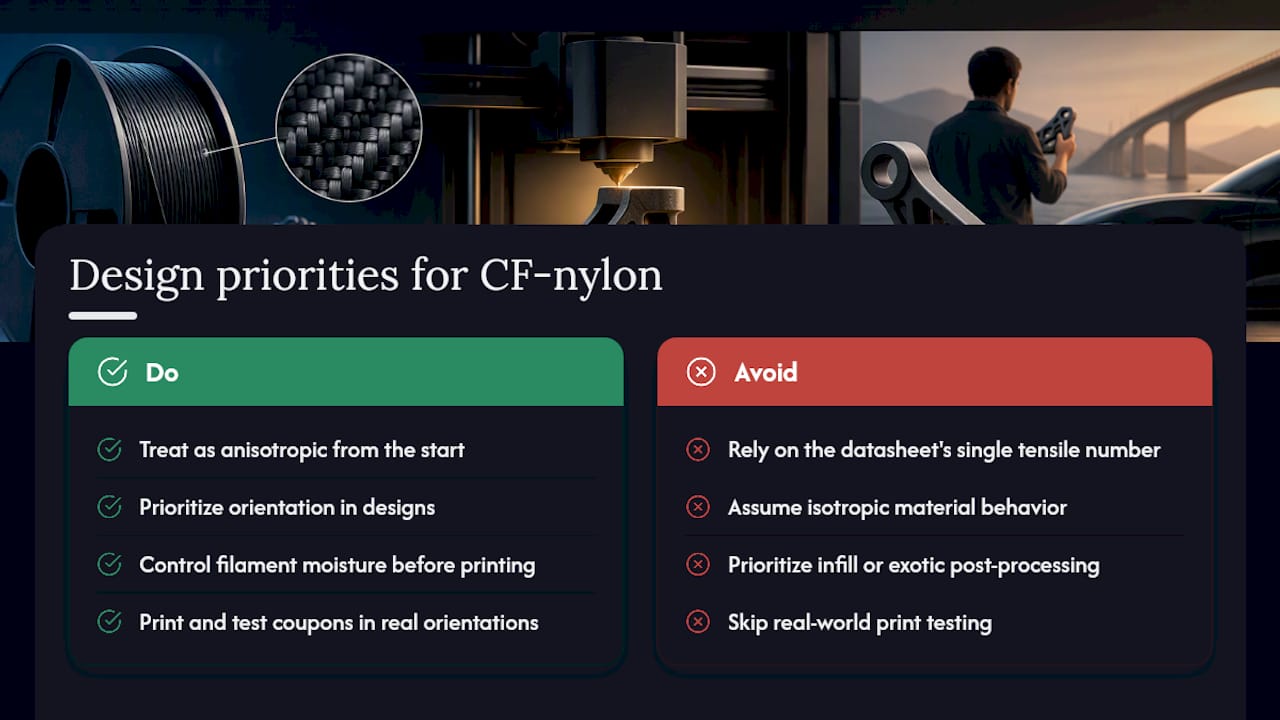
The most overrated number in this entire material class is the single tensile strength figure printed on a filament spool. Every datasheet reports a best-case XY orientation tested under controlled conditions, and every engineer who has pulled their own printed coupons knows that number rarely survives contact with a real build orientation, a humid filament box, or a rushed print profile.
What the evidence actually supports is a design mindset, not a lookup table. Treat carbon fiber nylon as an anisotropic material from the start, the same way you would treat plywood or a laminate, and never assume isotropic behavior just because the resin itself is homogeneous. Prioritize orientation and moisture control before you touch infill density or exotic post-processing, since those two variables account for the largest swings in the data reviewed here.
— Justin
Sources
- Carbon Fiber-Reinforced Polyamide 6 Composites: Impact of Fiber Type and Concentration on the Mechanical Properties
- PolyMide™ PA6-CF (Polymaker) product page/datasheet
- Determination of the Mechanical Tensile Characteristics of Some 3D-Printed Specimens from NYLON 12 CARBON Fiber Material
- Two-stage annealing method for short carbon fiber‐reinforced nylon 6 in fused filament fabrication
FAQ
Is carbon fiber nylon strong?
Carbon fiber reinforced nylon is substantially stiffer and often stronger in tension than unreinforced nylon, with one study reporting tensile strength near 166 MPa versus about 70 MPa for the pure polymer. Actual printed strength depends heavily on build orientation and moisture content at print time.
Which is stronger, PA6-CF or PA6 GF?
Both carbon fiber and glass fiber raise PA6’s stiffness and tensile strength over the unreinforced polymer, with carbon fiber generally producing higher stiffness at equivalent loading due to its higher modulus fibers. Specific comparisons depend on fiber grade, loading percentage, and test orientation, so a direct number should come from matching datasheets rather than a general rule.
Is PA6-CF strong?
PA6-CF is one of the stiffer FDM-printable materials available, with datasheet tensile strength around 105 MPa in the XY orientation dropping to about 67.7 MPa in the Z direction. That gap makes orientation the deciding factor in whether a printed PA6-CF part performs close to its datasheet potential.
What is nylon reinforced with carbon fiber?
Carbon fiber reinforced nylon is a composite where chopped or continuous carbon fibers are blended into a PA6 or PA12 matrix to increase stiffness and often tensile strength compared with the unreinforced polymer. The tradeoff is reduced elongation at break, meaning the material resists bending but can fail more abruptly under impact.
Ready to validate a carbon fiber nylon part before committing to a full run, get a quote based on a test print of your actual model rather than a generic estimate.