
TL;DR:
- Choosing the correct filament is essential for ensuring the performance, durability, and environmental resistance of engineering parts, preventing costly failures.
- Selecting materials like PETG, nylon, or carbon fiber composites depends on mechanical, thermal, and environmental requirements, with proper process control and supplier reliability being critical for success.
Choosing the wrong filament for an engineering part is not just a performance issue. It can mean a failed prototype, a recalled product, or thousands of dollars in avoidable rework. The question of why choose filament for engineering parts goes deeper than picking the strongest material on the shelf. Engineering-grade filaments are selected for functional performance first, not ease of print, and the spectrum of available materials now spans simple PETG all the way to carbon fiber reinforced composites. Understanding that range, and knowing where each material fits, is what separates parts that work from parts that just look like they work.
Table of Contents
- Key takeaways
- Why choose filament for engineering parts
- Environmental resistance and filament choice
- Printability challenges with engineering filaments
- Cost-benefit analysis for filament selection
- Real-world applications across filament types
- My take on filament selection in the real world
- How Cc3dlabs supports your engineering parts workflow
- FAQ
Key takeaways
| Point | Details |
|---|---|
| Filament choice drives part performance | Mechanical properties like tensile strength and heat deflection temperature directly determine whether a part survives in service. |
| Environment shapes material selection | UV, chemical exposure, and moisture can degrade the wrong filament quickly, making environmental fit as critical as strength. |
| Printability affects real-world outcomes | A material with excellent specs on paper fails if your process cannot reliably print it without warping or delamination. |
| Cost-effectiveness goes beyond unit price | Higher-cost filaments often reduce failure rates and iteration cycles, lowering total project cost over time. |
| Match material to application, not ego | Over-engineering with premium filaments wastes budget. Selecting a fit-for-purpose material is a professional decision, not a compromise. |
Why choose filament for engineering parts
Not all 3D printing filaments are created equal, and the engineering world proves that point daily. Professional material selection is a deliberate inquiry that balances load requirements, environmental conditions, and processing demands rather than simply reaching for whatever is labeled “strong.”
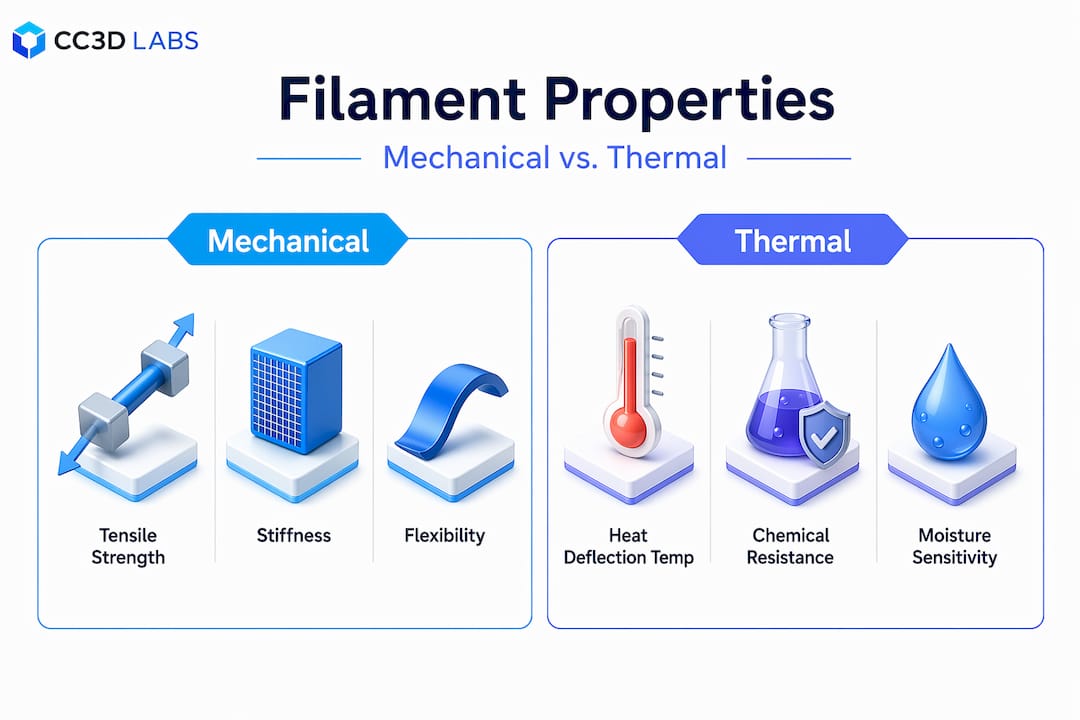
The core filament properties that determine suitability for functional parts fall into two categories: mechanical and thermal.
Mechanical properties that matter
Tensile strength tells you how much pulling force a part can take before it snaps. Stiffness, measured as elastic modulus, tells you how much it flexes under load. Toughness combines both into a measure of how much energy a part absorbs before fracturing. For engineers, toughness is often more useful than raw strength, especially for parts subject to impact or vibration.
Here is how common engineering filaments compare on key mechanical and thermal benchmarks:
| Filament | Tensile Strength (MPa) | Heat Deflection Temp (°C) | Best Use Case |
|---|---|---|---|
| PETG | 50 | 80 | Prototypes, housings |
| ABS | 40 | 98 | Interior structural parts |
| ASA | 45 | 100 | Outdoor structural parts |
| Nylon (PA12) | 55 | 110 | Wear parts, gears |
| Polycarbonate | 65 | 130 | High-load brackets |
| CF Reinforced | 80+ | 130+ | Structural frames, jigs |
Carbon fiber reinforced filaments deliver 2 to 3 times higher stiffness and heat deflection temperatures around 130°C compared to unfilled plastics. That gap matters when you are building jigs, fixtures, or any part that must hold dimensional tolerance under temperature cycling.
Thermal properties deserve equal attention. Heat deflection temperature (HDT) is the point at which a part begins to deform under load at elevated temperatures. Glass transition temperature (Tg) marks where the polymer structure softens. A housing printed in PETG with an 80°C HDT will warp inside a vehicle dashboard or near industrial heat sources. That failure is not a print defect. It is a material mismatch.

Pro Tip: When specifying filaments for load-bearing parts, request the material’s datasheet from your supplier. Published HDT values tested under 0.45 MPa load are more conservative and more accurate for engineering use than values tested under 1.82 MPa.
Environmental resistance and filament choice
Knowing how a part performs in a lab is only half the picture. The environment where it will actually live determines whether a perfectly printed part survives a season outdoors, a chemical wash, or a humid warehouse.
The key environmental factors that should drive your filament selection are:
- UV and weather resistance: ABS degrades noticeably under prolonged UV exposure. ASA filament provides superior UV and weather resistance, making it the go-to choice for outdoor parts that need to last years without significant degradation. It shares ABS’s strength and heat resistance while adding meaningful sunlight stability.
- Chemical resistance: Nylon and polycarbonate can absorb certain solvents and degrade in acidic environments. PETG offers reasonable chemical resistance for many industrial cleaning agents. For aggressive chemical environments, check material-specific resistance charts before committing to a filament, or reference industrial pipe material guides to see how comparable polymers hold up in practice.
- Moisture absorption: Nylon is highly hygroscopic. Uncontrolled moisture absorption does not just cause print failures. It directly degrades the mechanical properties of finished parts, reducing tensile strength and increasing brittleness over time. Parts printed from wet nylon are structurally compromised before they leave the printer.
Pro Tip: Dry nylon filament at 70 to 80°C for at least four hours before printing, and store it in a sealed container with desiccant. If you are running production quantities, an inline drying system attached to your printer feed is worth the investment.
For your outdoor parts selection, the Cc3dlabs guide covering outdoor-durable filaments breaks down the top material choices with real-world context.
Printability challenges with engineering filaments
Strong on paper does not mean easy to print. Engineering-grade filaments introduce processing requirements that general-purpose PLA users never encounter, and understanding those requirements before you start is how you avoid wasted prints and failed parts.
Here is the printability spectrum from accessible to highly specialized:
- PETG prints cleanly on most desktop FDM machines with a 230 to 250°C nozzle and a 70 to 85°C bed. Warping is minimal, and layer adhesion is reliable. It is the most accessible entry point for durable engineering parts.
- ABS and ASA require a heated enclosure to prevent warping, particularly on large footprint parts. Bed temperatures in the 100 to 110°C range and a consistent ambient temperature around 45 to 50°C are necessary for dimensional stability.
- Nylon needs a dry filament environment, high bed adhesion (PEI or garolite surfaces work well), and nozzle temperatures around 240 to 270°C depending on grade. Without proper drying, expect stringing, poor layer fusion, and degraded mechanical properties.
- Polycarbonate requires nozzle temperatures of 270 to 300°C and is highly prone to warping without an enclosed, heated chamber. It also absorbs moisture aggressively, so storage protocol matters.
- Carbon fiber composites need hardened steel or ruby-tipped nozzles. Standard brass nozzles wear out within a few hundred grams of CF-reinforced material. Carbon fiber reinforcement improves dimensional stability by locking the polymer matrix and reducing warping during cooling, which is a major advantage for complex or large parts.
- PEEK occupies its own category entirely. PEEK filaments require industrial-grade printers with nozzle temperatures between 360 and 450°C and bed temperatures from 120 to 160°C. Its use is only justified in extreme heat and chemical environments where no alternative material will hold up.
Bringing high-temperature filament capability in-house changes iteration economics significantly, shortening design-test-iterate cycles and reducing time-to-market for engineering teams working on complex assemblies.
Pro Tip: Before scaling a material to production volumes, run a print qualification test: print the same geometry in three separate batches from three separate spools. Variation between batches reveals supplier inconsistency before it becomes a production problem.
Cost-benefit analysis for filament selection
The sticker price of a filament spool is the least useful number in your cost analysis. What actually drives cost in filament-based engineering parts is the total cost of ownership: failed prints, post-processing time, rework rates, and iteration cycles.
Consider this comparison:
| Filament | Approx. Cost per kg | Failure Rate (Est.) | Best Total Cost Scenario |
|---|---|---|---|
| PETG | $25 to $40 | Low | High-volume functional prototypes |
| Nylon PA12 | $50 to $80 | Medium (if wet) | Gears, wear parts |
| Polycarbonate | $60 to $100 | Medium-High | Structural load applications |
| CF Nylon | $80 to $150 | Low (with right setup) | Stiff structural components |
| PEEK | $200 to $400+ | High without industrial hardware | Extreme environments only |
PETG is a pragmatic starting material for durable parts not exposed to extreme heat or chemicals. It combines printability with reasonable toughness and is widely available from consistent suppliers. For many functional parts, PETG delivers everything you need at a fraction of the cost of exotic materials.
The trap engineers fall into is over-engineering the material when the design is the actual problem. A polycarbonate bracket printed with poor layer adhesion will outperform nothing. A well-designed PETG bracket printed with optimal parameters will outlast a badly printed polycarbonate one every time.
Pro Tip: Before jumping to premium filaments, audit your print parameters and part design first. Most real-world failures in functional filament parts come from inadequate wall thickness, poor infill strategy, or moisture-degraded material, not from choosing the wrong polymer family.
Real-world applications across filament types
Theory becomes useful when you can connect it to specific parts solving specific problems.
- Outdoor enclosures and mounting brackets: ASA is the clear choice. Engineering teams building antenna mounts, sensor housings, or outdoor junction boxes routinely use ASA to get ABS-level toughness without the UV degradation risk. Parts produced with ASA maintain structural integrity and color stability after years of direct sun exposure.
- Wear-resistant sliding parts and bearings: The Igus Iglidur i190PF filament achieves wear rates 100 times lower than standard PETG, tested in a dedicated tribology laboratory against stainless steel. For lubrication-free bushings, guide rails, or any sliding contact application, this class of material changes what is achievable with FDM printing.
- Structural prototypes and tooling jigs: Carbon fiber reinforced nylon or PETG delivers the stiffness needed for jigs, fixtures, and assembly aids. The dimensional stability under temperature cycling makes CF composites far more reliable than unfilled materials for production floor tooling, where tolerances matter every shift.
- Functional prototypes bridging to production: PETG and ABS occupy a productive middle ground for prototype engineering parts where you need real mechanical behavior data without committing to expensive materials or processes. They print predictably, iterate quickly, and are cheap enough to run multiple design variants in a single day.
My take on filament selection in the real world
I have seen engineering teams spend weeks debating whether to use carbon fiber reinforced nylon versus PEEK for a bracket that operates at room temperature with a 20-pound static load. That debate was not an engineering decision. It was anxiety wearing the costume of rigor.
In my experience, the biggest mistake engineers make when selecting filaments is conflating material prestige with material fitness. The best filament for your part is the one that meets your mechanical, thermal, and environmental requirements at the lowest total cost with the highest print reliability. Full stop.
What I have found actually separates strong filament workflows from weak ones is not the material choice. It is the testing discipline. Teams that run small print qualification batches before committing to a material, that document their failure modes, and that track print parameters across suppliers iterate faster and waste far less than teams that treat every print as one-off experimentation.
Supplier quality is also wildly underrated. The same nominal filament from two different manufacturers can produce measurably different mechanical outcomes. Diameter consistency, moisture control during shipping, and formulation stability vary more than most engineers expect. Finding a reliable supplier and sticking with them across a project is a real process advantage.
Finally, building your material knowledge through deliberate iteration beats reading datasheets alone. Print the same geometry in three materials. Load test them. Break them. The result will tell you more than any specification document.
— Justin
How Cc3dlabs supports your engineering parts workflow
Working with engineering-grade filaments in-house is a significant capital and process investment. Cc3dlabs offers a ready alternative for teams that need production-quality filament parts without building the infrastructure from scratch.
From functional prototypes in PETG and ASA to advanced composite prints for structural applications, Cc3dlabs handles the material selection, process optimization, and quality validation so your team can focus on design. Their 3D printing services cover everything from single prototype prints to batch production runs, with fast turnaround and material guidance built into the engagement. If your project involves complex geometries, tight tolerances, or high-performance filament requirements, their team near Philadelphia offers both local pickup and shipping, backed by a track record of print accuracy that engineering applications demand. You can also explore how 3D printing drives product innovation to see where filament-based manufacturing fits in the broader product development picture.
FAQ
What filament is best for functional engineering parts?
The best filament depends on your specific load, temperature, and environmental conditions. PETG suits most prototypes and housings, while nylon, polycarbonate, and carbon fiber composites are better for higher-stress or high-temperature applications.
Why use filament instead of other manufacturing methods?
Filament-based 3D printing offers rapid iteration, low tooling cost, and the ability to produce complex geometries without fixturing. It is especially effective in early-stage development when design changes are frequent and speed matters more than per-unit cost.
How does moisture affect engineering filament parts?
Hygroscopic filaments like nylon absorb moisture from the air, which degrades both print quality and finished part strength. Drying filament before use and storing it with desiccant are non-negotiable steps for reliable engineering outcomes.
Is PETG strong enough for load-bearing parts?
PETG handles moderate loads well, with a tensile strength around 50 MPa and an HDT of roughly 80°C. For parts exposed to higher temperatures or impact forces, upgrading to polycarbonate or a carbon fiber reinforced filament delivers meaningfully better performance.
When does it make sense to use PEEK filament?
PEEK is justified only when a part must survive extreme heat above 200°C or aggressive chemical environments where no other filament will hold up. Its processing demands and cost make it impractical for most standard engineering applications.