
TL;DR:
- Layer adhesion in 3D printing depends on polymer fusion and chain entanglement before the interface freezes.
- Controlling factors such as nozzle temperature, build plate heat, fan speed, and part orientation is essential for optimizing bond strength.
Layer adhesion in 3D printing is defined as the interlayer bond strength formed when successive layers of molten polymer fuse together before the interface freezes. This bond quality is the single most important factor determining whether a printed part behaves as a solid, monolithic object or a laminated stack that splits under load. The role of layer adhesion in 3D prints extends far beyond surface appearance. It governs tensile strength, failure mode, and long-term durability. Understanding interlayer bonding, the industry’s standard term for this phenomenon, is non-negotiable for anyone producing functional parts with FDM or FFF technology.
What factors most influence layer adhesion quality in 3D printing?
Layer adhesion is fundamentally a polymer welding problem. A fresh bead must wet, contact, and fuse with the previous layer while both surfaces remain above the glass transition or crystallization threshold. Once the interface freezes, bond strength plateaus and no amount of downstream heat will recover it.
Several variables control whether that fusion window stays open long enough:
- Nozzle temperature. Higher melt temperatures increase polymer chain mobility and extend the fusion window. Prusa recommends adjusting printing temperature in 5°C increments for PLA to find the adhesion sweet spot without burning the material.
- Cooling fan speed. Aggressive cooling locks the interface before chains can entangle. For ABS, Prusa explicitly recommends running the fan off entirely and using an enclosure to prevent delamination.
- Layer thickness. Thinner layers produce stronger bonds. A 2026 Springer study found that PETG loses roughly 50% of shear strength at higher layer thicknesses, while PLA drops about 29%. Thinner layers mean more contact area and longer thermal exposure per unit of height.
- Build plate temperature. HIPS showed improved interlayer bond quality at approximately 105°C build plate temperature, while PP suffered from warping and voids when plate temperature was mismatched. Molecular diffusion at the interface depends on sustained heat from below.
- Ambient environment. Drafts and humidity disrupt the thermal profile around the part. Thermal gradients from the bed, enclosure, and environment influence void formation and residual stresses that degrade adhesion beyond nozzle temperature alone.
Pro Tip: Never treat nozzle temperature as the only thermal lever. Build plate temperature, enclosure heat, and fan speed all shape the time-temperature history at the interface. Tune them together, not in isolation.
How does layer adhesion affect mechanical performance and failure modes?
Weak interlayer bonding creates a predictable failure path. Load applied perpendicular to the layer lines generates peel stress at the weld lines, and the part splits along those interfaces rather than through the material itself. This is the defining characteristic of anisotropic behavior in FDM parts: strength along the print axis is always lower than strength within a layer plane.
Mechanical testing reveals how adhesion quality shows up in real failure data:
- Tensile testing perpendicular to layers exposes the weakest bond directly. Parts with poor adhesion fracture cleanly at layer interfaces at loads well below the material’s rated tensile strength.
- Shear testing measures how well layers resist sliding against each other. Mechanical interlocking between bi-material FDM joints can reach shear strength above 24 MPa, compared to roughly 21.7 MPa for alternate deposition without interlocking geometry.
- Bending tests reveal combined tension and compression across layers. Delamination typically initiates on the tension face where peel stress concentrates.
- Fracture surface analysis is the most practical diagnostic. A smooth shear fracture indicates good bonding. A rough, stepped fracture surface signals adhesion failure at the interface rather than bulk material failure.
| Material | Layer thickness effect | Approximate strength loss |
|---|---|---|
| PLA | Increased thickness reduces bond | ~29% at higher layer heights |
| PETG | More sensitive to thickness | ~50% at higher layer heights |
| PEKK | Crystallization-controlled | 93.9 MPa tensile via cooling regulation |
| HIPS | Build plate temperature sensitive | Improved at ~105°C plate temp |
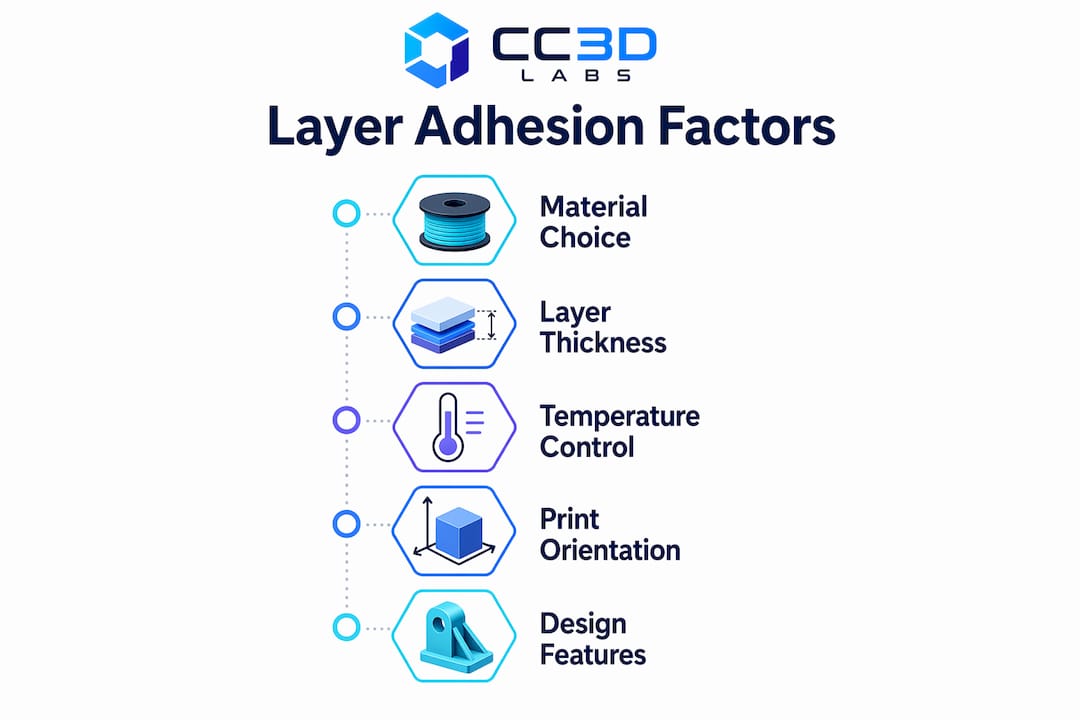
The table above makes one point clear: material choice and layer thickness interact. You cannot apply PLA settings to PETG and expect equivalent bond quality.
Design decisions compound the risk. Parts oriented so that the primary load runs parallel to layer lines perform far better than parts where load pulls layers apart. For strength-critical parts, print orientation is as important as material selection.
What advanced techniques and design strategies enhance layer adhesion?
Professional-grade adhesion requires going beyond default slicer presets. The following approaches produce measurable improvements in interlayer bond strength:
- Mechanical interlocking geometry. When chemical adhesion between two materials is limited, geometry does the work. Dovetail or interlocking features at bi-material interfaces limit interlayer sliding under shear and push shear strength above what surface bonding alone achieves.
- Extrusion multiplier tuning. Slight over-extrusion (typically 1–5% above nominal) increases contact pressure between the fresh bead and the previous layer. This widens the fusion zone without requiring a temperature increase that might cause stringing or dimensional error.
- Controlled crystallization for high-performance polymers. PEKK and similar semi-crystalline materials require cooling regulation to stay below the crystallization threshold during printing. Printed PEKK parts achieved tensile strength of 93.9 MPa when cooling was managed to preserve chain mobility. Premature crystallization induces brittleness and kills bond quality.
- Enclosures for warp-prone materials. ABS, ASA, and PC all benefit from a heated enclosure that keeps the ambient temperature above the material’s glass transition. This extends the fusion window for every layer deposited.
- Layer orientation strategy. Aligning the print so that critical load paths run parallel to layer planes, not perpendicular to them, avoids peel stress at weld lines entirely. This is a design decision, not a slicer setting, and it belongs in the part design phase.
Pro Tip: When printing multi-material parts, add a small interlocking feature at the interface zone rather than relying on surface contact alone. Even a simple tongue-and-groove profile dramatically increases shear resistance where chemical bonding is limited.
Common challenges with layer adhesion and how to troubleshoot them
Most real-world FDM delamination comes from thermal mismatch and poor interface control, not from defective filament or hardware failure. Knowing what to look for narrows the diagnosis quickly.
- Visible layer separation or cracking. The first check is always temperature. Raise nozzle temperature in 5°C steps. For ABS, confirm the fan is off and the enclosure is sealed against drafts.
- Weak fracture along layer lines under light load. This points to insufficient fusion time. Reduce print speed to keep the interface hot longer, or increase nozzle temperature. Check that the wall thickness is adequate for the load the part will carry.
- Delamination only at specific heights. Look for environmental causes: a nearby vent, a door opening during the print, or a section of the part that cools faster due to geometry. Drafts cause localized thermal drops that freeze interfaces prematurely.
- Inconsistent bond quality across a batch. Filament moisture is the most common culprit. Wet filament produces steam voids at the interface that destroy bond continuity. Dry filament at the manufacturer’s recommended temperature before printing.
- Rough fracture surface on a failed part. A rough, granular fracture face confirms adhesion failure rather than bulk material failure. Smooth fracture surfaces indicate the bond held and the material itself failed, which is the correct outcome for a well-printed part.
Thermal profile control is more effective than simply raising temperature across the board. Systematic adjustment of nozzle temperature, bed temperature, fan speed, and enclosure conditions together produces consistent results. Changing one variable at a time makes it possible to identify the actual cause rather than masking it.
Key takeaways
Strong interlayer bonding requires controlling the full thermal environment at the interface, not just the nozzle temperature, and designing parts so critical loads run parallel to layer planes rather than pulling layers apart.
| Point | Details |
|---|---|
| Adhesion is a welding problem | Polymer chains must entangle before the interface freezes; once frozen, bond strength cannot recover. |
| Layer thickness drives strength loss | PETG loses ~50% shear strength at higher layer thicknesses; thinner layers consistently outperform thicker ones. |
| Thermal environment matters beyond the nozzle | Build plate temperature, enclosures, and draft control all shape the fusion window at every layer. |
| Mechanical interlocking compensates for weak chemistry | Interlocking geometry at bi-material joints pushes shear strength above 24 MPa where surface bonding falls short. |
| Fracture surface analysis beats visual inspection | Rough fracture faces confirm adhesion failure; smooth faces confirm the bond held and material failed correctly. |
Why I think most 3D printing teams underestimate thermal environment
The industry conversation about layer adhesion almost always centers on nozzle temperature. Raise it, lower it, find the sweet spot. That framing is too narrow, and I have seen it lead experienced teams in circles for weeks.
The interface does not care only about what temperature the nozzle deposited the material at. It cares about the entire time-temperature history from deposition to freeze. A draft from an HVAC vent three feet away can collapse bond quality on one side of a tall part while the other side prints perfectly. A build plate running 10°C below spec on a HIPS job produces voids that look like filament defects but are actually thermal failures.
What I find most useful is treating the printer as a thermal system, not a mechanical one. Before changing any slicer setting, I look at the fracture surface of a failed part. Rough and stepped means the interface never fused properly. Smooth and planar means the bond held and something else failed. That single observation cuts diagnostic time in half.
The other thing I push hard on is print orientation. Most practitioners treat it as a geometry problem. It is actually a stress engineering problem. Orienting a bracket so the primary load runs along the layer plane instead of across it can double effective part strength without changing a single print parameter. That is free performance, and it costs nothing except a few minutes of thought during prototype design.
Continuous experimentation with materials and parameters is the only way to build real intuition here. No datasheet replaces the knowledge you get from deliberately breaking parts and reading the fracture surfaces.
— Justin
Cc3dlabs delivers prints where layer bonding is never a compromise
At Cc3dlabs, near Philadelphia, every filament-based print goes through a process tuned for the specific material and part geometry. That means build plate temperatures dialed for the polymer, enclosures used where ABS or ASA demand them, and layer thickness selected for the strength the part actually needs. The team handles everything from single prototypes to batch production runs, with material consultation built into the workflow. If you need parts that hold up under real mechanical loads, explore Cc3dlabs’ professional 3D printing services or get a free online estimate to see what optimized layer bonding looks like in practice.
FAQ
What is layer adhesion in 3D printing?
Layer adhesion is the bond formed between successive layers of deposited polymer in FDM or FFF printing. Bond strength depends on polymer chain entanglement and fusion before the interface freezes by glass transition or crystallization.
Why does layer thickness affect interlayer bond strength?
Thinner layers maintain more contact area and longer thermal exposure between the fresh bead and the previous layer. A 2026 Springer study found PETG loses approximately 50% of shear strength at higher layer thicknesses compared to 0.1mm layers.
How do I fix layer separation in ABS prints?
Turn the cooling fan off, use an enclosure to block drafts, and raise nozzle temperature in 5°C increments. Most ABS delamination comes from thermal mismatch and ambient air cooling the interface before fusion completes.
Does print orientation affect layer adhesion performance?
Print orientation determines whether loads run parallel or perpendicular to layer planes. Parts oriented so critical loads run parallel to the layer plane avoid peel stress at weld lines and perform significantly better under mechanical loading.
What does a rough fracture surface on a failed print indicate?
A rough, stepped fracture surface confirms that the interlayer bond failed rather than the bulk material. A smooth fracture surface means the bond held correctly and the material itself reached its strength limit.