
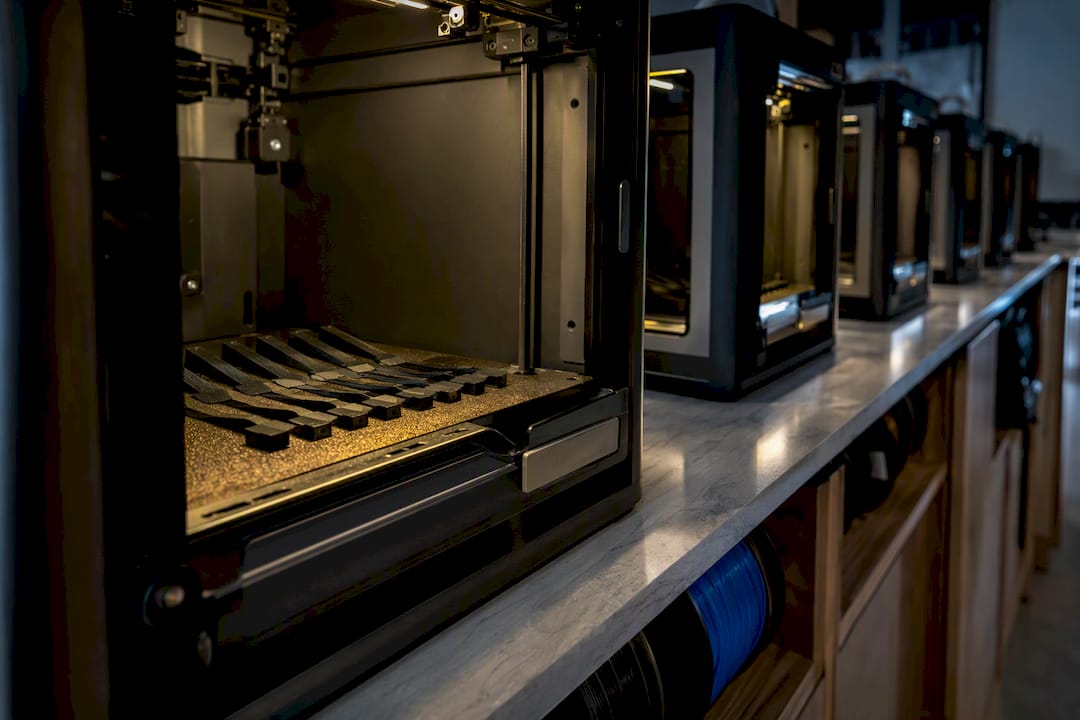
PEEK and PEI sit at the top of the heat resistance ladder, with service temperatures that stretch well past 140°C. Polycarbonate and carbon-fiber-filled nylon are the practical workhorses for most engineering projects on a desktop or production printer. PETG, ABS/ASA, and HT-PLA handle moderate heat with less printing hassle. If a part needs to hold its shape under load at high temperatures, PAEK or PEI is preferred. At moderately high temperatures, PC or CF-PA usually gets the job done.
TL;DR:
- Heat deflection temperature measured at low load (0.45 MPa) is more relevant for design than the glass transition temperature, which reflects softening point.
- PAEK and PEI materials require all-metal hotends and controlled chamber environments to withstand high temperatures safely during printing.
- Moisture absorption significantly reduces nylon’s heat resistance and can cause surface defects, making filament drying and sealed storage essential.
- For long-term service near their rated HDT, parts should be designed for 80% of the material’s maximum temperature to prevent creep and failure.
- Choosing the right heat resistant filament depends on actual operating temperature, load conditions, chemical exposure, and printer capabilities, not just marketing claims.
Table of Contents
- What Actually Makes a Filament Heat Resistant
- Comparing the Heat Resistant Filament Families
- What Your Printer Actually Needs to Handle These Materials
- How to Choose the Right Heat Resistant Filament
- How CC 3D Labs Approaches Engineering-Grade Heat Resistant Parts
- Do Heat Resistant Filaments Age or Degrade Over Time?
- Handling High-Temp Filaments Safely
- A Practitioner’s Note on Trade-Offs and Incremental Testing
- Get Heat Resistant Parts Printed by CC 3D Labs
- Sources
- FAQ
What Actually Makes a Filament Heat Resistant
Two numbers matter here, and they get confused constantly. Glass transition temperature (Tg) marks the point where an amorphous polymer starts softening. Heat deflection temperature (HDT) measures something more useful: how much a material bends under a specific load at a specific temperature. Engineers lean on HDT because it answers the real question. Will this bracket sag on a dashboard in July, or will this housing warp near a motor?
The catch is that HDT numbers shift depending on test load. A datasheet quoting HDT at 0.45 MPa will show a noticeably higher number than the same material tested at 1.8 MPa, because a lighter load is easier to resist. Engineers generally trust HDT over Tg for design decisions precisely because it reflects stiffness under real stress, not just the onset of softening.
Material structure matters too. Amorphous polymers like PC and PEI soften gradually and predictably, which makes them easier to print consistently. Semi-crystalline materials like PEEK, PPS, and PEKK behave differently. Their performance depends on how well the polymer chains crystallize during cooling, which means print settings can change the final part’s real-world heat tolerance, not just its appearance.
Comparing the Heat Resistant Filament Families
Choosing among heat resistant filaments gets easier once you line them up by what they actually do, not just their marketing names. Here’s how the major families stack up on the numbers that matter for functional parts.
PPS stands out for inherent flame resistance, with suitable grades reaching UL94 V-0 ratings, which makes it a strong candidate for electrical enclosures where standard nylon or PC would fail a burn test.
A few things narrow this list fast:
- If you need flame rating for an electrical housing, PPS is worth the printing difficulty.
- If dimensional accuracy under gentle heat matters more than raw temperature ceiling, PEI outperforms PEEK.
- If mechanical toughness at moderate heat is the goal, carbon-fiber nylon or PC covers most real-world engineering needs.
What Your Printer Actually Needs to Handle These Materials
Printing PEEK or PEI on a standard PTFE-lined hotend is not a minor risk. It’s a guaranteed failure. PTFE breaks down above roughly 240°C, releasing fumes and degrading print quality, so anything in the PAEK or PEI family requires an all-metal hotend built for sustained high temperatures. Residence time inside the hotend matters too. Materials sitting too long at extreme temperatures can degrade before they even leave the nozzle.
Bed and chamber control matter just as much as nozzle temperature:
- PC and nylon print best with a heated bed around 100–120°C and benefit from an enclosure that slows cooling.
- Semi-crystalline materials like PEEK and PPS need a controlled heated chamber to crystallize properly, not just to prevent warping.
- Skipping chamber control on these materials often means the printed part never reaches its rated thermal performance, no matter what the spool says.
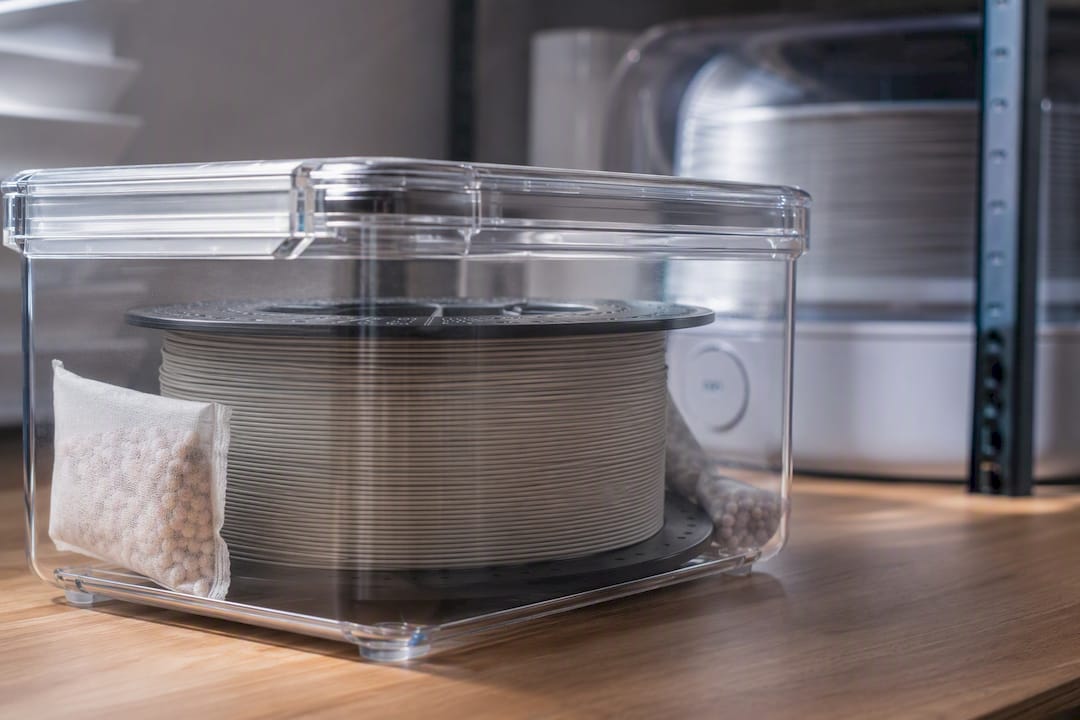
Moisture is the quiet killer for nylon and CF-PA. Absorbed moisture acts like a plasticizer, lowering usable HDT and causing surface defects, brittleness, or popping during extrusion. Dry filament before printing and store it in a sealed container with desiccant, especially for anything left out overnight.
Pro Tip: Annealing a printed part after cooling, holding it near its Tg for a controlled period, can relieve internal stress and push effective HDT closer to the datasheet number, particularly for PC and nylon parts.
How to Choose the Right Heat Resistant Filament
Start with the real number, not the impressive one. What temperature will this part actually see in service, and under what load? A dashboard clip baking in a closed car cabin experiences different stress than a fixture sitting near a motor housing.
Run through this before committing to a material:
- Identify the actual operating temperature under load, not just ambient exposure.
- Match that number to HDT tested at a load close to your application (0.45 MPa for light duty, 1.8 MPa for structural parts).
- Decide if you need chemical resistance, flame rating, or electrical insulation. These requirements eliminate most of the list quickly.
- Check whether your printer can hit the nozzle, bed, and chamber requirements, or whether upgrading is worth the cost versus using a printing service.
- Weigh iteration cost. A failed PEEK print wastes far more material and time than a failed PETG test.
A few practical notes worth keeping in mind:
- Don’t overspec. If PETG meets your temperature and load requirements, printing in PEEK adds cost and difficulty for no benefit.
- Chemical exposure (fuel, solvents, cleaning agents) can matter more than heat alone for automotive parts.
- Always request the exact HDT test load from a datasheet before comparing two materials head to head.
How CC 3D Labs Approaches Engineering-Grade Heat Resistant Parts
CC 3D Labs runs a production farm of Bambu Lab FDM printers and works regularly with PC, carbon-fiber nylon, ABS/ASA, and PETG for functional parts that need to survive real heat and mechanical stress. Every job starts with a test print of the actual model before quoting, which catches warping, moisture issues, or tolerance problems before a full batch runs.
For reverse-engineered or legacy parts, handheld 3D scanning with accuracy to roughly 0.1 mm supports scan-to-CAD verification, useful when an original part no longer exists or specs are unknown. Sending a project to a service makes the most sense when tolerances are tight, materials are moisture-sensitive, or the assembly involves multiple mating parts that need to fit consistently across a batch.
Do Heat Resistant Filaments Age or Degrade Over Time?
Continuous heat exposure changes polymers over months and years, even below their rated HDT. Repeated thermal cycling, heating and cooling a part again and again, can cause micro-cracking at layer boundaries before the polymer itself shows visible damage. This matters more for FDM parts than injection-molded equivalents, because layer adhesion is inherently weaker than a solid molded structure.
Semi-crystalline materials like PEEK and PPS tend to hold their properties longer under sustained heat than amorphous polymers, largely because their crystalline structure resists chain movement that leads to creep. Amorphous materials like PC can experience gradual dimensional drift under long-term load near their Tg, even without visible cracking or discoloration.
UV exposure compounds the problem for outdoor parts. ASA resists UV better than ABS, but neither matches the long-term stability of PEI or PPS in sustained outdoor heat. Chemical exposure adds another layer: a part rated for dry heat may degrade faster when exposed to oils, fuels, or cleaning solvents at the same temperature, since some solvents plasticize polymers in ways similar to moisture in nylon.
The practical takeaway is that a datasheet’s HDT number describes a snapshot, not a warranty. Parts intended for years of service near their thermal ceiling deserve a wider safety margin. Designing for continuous use at 80% of rated HDT, rather than the maximum, extends functional life considerably and avoids the slow creep failures that show up only after months in service.
Handling High-Temp Filaments Safely
Printing above 300°C introduces real risks that PLA and PETG users rarely think about. All-metal hotends running PEEK or PEI temperatures can cause severe burns on contact, and the fumes released by overheated or degraded polymer, especially anything that touches a PTFE-lined part rated below its actual temperature, can be harmful in an enclosed space.
Ventilation matters more here than with standard filaments. A closed chamber that helps print quality also traps fumes, so printing high-temperature materials in a well-ventilated area or with proper exhaust filtration isn’t optional. Nylon and PC both release noticeable odor at printing temperature, and while occasional exposure isn’t typically dangerous, sustained exposure in a poorly ventilated room is worth avoiding.
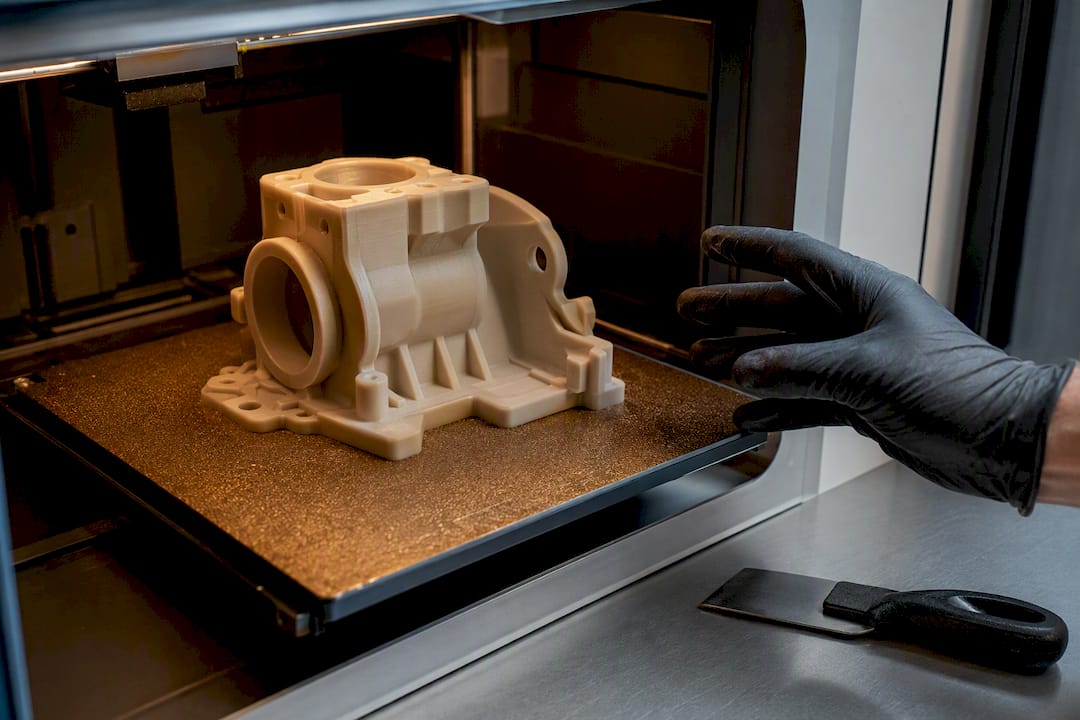
Handling finished parts requires some care too, particularly right after printing. Bed temperatures above 100°C stay hot longer than most people expect, and removing a PC or nylon part too soon risks both burns and warped parts from uneven cooling. Let parts cool gradually on the bed when possible, especially larger PC prints prone to stress cracking if pulled too early.
Storage matters for safety as much as print quality. Nylon and CF-PA absorb moisture quickly, and printing damp filament doesn’t just hurt HDT. It can cause violent popping and spattering at the nozzle as trapped moisture flashes to steam. Keep spools sealed with desiccant, and dry filament in a dedicated dryer before any print that matters.
A Practitioner’s Note on Trade-Offs and Incremental Testing
Escalate deliberately: PETG first, then PC or CF-PA, and only reach for PEI or PEEK when the application genuinely demands it. Test coupons and thermal cycling beat guesswork every time. Part geometry, wall thickness, ribbing, often determines thermal performance as much as the polymer itself, so redesigning before upgrading materials is usually the smarter move.
— Justin
Get Heat Resistant Parts Printed by CC 3D Labs
CC 3D Labs is a direct alternative to guessing your way through material trials on a home printer that was never built for PC or carbon-fiber nylon. Our production farm of Bambu Lab FDM printers runs engineering filaments daily, PC, CF-PA, ABS/ASA, and PETG, with the bed control and process consistency those materials demand.

Every job starts with a test print of your actual model before we quote the batch, so you know how the part performs before committing to volume. If your design started as a legacy or damaged component, our handheld 3D scanning service, accurate to roughly 0.1 mm, can reverse-engineer it into a usable CAD file first. Ready to move a heat-demanding part from concept to production? Request a custom 3D printing quote and get real feedback based on a test print of your part, not a generic estimate.
Sources
For deeper HDT and Tg values across polymer families, the Filabase materials guide offers aggregated datasheet comparisons. The FilamentCompare high-temperature guide breaks down PEEK, PEI, and PEKK behavior in more detail, and BAPolymers’ nylon moisture guide covers drying protocols worth following before any nylon print.
FAQ
Is PLA or PETG better for heat resistance?
PETG holds up better, with a median HDT around 70°C compared to roughly 55–60°C for PLA. PETG is the more practical choice for any part that will sit in a warm car or near a heat source.
Can PLA filament withstand heat?
Standard PLA softens around 55–60°C, which means it deforms quickly in a hot car, near sunlit windows, or close to any heat-generating device. HT-PLA improves on this, reaching roughly 94°C HDT, but it still trails PETG and PC for sustained heat exposure.
Can PETG withstand boiling water?
PETG’s HDT sits around 70°C, close to boiling water’s 100°C, so brief exposure may be tolerable but sustained contact risks softening and deformation. For parts that regularly contact boiling water, PC or nylon offers a safer margin.
Which 3D printing filaments are fire-resistant?
PPS is the standout choice, with suitable grades achieving UL94 V-0 flame ratings, making it a strong option for electrical housings and components near heat sources. Standard PLA, PETG, and ABS carry no meaningful flame resistance and should not be used where fire rating matters.