
TL;DR:
- Durability in 3D printed parts depends on optimal material choice, print orientation, and design features tailored to stress conditions.
- Materials like nylon and carbon fiber composites outperform PLA and resin in impact resistance and long-term strength, especially outdoors.
Most people assume 3D printed parts are fragile curiosities, good for display models and little else. That assumption is wrong, and explaining 3D print durability correctly requires looking past surface-level impressions. The right material, print settings, and part design can produce components that handle real mechanical loads, survive harsh environments, and last for years. This guide breaks down exactly what drives durability in 3D printed parts, from material choice and layer orientation to environmental exposure, so you can make decisions that actually hold up under pressure.
Table of Contents
- Key takeaways
- Explaining 3D print durability through material properties
- Print settings and design decisions that determine strength
- Environmental factors and long-term longevity
- Real-world durability: from hobby projects to industrial parts
- My take on what durability really comes down to
- Get durable 3D printed parts from Cc3dlabs
- FAQ
Key takeaways
| Point | Details |
|---|---|
| Material choice drives durability | Nylon and carbon fiber composites outperform PLA significantly in impact resistance and long-term toughness. |
| Orientation determines strength direction | Parts fail along the Z-axis first, so orienting critical load paths in the X/Y plane is non-negotiable. |
| Walls beat infill for surface strength | Adding more perimeter walls resists crack propagation better than pushing infill above 30%. |
| Environment degrades materials over time | UV exposure, humidity, and chemical contact all reduce longevity differently depending on the material. |
| Process and design must align | Chasing high tensile strength numbers means nothing if print orientation and wall count undercut real-world performance. |
Explaining 3D print durability through material properties
When people talk about the durability of 3D printed materials, they often collapse several distinct mechanical properties into one vague concept. Real durability covers tensile strength, impact resistance, stiffness, ductility, and fatigue resistance. A material can score high on one and fail badly on another. Strength is multifaceted, and selecting the right material means matching the right combination of properties to the specific stress your part will face.
Here is how the most common materials stack up:
- PLA is the most popular filament and the least durable for functional use. It prints easily, holds decent tensile strength on paper, but becomes brittle under impact and starts to deform around 60°C. It works for display models and low-stress brackets, not load-bearing parts.
- ABS improves on PLA in heat resistance and impact toughness, tolerating temperatures up to roughly 100°C. It warps during printing if conditions are not controlled, but the finished part handles moderate mechanical stress better.
- PETG sits between PLA and ABS in most categories. It offers good layer adhesion, chemical resistance, and a balance of flexibility and stiffness that makes it popular for functional enclosures and PC components. PETG and ABS material comparisons show why PETG is often the go-to for durable everyday parts.
- Nylon is the toughest thermoplastic available for desktop 3D printing, combining high impact strength with enough flexibility to absorb energy rather than crack. It absorbs moisture from the air, so storage and drying matter, but for demanding mechanical applications it leads the pack.
- Carbon fiber composites take stiffness further than any standard filament. Short-fiber reinforced nylon or PETG resists flexing under load, making it popular in industrial jigs, brackets, and structural prototypes. The tradeoff is brittleness compared to pure nylon.
- Resins (SLA/MSLA) produce highly detailed parts with smooth surfaces, but their durability profile differs significantly. They tend toward brittleness and are sensitive to UV degradation over time.
| Material | Tensile Strength | Impact Resistance | Heat Resistance | Best Use |
|---|---|---|---|---|
| PLA | Moderate | Low | Low (~60°C) | Display, low-stress parts |
| ABS | Moderate | Moderate | Medium (~100°C) | Enclosures, functional parts |
| PETG | Moderate-High | Moderate | Medium (~80°C) | Functional parts, PC components |
| Nylon | High | Very High | High | Mechanical, load-bearing parts |
| CF Composite | Very High | Moderate | High | Industrial, structural parts |
| Resin | Moderate | Low | Low-Medium | Detail models, dental, short-term use |
Print settings and design decisions that determine strength
Material gets you into the game. Print settings and part design win or lose it. Understanding 3D print toughness at the process level is where most projects go wrong, because people assume default settings produce adequate parts.
3D print tensile strength is directional. Parts printed in FDM are built layer by layer, which means bonding between layers is weaker than the material strength within a layer. Load applied across layers (Z-axis) will cause failure far sooner than load applied along the print plane. Anisotropic mechanical behavior is not a flaw you can engineer away entirely. It is a fundamental property of layer-based manufacturing that you have to design around.
The most impactful settings and design choices include:
- Print orientation. Align the primary load path along the X/Y plane whenever possible. If your part resists bending along its length, print it lying flat rather than standing upright. For parts resisting pull or tension, the fibers should run parallel to the force direction.
- Wall count over infill. Failures commonly start on outer surfaces, making perimeter walls more critical than interior density. Three to five walls create a thick shell that prevents cracks from propagating inward, even with modest infill.
- Infill type and percentage. Gyroid and cubic infill patterns distribute load in multiple directions better than grid or lines. Beyond roughly 20 to 30% density, adding more walls produces better durability gains than pushing infill higher.
- Layer height. Thinner layers mean more surface area between layers, which improves layer adhesion and overall part strength. Thicker layers print faster but reduce inter-layer bonding.
- Avoid sharp internal corners. Stress concentrates at corners. Fillets and generous radii on internal features distribute load across a larger area and reduce crack initiation points.
Pro Tip: If you are printing a functional bracket or tool and wondering whether to increase infill from 30% to 60%, stop. Add two more perimeter walls instead. The part will be more crack-resistant, print faster, and use less material.
For deeper guidance on applying these principles before production, designing reliable 3D printed parts covers how design decisions compound with process choices for better outcomes.
Environmental factors and long-term longevity
A part that performs perfectly on day one can degrade significantly over months depending on where it lives. Factors affecting 3D print durability over time include UV exposure, moisture, chemical contact, and temperature cycling. Each material responds differently, and ignoring the end-use environment during material selection is a common source of premature failure.

UV and sunlight break down polymer chains in most standard materials. PLA degrades noticeably after extended outdoor exposure, becoming brittle and discolored within a season. ABS handles UV slightly better but still fades and weakens. PETG and ASA are significantly more stable outdoors. If your part lives outside, material choice is not optional. Outdoor 3D printed materials should be selected specifically for UV stability, not just mechanical strength.
Moisture is a persistent threat for nylon parts in particular. Nylon absorbs water from ambient humidity, which changes its mechanical properties. Printed nylon used in a dry warehouse behaves very differently from the same part in a humid coastal environment.
Resins face a specific durability challenge. Incomplete curing or improper washing of printed resins increases water absorption and color instability, reducing long-term durability. Dental resins show adequate short-term performance over six to twenty-four months, but their flexural strength and fatigue resistance lag behind milled ceramic or metal alternatives over the long term.
Specialty applications have driven interesting solutions at the material engineering level. Research into nano-calcium carbonate additives shows improved matrix density and chemical resistance in 3D printed cementitious materials at roughly 2% dosage. Similarly, nano-SiO2 at 7% concentration in resin composites improved wear resistance and compressive strength in structural honeycomb prints, though pushing concentration to 9% reversed those gains due to particle clumping.
For most practical applications, the takeaways are straightforward. Match your material to the actual environment the part will experience. Post-process resins properly and completely. Protect UV-sensitive materials with paint or coatings when used outdoors.
Real-world durability: from hobby projects to industrial parts
Maximizing 3D print durability looks very different depending on what you are building. Hobbyist tools and professional production parts operate in completely different performance brackets.
- PC case accessories and cable management parts printed in PETG or ABS handle the mechanical stress of regular use well. They clip, flex, and fasten without snapping. For this use case, PETG is the default choice among experienced makers because of its balance of toughness and printability.
- Functional brackets and mounts in mechanical environments benefit most from nylon or carbon fiber composites. These materials handle vibration, repetitive loading, and incidental impact without fatigue cracking that would destroy a PLA version within weeks.
- Industrial prototypes and jigs regularly use glass-filled or carbon-fiber-filled engineering thermoplastics. The orientation of fiber-reinforced composites dramatically affects results. Wood-polymer composite research demonstrates that optimized 0-degree orientation can produce hardness exceeding six times that of the natural source material, illustrating how process control multiplies material performance.
- Dental and medical resin prints serve well in short-term clinical applications where detail and biocompatibility matter. For long-term load-bearing use, however, their lower fatigue resistance compared to milled alternatives limits their application range.
- Outdoor structural or enclosure parts demand UV-stable materials like ASA or weatherable PETG blends, and should include design features like drain holes and overlapping geometry to prevent water pooling that accelerates degradation.
The pattern across all these examples is consistent. Durable 3D printed parts emerge from aligning material properties, print settings, and design geometry with the specific demands of the application rather than applying generic defaults.
My take on what durability really comes down to
I have seen a lot of clients arrive with parts that failed and an assumption that the material was to blame. Nine times out of ten, the material was not the problem. The print orientation was wrong, or the designer added infill and called it done without touching wall count. Durability is rarely a single-variable problem.
What I find consistently true is that tensile strength numbers from a data sheet tell you almost nothing about how a part will perform in the real world. A material rated at 50 MPa tensile strength printed in the wrong orientation, with two walls and default infill, will fail at a fraction of that number. The mechanical properties you see on spec sheets are measured in ideal test conditions along the strongest axis.
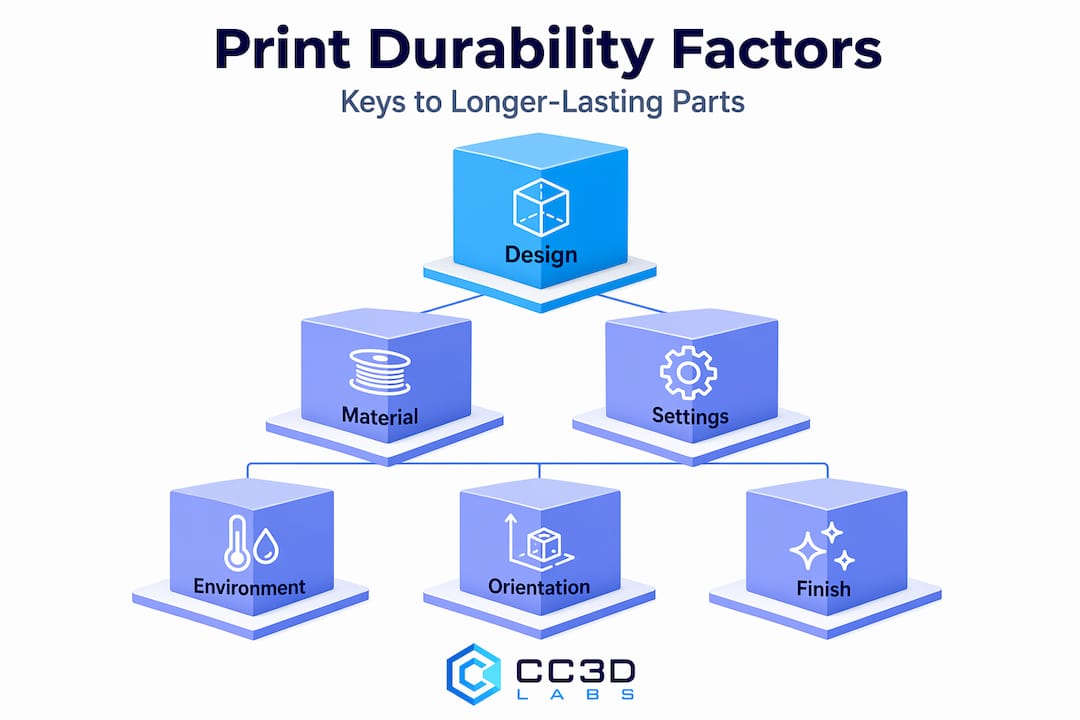
The other thing I would push back on is the assumption that engineering materials automatically solve durability problems. I have watched carbon fiber composites fail on a bracket that was just printed at the wrong angle. The composite stiffness that makes it great in one direction makes it brittle in another. Understanding this is more useful than any spec sheet comparison.
My recommendation for critical applications is to validate your 3D designs before committing to production. Print test coupons in the intended orientation. Load them the way the final part will be loaded. The thirty minutes you spend on that test will tell you more than hours of reading material specs.
— Justin
Get durable 3D printed parts from Cc3dlabs
If this article has you thinking carefully about material selection, orientation, and design for your next project, Cc3dlabs can take that further with hands-on expertise. Based near Philadelphia, Cc3dlabs handles everything from single prototypes to batch production runs, with material knowledge that matches the right filament to the real demands of your application.
Whether you need a structurally sound bracket, a functional prototype that will survive testing, or production parts built for longevity, the team at Cc3dlabs applies the same principles covered here at every step. Explore professional 3D printing services or request a free online estimate to get started with parts that are built to last, not just built.
FAQ
What is the most durable material for 3D printing?
Nylon is the toughest standard thermoplastic for FDM printing, offering high impact resistance and flexibility. Carbon fiber composites provide the highest stiffness and are preferred for structural industrial parts.
Why do 3D printed parts fail along layer lines?
Tensile strength in 3D prints is directional because layer-to-layer bonding is weaker than the material within a layer. Parts loaded across the Z-axis fail first at those inter-layer boundaries.
Does higher infill percentage mean a stronger part?
Not beyond about 20 to 30% infill. Adding more perimeter walls is more effective for resisting crack initiation and surface failure than continuing to increase infill density.
How durable are resin 3D prints compared to filament prints?
Resin parts offer excellent detail but lower impact resistance and fatigue strength than engineering filaments like nylon. Short-term durability is adequate for many uses, but improper post-processing significantly reduces long-term performance.
Can 3D printed parts be used outdoors long-term?
Yes, with the right material. PLA degrades quickly under UV and moisture. ASA, weatherable PETG blends, and properly coated ABS handle outdoor conditions far better, especially when the part design avoids water traps.