
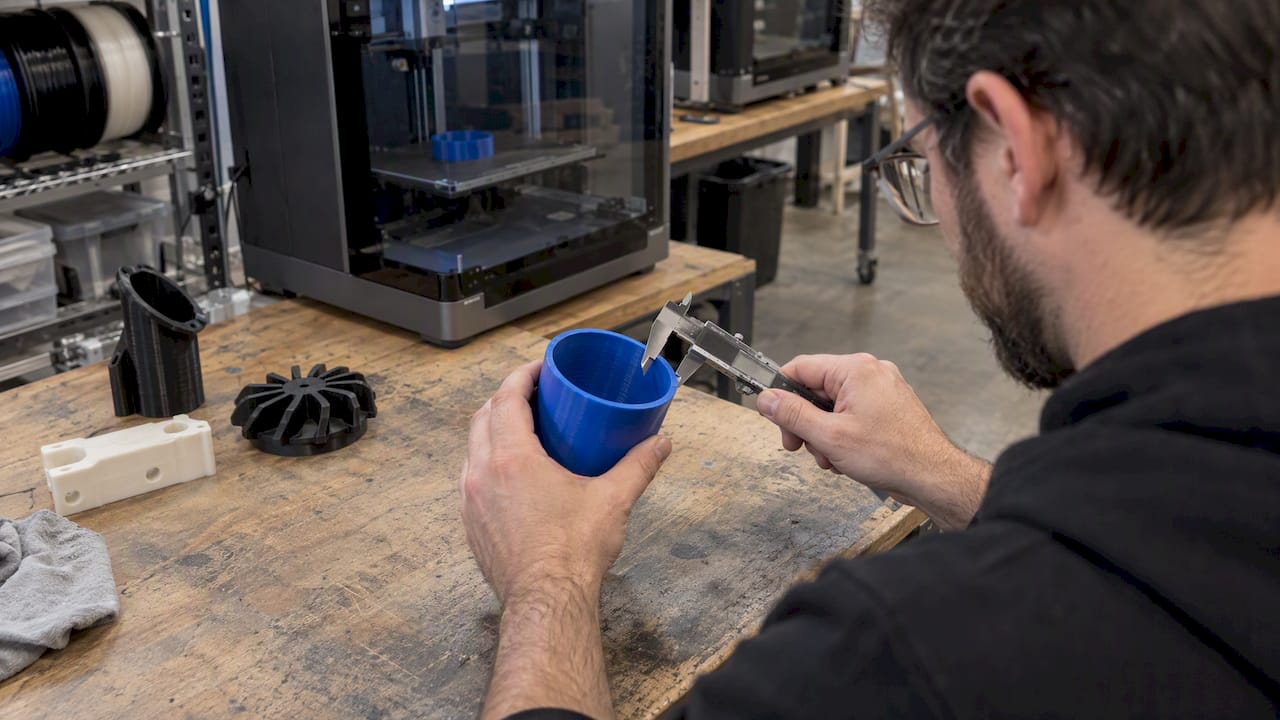
A food-safe filament spool does not automatically make a printed cup, mold, or utensil safe for repeated food contact. Whether a 3D-printed part is actually food-contact safe depends on three things working together: the material’s regulatory status for the specific intended use, a design and surface finish that can be properly sanitized, and validated migration testing on the finished article rather than assumptions about the raw material.
TL;DR:
- FDA does not issue blanket approval for filaments; check each resin, colorant, and additive against the intended food type, temperature, and contact duration.
- Raw resin declarations do not establish printed part safety; test finished articles with food simulants under severe use conditions at 8, 72, and 240 hours.
- Design parts with rounded internal corners, drainage, and separable pieces, because untreated FDM layer gaps can trap residue beyond the reach of ordinary washing.
- PLA softens around 60°C and PETG around 80°C, so neither suits boiling water or autoclaves; choose cleaning methods within the material’s limits.
- A prototype used only outside food service rarely needs formal validation, but repeated food contact or commercial production warrants documented migration testing.
Table of Contents
- Which polymers are marketed as food-contact candidates
- How the FDA decides whether a material can touch food
- Why FDM surfaces are hard to sanitize and how to design around it
- Turning a porous print into a smooth, sanitizable surface
- A practical workflow for producing a food-contact-safe part
- Should you handle this in-house or bring in a professional shop?
- How we help you get from filament claim to validated part
- FAQ
- Sources
Which polymers are marketed as food-contact candidates
Most conversations about food-safe 3D printing start with a handful of common polymers, each with different strengths and different blind spots.
PLA is the default recommendation for beginners because it is widely available and prints at relatively low temperatures, but its performance ceiling is a real constraint. PLA begins to soften around 60°C, which rules it out for hot liquids, dishwasher cycles, or anything approaching boiling water. Its porous, layered surface also makes it a poor candidate for repeated washing without additional finishing.
PETG sits a step above PLA in thermal resistance, generally tolerating temperatures up to about 80°C before deforming, and it is chemically similar to the PET used in many commercial food containers. That similarity is often cited informally as a reason to trust PETG, but similarity in base polymer chemistry does not mean a printed PETG part automatically meets the same regulatory bar as injection-molded PET packaging, especially once colorants or print artifacts are introduced.
Polypropylene (PP) is used in food-contact applications across conventional manufacturing and shows up in some filament lines marketed for kitchenware. It handles higher temperatures than PLA or standard PETG and resists many solvents, but PP is notoriously difficult to print well with FDM due to warping and poor bed adhesion, which can produce rougher, less consistent surfaces.
Food-rated nylon variants and other engineered polymers appear in specialty filament lines aimed at commercial kitchen tools, but they tend to be more expensive, more hygroscopic, and more demanding to print consistently than PLA or PETG.
A few points apply across all of these:
- A polymer’s chemical identity is only one factor. Colorants, plasticizers, UV stabilizers, and processing aids added to a filament can introduce migrating substances that a plain, uncolored version of the same base polymer would not have.
- “Food-safe” printed on a spool label typically refers to the base resin, not an evaluation of the finished, printed, and possibly post-processed object.
- A supplier’s claim is a starting point, not a substitute for documentation; request migration data or a reference to a Food Contact Substance Notification when it is available, rather than relying on a filament’s marketing copy alone.
When evaluating supplier declarations, ask specifically what was tested: the raw pellet, the extruded filament, or an actual printed part. Those are different materials from a chemistry and surface standpoint, and a declaration covering only the pellet tells you little about what happens after a nozzle has melted, extruded, and layered it.
How the FDA decides whether a material can touch food
The FDA does not issue a blanket “food safe” certification for 3D printer filaments or printers, and no spool or printer carries an FDA approval in that sense. Regulatory status is determined per-substance, as a food contact substance, based on whether that specific substance is covered by an existing regulation, a Generally Recognized as Safe (GRAS) determination, a prior sanction, a threshold-of-regulation exemption, or an effective Food Contact Substance Notification (FCN).
That per-substance, per-use framing matters because it means compliance is not about the polymer family in general. It is about whether every individual component, including the base resin, colorants, and any additives, avoids causing unsafe migration into food under the article’s actual conditions of use. A PETG filament that is compliant for a dry snack container at room temperature is not automatically compliant for a mug holding hot coffee for an hour, because the migration risk changes with temperature and contact time.
This is where migration testing comes in. For articles meant for repeated or long-term food contact, the FDA’s chemistry guidance for premarket submissions recommends testing with food simulants (such as aqueous ethanol or oils, depending on the food type) under the most severe conditions the article would realistically see, including temperature and duration.
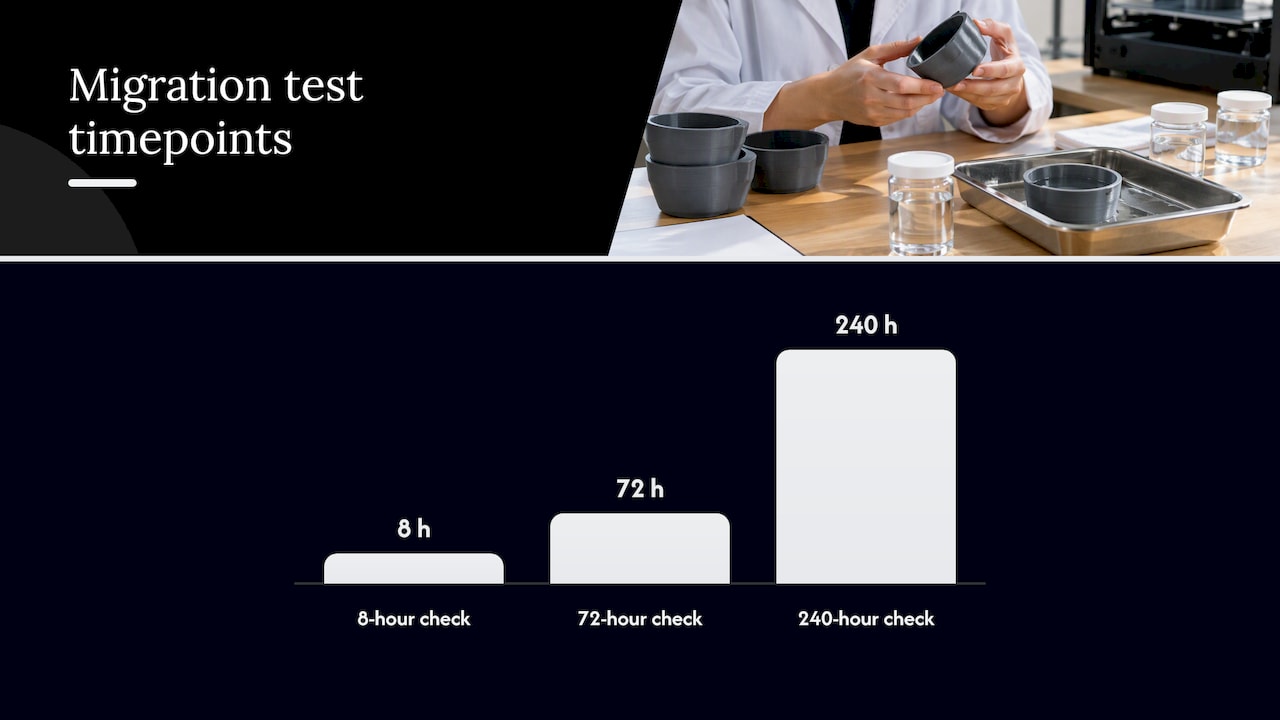
A key detail engineers often miss: migration is typically measured at 8, 72, and 240 hours to assess whether a substance keeps leaching over extended use rather than tapering off quickly, which is the difference between a part that is fine for one meal and one that is not fine for a month of dishwasher cycles.
A few practical implications follow from this framework:
- Regulatory compliance attaches to the finished article’s end-use conditions, not to a filament’s generic label.
- Recycled or reground plastics carry additional chemistry considerations because contaminant history is harder to characterize than virgin resin.
- Toxicology expectations for a food contact substance often focus on the actual migrating constituents, such as low-molecular-weight oligomers, rather than the bulk polymer itself, according to the FDA’s toxicology recommendations for these notifications.
None of this requires a hobbyist or small manufacturer to run a full FDA submission for a one-off kitchen gadget. But it does mean that claims like “FDA approved 3D printing filament” are not accurate as stated, and that anyone producing parts for repeated food contact, especially at commercial scale, should treat migration testing as a planning requirement rather than an afterthought.
Why FDM surfaces are hard to sanitize and how to design around it
Layer lines are the defining feature of FDM printing, and they are also the primary reason a technically food-grade filament can still produce an unsafe part. Each layer boundary and every internal seam creates a microscopic ridge or gap that ordinary washing cannot fully reach, and those niches can harbor microbial colonization over repeated use.
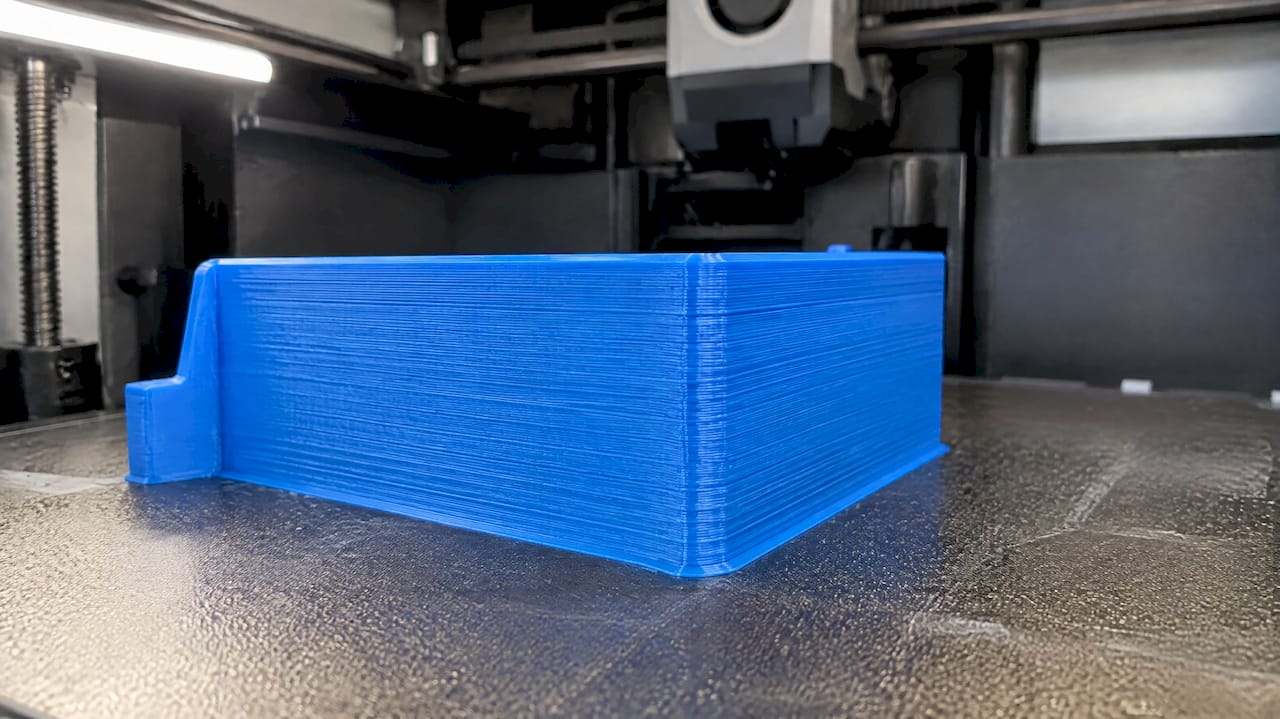
Industry sanitation guidance addressing this exact problem comes from food-processing environments rather than 3D printing specifically, but the principle transfers directly. Penn State Extension’s guidance on eliminating Listeria monocytogenes from food-processing surfaces stresses that food-contact surfaces need to be smooth and non-absorbent, and that designs with internal angles, open seams, and sharp corners are difficult to clean and can harbor pathogens. A standard FDM part, straight off the printer, checks almost none of those boxes.
Three design and process priorities address most of the risk:
- Minimize crevices and internal angles. Round internal corners instead of leaving 90-degree joints, and avoid designs that trap liquid in pockets that cannot be reached with a brush or cloth.
- Design for disassembly. A part that separates into simple, washable pieces is easier to sanitize completely than a single complex geometry with hidden internal channels.
- Plan drainage and smooth transitions. Surfaces should shed water and food residue rather than pooling it against a layer-line ridge.
Printer-side contamination deserves equal attention, since even a compliant filament can pick up residue from a machine that previously ran other materials. Shared nozzles, Bowden tubes, and extruder paths can carry trace contaminants between jobs, which is why production environments benefit from dedicating specific print heads or machines to food-contact work, documenting purge sequences between material changes, and storing filament in sealed, moisture-controlled conditions to avoid degradation that changes a polymer’s migration behavior.
Pro Tip: Treat geometry, not just material choice, as your first line of defense: a part that is impossible to fully clean will stay a hygiene risk no matter how many certifications the filament carries.
Readers planning parts with complex internal geometry may find it useful to review how print settings and quality controls affect surface consistency before finalizing a design intended for food contact.
Turning a porous print into a smooth, sanitizable surface
Raw FDM parts are porous by nature, and getting from “printed” to “sanitizable” almost always requires post-processing. The right method depends on the polymer and the part’s intended use.
- Mechanical finishing (sanding, polishing) reduces surface roughness directly and works across most filament types, but it is labor-intensive for complex geometry and can still leave microscopic texture that harbors residue if not taken far enough.
- Chemical vapor smoothing can melt layer lines into a glassy finish on compatible materials, though it works best on specific polymer chemistries and is not a universal solution across the PLA, PETG, and PP families.
- Food-safe coatings and sealants can fill layer-line gaps and create a continuous, non-porous barrier, but the coating itself becomes part of the food-contact assembly and needs its own evaluation, since a non-compliant coating can undermine an otherwise reasonable base material.
Sterilization method matters just as much as the finishing method. PLA’s roughly 60°C heat tolerance rules out boiling water or most dishwasher cycles entirely, while PETG’s higher tolerance around 80°C still falls short of the temperatures used in autoclave sterilization. Chemical sanitizers common in commercial kitchens can also degrade certain coatings or plasticizers over repeated exposure, which means the sanitization method has to be chosen to match both the base polymer and whatever coating sits on top of it.
Whatever combination of finishing and sterilization method is chosen, the FDA’s guidance is consistent on one point: the finished part, under its actual end-use conditions, is what needs migration testing, not the raw filament in isolation. A coating that looks food-safe on paper can still change the part’s real-world migration profile once applied. For a broader look at finishing options and their trade-offs, see our guide to post-processing in 3D printing.
Suppliers of filament and consumables sometimes publish their own verification guidance as well; SubliBlanks’ overview of food-safe filament checks is one example of a materials supplier walking through what to ask for when confirming a filament’s claims before committing to a production run.
A practical workflow for producing a food-contact-safe part
A professional shop producing food-contact parts generally follows a sequence that mirrors the regulatory logic above rather than skipping straight to printing:
- Select material based on documentation, not marketing. Request migration data or FCN references from the filament supplier and flag any additive package that is not clearly disclosed.
- Produce a test print. A single sample print reveals surface quality, layer adhesion, and warping behavior before committing to a production run.
- Evaluate finishability. Decide whether mechanical polishing, smoothing, or a food-safe coating is realistic for the part’s geometry and the chosen polymer’s temperature limits.
- Apply the chosen post-processing and inspect the result for residual porosity or trapped seams.
- Verify with sample testing appropriate to the part’s actual use conditions before scaling to a full batch.
We run this sequence as standard practice for engineering and functional parts: a test print first, followed by a custom quote based on what that print reveals about material behavior and finishing needs, rather than a blanket price quoted sight unseen.
Pro Tip: Keep a simple batch record of material lot, print settings, and post-processing applied to each food-contact part. That record is what lets you trace a problem back to its source if a part ever fails inspection.
Should you handle this in-house or bring in a professional shop?
A one-off prototype or single-use mold for non-food testing carries little risk and rarely justifies formal validation. Repeated consumer food contact, or any commercial batch, is a different calculation: the liability and sanitation requirements usually justify a professional workflow with documented testing. We can quote a validated run after reviewing a test print of your actual design.
— Justin
How we help you get from filament claim to validated part
We run a production farm of Bambu Lab FDM printers supporting materials including PLA, PETG, ABS, ASA, and PC, with multi-color capability for parts that need it. Every job starts with a test print of your actual design, which is what we use to evaluate finishability and surface quality before issuing a quote, rather than pricing blind.
What that looks like in practice:
- A test print of your part to assess layer quality, warping, and suitability for post-processing.
- A custom quote based on what the test print shows, with no fixed pricing published in advance.
- Material selection guidance drawn from our experience across PLA, PETG, ABS, ASA, and PC for functional parts.
- Professional handheld 3D scanning, accurate to roughly 0.1 millimeters, when a part needs to be reverse-engineered from an existing object before redesign.
We serve customers from our base in the Greater Philadelphia area with residential pickup, and we ship completed orders anywhere in the United States. If you have a part that needs to move from concept to a validated, production-ready print, start with our services overview or head straight to request a 3D printing quote to get a test print scheduled.
FAQ
Is PLA or PETG better for food safe use?
Neither is automatically better; both depend on the specific additive package and intended conditions of use. PETG generally tolerates higher temperatures, up to around 80°C, than PLA’s roughly 60°C limit, which matters more for hot-liquid use than for dry, room-temperature contact.
Is PETG actually food safe?
PETG’s base chemistry is similar to the PET used in many commercial food containers, but that similarity does not make every printed PETG part compliant on its own. Compliance depends on the specific resin, any colorants or additives used, and whether the finished part has undergone the kind of migration testing the FDA recommends for its actual conditions of use.
Is PETG okay to drink out of?
An occasional, short-term sip from a plain PETG print carries lower risk than repeated daily use, but porous FDM layer lines make any untreated print hard to fully sanitize between uses. For a cup intended for regular use, post-processing to seal the surface and testing under the actual conditions of use are the more defensible approach.
Is it safe to drink out of a 3D printed PLA cup?
A raw, unfinished PLA print is not a good candidate for repeated drinking use because PLA softens around 60°C and its layered surface is difficult to sanitize thoroughly. The porosity concerns that Penn State Extension’s sanitation guidance describes for food-processing surfaces apply directly to an unfinished printed cup.
Sources
- Determining the regulatory status of components of a food contact material | FDA
- Eradicating Listeria monocytogenes from mushroom slicing and packaging environments | Penn State Extension