
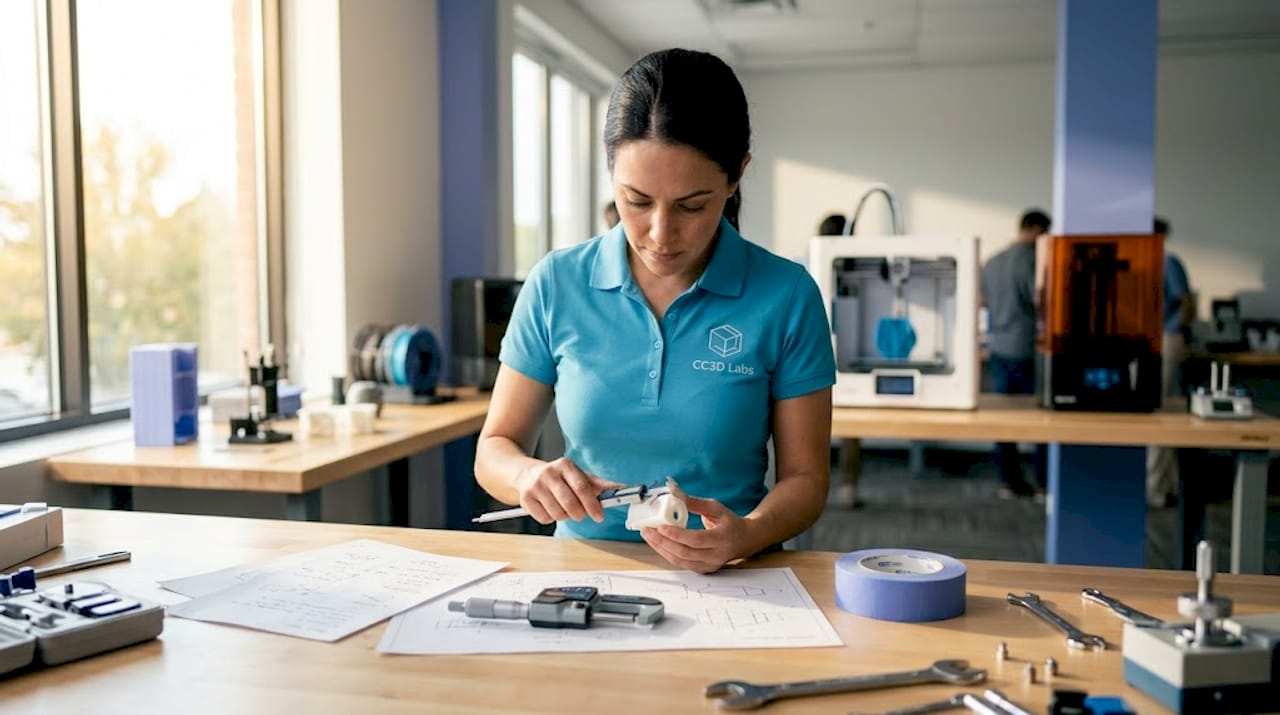
TL;DR:
- Part validation in 3D printing ensures a process consistently produces conforming parts, not just individual successful prints.
- Implementing structured IQ/OQ/PQ procedures and using multiple validation techniques reduces scrap, enhances quality, and meets regulatory standards.
Most manufacturers assume that once a 3D printer finishes a job, the part is ready to use. That assumption is expensive. The role of part validation in 3D printing is far more critical than most production teams realize, and the gap between “it printed” and “it works reliably” is where quality problems, warranty failures, and regulatory risks pile up. Projects that skip validation show 3 to 5 times higher scrap rates in the first three months of production. This article breaks down what validation actually involves, which techniques work, and how to build a process that protects your parts and your bottom line.
Table of Contents
- Key takeaways
- The role of part validation in 3D printing explained
- Methods for part validation that actually work
- Business impact of rigorous part validation
- Challenges in validation and how to address them
- My take on where validation fits in your strategy
- How Cc3dlabs supports your validation needs
- FAQ
Key takeaways
| Point | Details |
|---|---|
| Validation goes beyond inspection | Process validation confirms repeatable results across all future builds, not just one good part. |
| Multiple techniques compound accuracy | Combining dimensional checks, 3D scanning, and functional testing catches defects that single-method inspection misses. |
| Business impact is measurable | Proper validation dramatically reduces scrap, rework costs, and machine downtime across production runs. |
| Regulated industries require it | Medical, aerospace, and defense applications mandate formal IQ/OQ/PQ validation before production parts ship. |
| Continuous monitoring sustains quality | SPC systems fed by validation data catch process drift before it becomes a defect wave. |
The role of part validation in 3D printing explained
Part validation and product inspection are not the same thing, and confusing the two is one of the most common mistakes manufacturers make when scaling from prototype to production. Inspection checks whether a specific part meets specifications. Validation proves that the process consistently produces conforming parts within defined parameters, every time, without relying on 100% inspection to catch failures.
Think of it this way: inspecting one part from a batch of 500 tells you about that one part. Validating the process tells you whether all 500 are likely to be good before you even measure them.
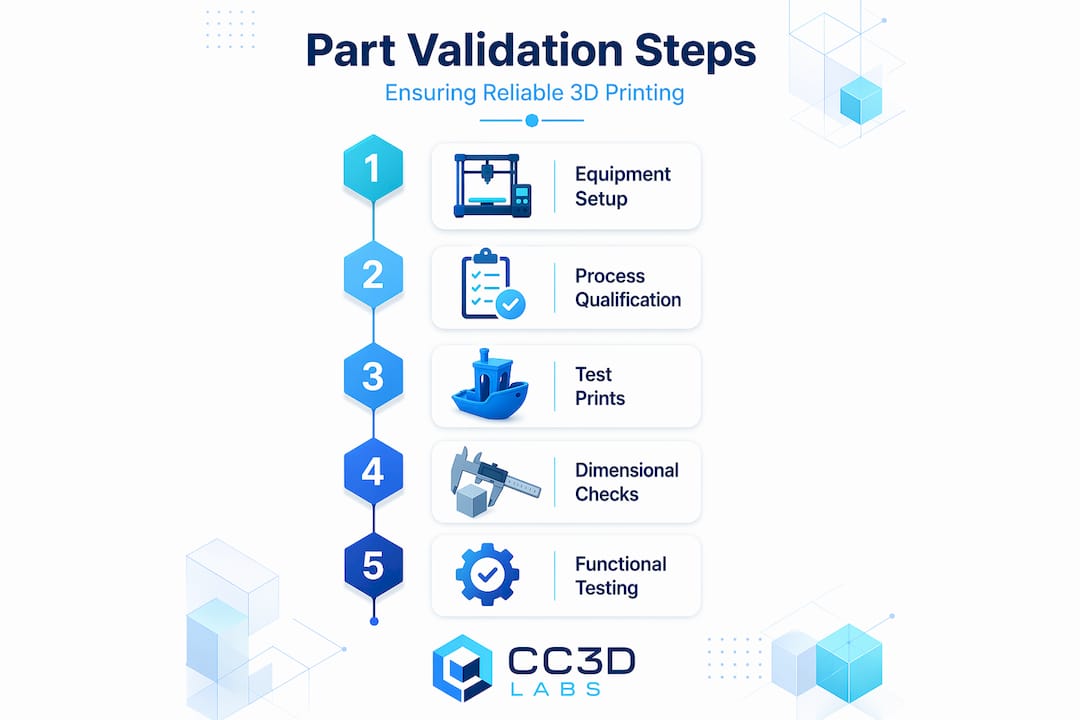
In regulated industries, this distinction carries legal weight. Process validation is mandatory for medical devices, aerospace components, and pharmaceutical manufacturing equipment. Regulatory bodies require documented evidence that the process, not just the product, is under control. But even outside those industries, validation is the framework that separates reactive quality control from proactive quality assurance.
The most widely adopted framework is IQ/OQ/PQ, adapted directly from pharmaceutical and medical device manufacturing:
- Installation Qualification (IQ): Confirms the printer and supporting equipment are installed correctly, calibrated, and operating within manufacturer specifications.
- Operational Qualification (OQ): Tests whether the process produces conforming parts across the defined operating range, including edge conditions.
- Performance Qualification (PQ): Demonstrates that the validated process consistently delivers acceptable output under real production conditions over time.
Equipment qualification follows this IQ to OQ to PQ sequence as a prerequisite to process validation, and skipping any stage undermines the entire framework. This structure forces manufacturers to think systematically rather than relying on operator intuition.
Pro Tip: When starting a validation program for 3D printing, document your IQ stage meticulously. Calibration records, environmental conditions, and software version logs protect you during audits and give you a meaningful baseline when troubleshooting future deviations.
Methods for part validation that actually work
Choosing the right validation technique depends on part geometry, material, application criticality, and whether you need destructive or non-destructive data. Most production environments benefit from layering multiple approaches rather than relying on any single method.
Dimensional measurement and 3D scanning
Calipers and coordinate measuring machines (CMMs) remain reliable for straightforward geometries. However, for complex organic shapes, thin walls, or surfaces that require full-field data, structured-light or laser 3D scanning delivers far more information per measurement cycle. Boeing’s approach illustrates the scale of this advantage: their AI-powered validation tool saves 17 or more hours per aircraft during inspection, while reducing gauge repeatability and reproducibility variance to 0.93%. That level of measurement consistency would be impossible with manual methods alone.
Functional and mechanical testing
Dimensional accuracy tells you if a part is shaped correctly. Functional testing tells you if it performs correctly under load, temperature, chemical exposure, or repeated cycling. For structural components, this might mean tensile or compression testing. For enclosures, it might mean IP rating validation. Destructive testing is sometimes the only honest way to understand failure modes, particularly for safety-critical parts where the cost of a field failure far exceeds the cost of the test sample.
Statistical process control and capability metrics
- Collect baseline data across multiple print runs using consistent measurement methods and operator protocols.
- Calculate Cpk and Ppk to quantify how well the process holds critical dimensions within specification limits.
- Set up control charts for key process variables like nozzle temperature, layer adhesion, and print speed.
- Establish control limits based on your baseline and trigger revalidation when measurements drift outside them.
- Feed data back into your process settings to tighten variation over time.
Validation data integrates directly with SPC systems for early detection of variation and continuous process improvement. This transforms validation from a one-time event into an ongoing quality intelligence system.
Pro Tip: Do not target a Cpk of exactly 1.0 when setting your process capability goals. Aim for 1.33 or higher. That margin gives your process room to drift before parts fall out of spec, which means fewer emergency stops and more predictable output.
A comparison of common validation techniques by application:
| Technique | Best for | Destructive? | Cost level |
|---|---|---|---|
| CMM dimensional inspection | Prismatic, tight-tolerance parts | No | Medium |
| Structured-light 3D scanning | Complex geometry, full-field data | No | Medium to high |
| Tensile and compression testing | Structural or load-bearing parts | Yes | Low to medium |
| CT scanning | Internal features, porosity detection | No | High |
| Functional performance testing | End-use assemblies, fit checks | Sometimes | Varies |
Learning more about ways to validate 3D designs can help you choose the right combination for your specific production environment.
Business impact of rigorous part validation
The financial argument for validation is not abstract. Filament runout issues alone cost $127 million in wasted material and 14 million hours of idle printer time in 2025, with proper process validation reducing those losses by 92%. That is one failure mode. Multiply it across material inconsistency, temperature variation, and calibration drift, and the cumulative cost of unvalidated 3D printing operations becomes significant.
Manufacturers who build validation into their workflow see measurable improvements across four areas:
- Scrap and rework reduction: Catching process drift early prevents entire batches from becoming waste. The difference between catching a problem at print cycle 3 versus print cycle 300 is the difference between a minor correction and a production crisis.
- Customer confidence: Validated parts ship with documented proof of conformance. For product developers sourcing parts from contract manufacturers, this documentation is the difference between an acceptable supplier and a preferred supplier.
- Regulatory readiness: Companies in medical, aerospace, or defense supply chains cannot bid on regulated contracts without validated processes. Building that infrastructure now opens market doors later.
- Scalability from prototype to production: A prototype can tolerate variability. A production run cannot. Validation is what makes the transition from “it worked once” to “it works every time.”
Scaling production without validation is like building a house on a foundation you have never tested. It might hold, but you will not know until something fails. A well-documented validation record also reduces engineering review time when design changes trigger revalidation, since your process baseline is already defined.
Challenges in validation and how to address them
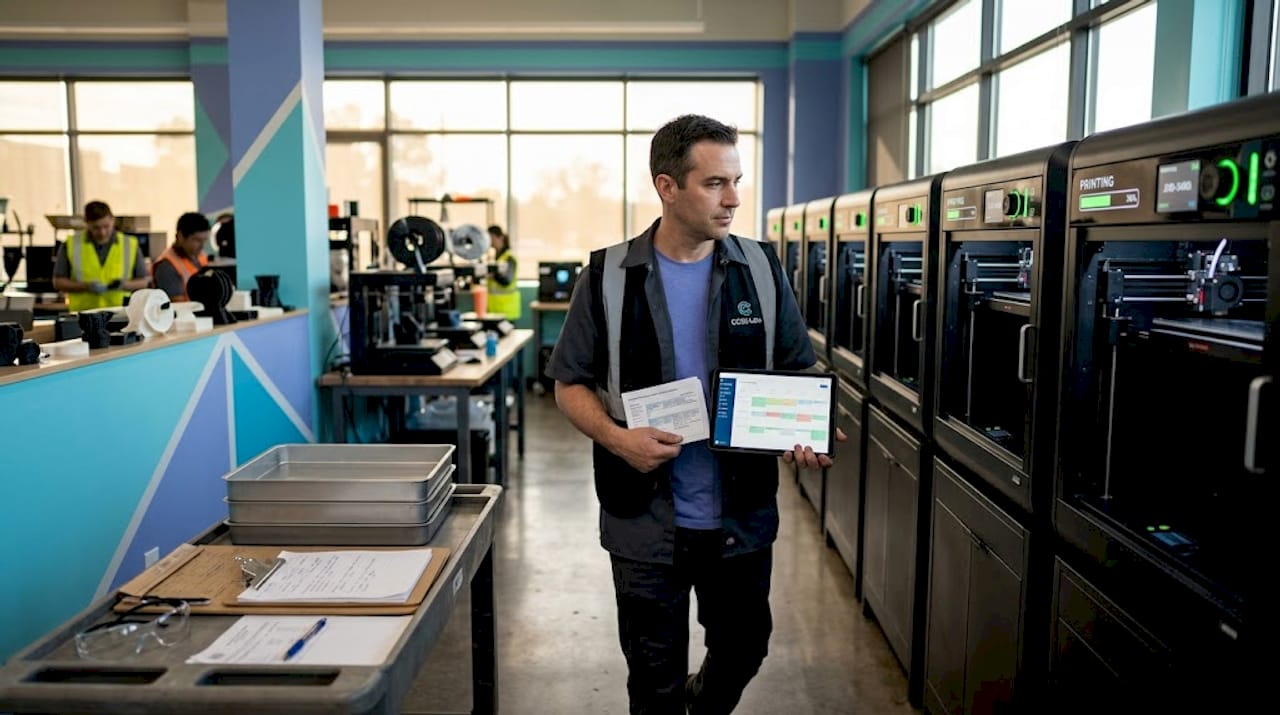
Integrating part validation into a 3D printing workflow is not without friction, especially for manufacturers who built their operations around rapid iteration rather than process rigor.
The most persistent challenge is measurement uncertainty. Knowing that a part is within tolerance requires that your measurement system is itself accurate and repeatable. Misaligned mating parts caused by unclear dimensional definitions often trace back to incomplete GD&T on drawings rather than actual process failures. Fixing the drawing is faster and cheaper than retesting the process, but you have to know which problem you are actually solving.
Environmental variability is another overlooked factor. Humidity, ambient temperature, and even vibration from nearby equipment affect print quality in ways that are invisible until validation data reveals the pattern. This is where the distinction between Factory Acceptance Testing and Site Acceptance Testing becomes practical. FAT confirms equipment performance in a controlled environment, while SAT validates that same performance under your actual production conditions. A printer that passes FAT may still behave differently on your shop floor, and SAT validates real-world performance for long-term stability.
Best practices for making validation sustainable:
- Start with a risk-based sampling plan. Not every part or every batch needs 100% inspection. Identify your highest-risk features and focus measurement resources there.
- Define revalidation triggers upfront. Material lot changes, nozzle replacements, firmware updates, and facility moves all warrant revalidation. Write them down before production starts.
- Build documentation habits early. Validation reports are only useful if they reflect what actually happened. Standardize your data capture formats from day one.
- Treat print accuracy insights as a continuous feedback loop rather than a pass/fail gate at the end of a run.
Pro Tip: If you are launching a validation program with limited resources, start with your most critical dimension on your most common part. Validate that one feature thoroughly, document your results, and build from there. A narrow validation done well is more useful than a broad validation done superficially.
My take on where validation fits in your strategy
I’ve talked with a lot of manufacturers who treat part validation as something you do for auditors. You prove compliance, file the paperwork, and move on. In my experience, that framing costs them more than they realize.
What I’ve seen work is treating validation as a data collection strategy. Every measurement you take, every capability study you run, every batch you document gives you a clearer picture of what your process is actually doing versus what you think it’s doing. The manufacturers who use that data proactively, adjusting parameters before scrap rates climb rather than after, are the ones who scale 3D printing production without the chaos that typically comes with it.
The other thing I’d push back on is the idea that validation is only for regulated industries. I’ve seen product developers lose significant time and money when a part that worked perfectly in prototyping failed consistently in production, specifically because no one validated the transition. The process that produced five good prototypes is not automatically the same process that will produce five hundred reliable production parts.
Start lean. Start with one part, one critical feature, one documented study. The insights you get from that first real validation run will tell you more about your process than months of informal inspection. And when you’re ready to scale your 3D printing with confidence, you’ll have the data to back every decision.
— Justin
How Cc3dlabs supports your validation needs
Reliable 3D printed parts start with a process built for quality from the first layer to the final inspection. At Cc3dlabs, we bring metrology-grade 3D scanning, precision filament-based printing, and design support together under one workflow, so product developers and manufacturers get parts they can actually validate.
Whether you need functional prototypes with documented dimensional reports, batch production runs with consistent quality, or scanning services to compare printed parts against CAD geometry, Cc3dlabs has the equipment and experience to back it up. Our 3D printing services are built around the kind of accuracy and repeatability that makes validation straightforward, not a burden. Get a free online estimate today and see how a quality-focused print partner changes what’s possible for your production program.
FAQ
What is part validation in 3D printing?
Part validation in 3D printing is the process of confirming that a print workflow consistently produces parts meeting defined specifications, not just that a single part passed inspection. It focuses on the process, not just the product.
Why do manufacturers skip part validation?
Most manufacturers skip validation because they perceive it as time-consuming or only required for regulated industries. In practice, skipping validation leads to 3 to 5 times higher scrap rates in early production, making it far more costly than the validation itself.
What methods are used for part validation in 3D printing?
Common methods include CMM dimensional inspection, structured-light 3D scanning, functional mechanical testing, CT scanning for internal features, and statistical process control using Cpk metrics to track process capability over time.
How does the IQ/OQ/PQ framework apply to 3D printing?
IQ confirms correct printer installation and calibration, OQ tests the process across its operating range, and PQ demonstrates consistent output under real production conditions. This sequence is a prerequisite for regulatory compliance and is increasingly adopted in non-regulated 3D printing operations as a best practice.
When should a manufacturer revalidate their 3D printing process?
Revalidation is required after material lot changes, equipment repairs or replacements, firmware or software updates, facility moves, and any design changes that affect critical dimensions. Documenting these triggers upfront prevents gaps in your quality record.