
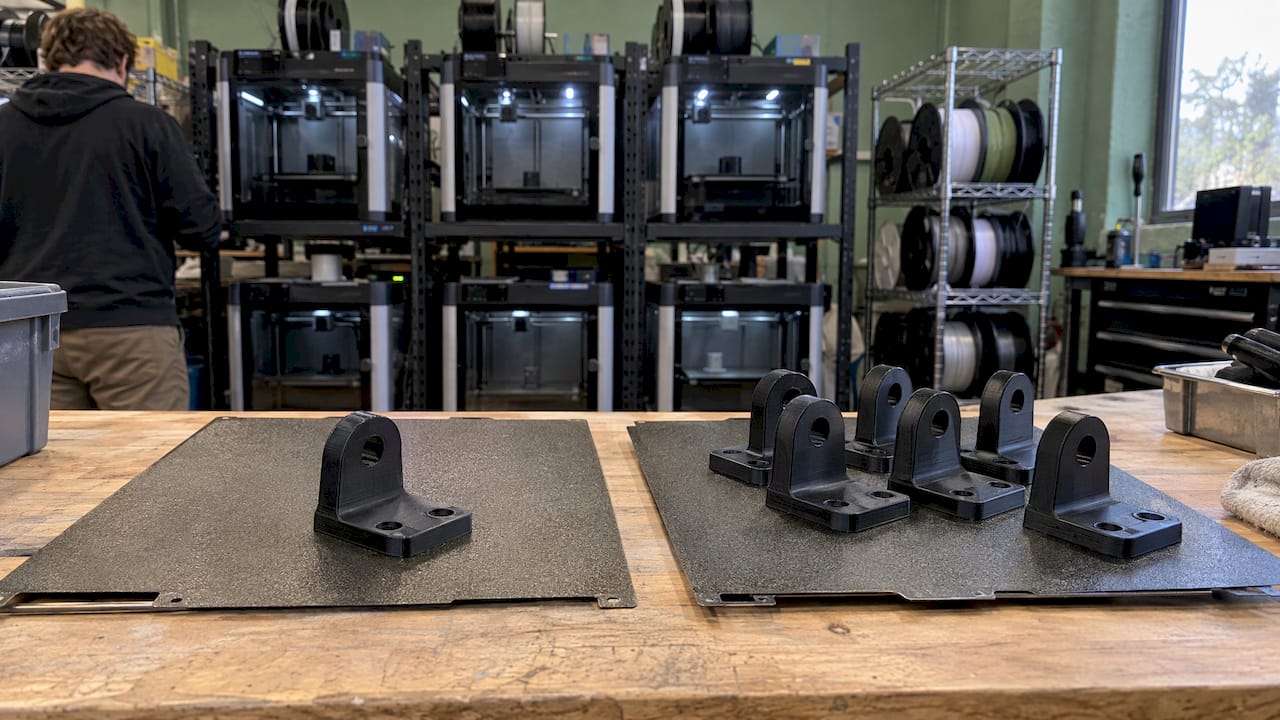
A minimum order in 3D printing is usually one of two things: a minimum quantity (a number of parts) or a minimum charge (a dollar floor per order). Many services that print on demand set a floor on the dollar amount rather than the part count, because the work of preparing a file, checking it and packing the order does not shrink when the part is small. At CC 3D Labs we print one-off parts and small batches on a Bambu Lab FDM farm, and every production job is quoted individually after a test print of your actual model. That is the practical answer for engineers and product developers: the number that matters is the quote for your part, not a generic minimum.
TL;DR
- “Minimum order” can mean a minimum quantity, a minimum charge, or both. Ask which one applies before you compare quotes.
- One-off prototypes and replacement parts are normal work for a production service. The cost driver is setup and machine time, not the count.
- Published industry figures, such as a suggested $25 order minimum, are averages from pricing guidance, not rules. Your quote is what counts.
- A complete file, material, tolerance and quantity let a shop quote accurately the first time.
- We publish no fixed pricing or minimums at CC 3D Labs. Jobs are quoted after a test print of the real model.
Table of Contents
- What “minimum order” actually means
- Why one part is not free to make
- Can you order just one part?
- How minimums vary by process
- Material and temperature limits affect the quote
- What to send for an accurate quote
- Deposits and payment on custom work
- Lowering the cost of a small order
- Local pricing context for Philadelphia and Bucks County
- Our perspective
- Start a quote with CC 3D Labs
- FAQ
- Sources
What “minimum order” actually means
The phrase covers three different policies, and they behave differently when you order a single bracket or a run of fifty.
| Policy | What it means | Who it affects |
|---|---|---|
| Minimum quantity | The shop will not accept fewer than a set number of parts | Buyers of single prototypes or repair parts |
| Minimum charge | The order total is raised to a floor if the parts come in below it | Buyers of small, fast-printing parts |
| Setup fee | A per-file or per-job charge for file preparation and print setup | Every order, usually most visible on small ones |
A minimum quantity matters most with processes that need a full build chamber or tooling to be economical. FDM is a different situation. Each part prints directly from your file on a single machine, so a quantity of one is a normal job. A minimum charge is the more common floor you meet when a part is small.
One pricing guide aimed at 3D printing businesses describes a $15 to $25 setup floor and a $25 order minimum as a way to cover file preparation, communication and invoicing even for a tiny part. Treat that as an industry average from one source. Shops set their own figures, and a service that quotes each job individually may not use a flat floor at all.
Why one part is not free to make
It helps to see where the cost of a small order comes from, because it explains why quotes for one part and ten parts do not scale in a straight line.
- File preparation. Someone checks the model for printability, orients it on the build plate, picks wall count, infill and layer height in the slicer (the software that turns a model into machine instructions), and confirms the material suits the use.
- Machine time. A part that prints for six hours occupies a printer for six hours, whether it is one part or the first of several.
- Material. Engineering filaments such as ABS, ASA, polycarbonate and carbon-fiber nylon cost more per kilogram than PLA, and some need dry storage and enclosed printing.
- Post-processing and inspection. Support removal, trimming, fit checks and measuring critical dimensions take hands-on time.
- Packing, shipping and communication. These are per order, not per part.
The pricing guide mentioned above lays out a quoting formula built from these elements: a setup or CAD fee, material cost with a markup, machine hours, and post-processing labor. Its figures are one blog’s suggestions and should not be read as what any given shop charges. The structure is the useful part: setup and handling are fixed per order, while machine time and material grow with quantity.
What that means for your order
When you order one part, the fixed items make up a larger share of the price. When you order a batch, the fixed items are spread across the parts. That is why per-unit cost often falls as quantity rises, and why we explain in our guide to small batch 3D printing cost that engineers do well to look beyond a price per gram.
Can you order just one part?
Yes, for FDM work. A single prototype, a one-off fixture, or a replacement part for a restoration is routine for a production farm. This is the kind of work behind our custom one-off prints and our 3D printed prototypes and repair parts.
What changes with a single part is how you should think about the order:
- Print it as a test, not as a final. A first article lets you check fit and form before you commit to a run. If the part passes, quantity two through fifty reuses the same setup.
- Combine variants in one order. If you are comparing two wall thicknesses or two materials, ordering them together shares the file handling and the packing.
- Batch small parts. Several copies of a small part can print on the same plate, which uses machine time more efficiently than printing them one at a time.
Pro Tip: if you expect to reorder, say so when you ask for the quote. A part that will be repeated is worth setting up with the print profile saved, and our guide to batch 3D printing shows how repeat runs are planned.
How minimums vary by process
The minimum you meet depends on the technology behind the service.
- FDM (filament extrusion). Low barriers to a single part. Machine time and material dominate. Tolerances are typically in the range of ±0.2 to ±0.5 mm, which should be designed for rather than discovered afterward.
- Powder and resin processes. These often print many parts per build, so services built around them tend to price by build volume and may favor batches. We do not offer these processes and do not quote them.
- Tooling-based processes such as molding. The tooling is the cost, so quantity thresholds are naturally higher. At CC 3D Labs, our related work is printed mold masters, which is a different job from running production tooling.
If you are comparing services, compare them on the same basis: same material, same tolerance expectation, same quantity, same finishing. A low advertised minimum on a different process does not tell you what your part will cost on FDM.
Material and temperature limits affect the quote
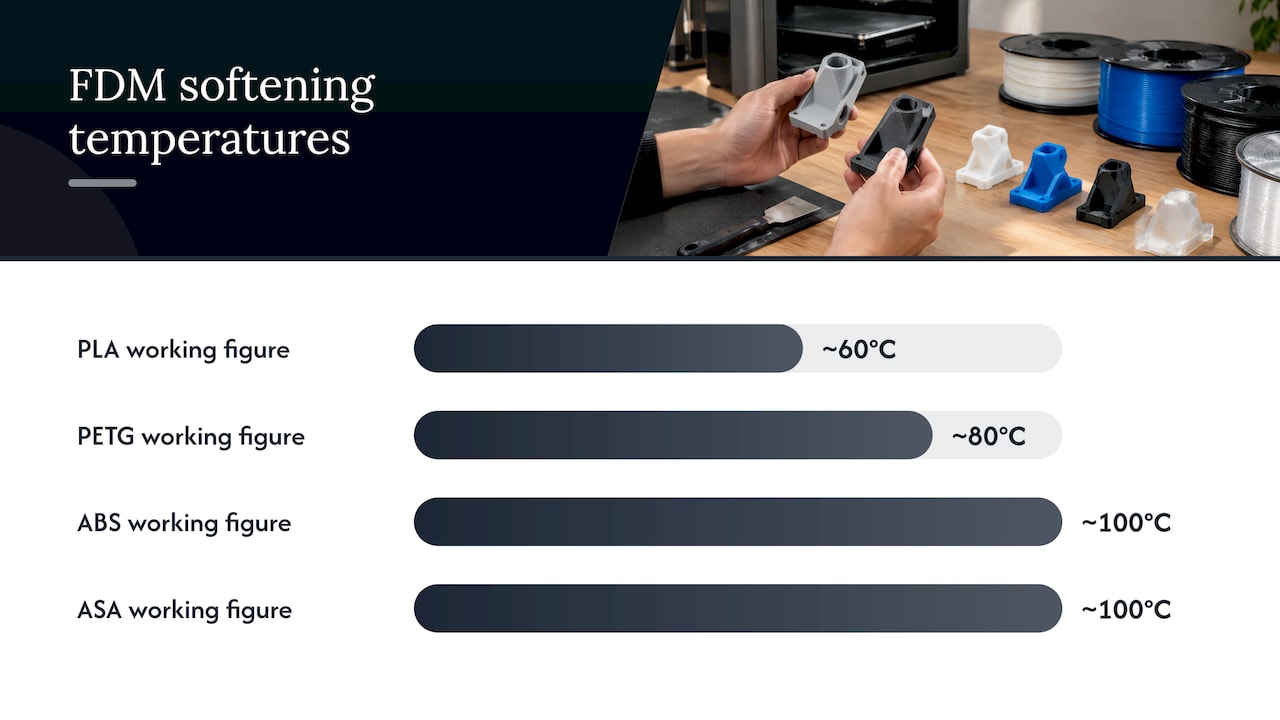
The material changes both price and suitability, so it belongs in the first conversation. As working figures for FDM materials, PLA softens at around 60°C, PETG at around 80°C, and ABS and ASA at around 100°C. A part that lives in a vehicle cabin, a warm enclosure or near a motor should start from that limit, which is why automotive restorers and engineers often move to ASA, ABS, polycarbonate or carbon-fiber nylon for functional parts.
Choosing a stronger material is not just a cost decision. It affects print settings, machine time and how many parts fit on a plate, all of which move the quote. Our page on engineering-grade 3D printing covers the materials we run, including multi-color and multi-material work.
What to send for an accurate quote
Quote accuracy depends on the information you provide. A short, complete request saves a round of back-and-forth. Include:
- The model file. STEP is preferred for engineering parts because it keeps solid geometry. STL works for printing but carries less design intent.
- Quantity, and how often you will reorder. One part, a first run of 25, or a monthly repeat each leads to a different plan.
- Material and environment. Where the part will be used, the temperatures, loads and chemicals it will see.
- Critical dimensions and tolerances. Mark the mating surfaces and holes. Remember FDM’s typical ±0.2 to ±0.5 mm range when you set them.
- Finish and color. Raw print, trimmed, multi-color, or a specific color match.
- Delivery. Local pickup in the Philadelphia area or shipping within the United States.
- Deadline. Say when you need it. We do not promise turnaround before we have seen the job, but we can plan around a real date.
If you do not have a model, say what you have. We offer 3D modeling and CAD services, and for an existing physical part, professional handheld 3D scanning with accuracy to about 0.1 mm can capture it for scan-to-CAD work. Our scan-to-CAD workflow guide explains how a scanned mesh becomes an editable solid.
For a fuller walk-through of this step, see our full guide to getting a quote for a custom 3D print.
Deposits and payment on custom work
Project work is often paid in stages. The pricing guide cited earlier suggests a 50% non-refundable deposit before expensive runs, which is its recommendation for B2B quoting, not a rule. Deposits protect material purchases and reserved machine time for larger jobs. If your own company handles many such orders and wants to automate deposit collection or invoicing, software product development services can build that kind of workflow. For printing work itself, ask for payment terms in writing alongside the quote.
Lowering the cost of a small order
The levers are in your hands before the quote arrives.
- Design for printing. Reduce unnecessary support material by choosing print orientations and avoiding steep overhangs. Our guide to cutting 3D printing costs goes through these decisions.
- Right-size the infill and walls. Wall thickness set as a multiple of the nozzle diameter, with infill matched to load, avoids both over-building and weak parts.
- Use the cheapest material that meets the requirement. If the part never sees heat, a standard material may do.
- Order a test before a run. A single validated part is cheaper than a batch of parts that do not fit.
- Group parts. Put related parts in one order so file handling and shipping are shared.
For product developers planning beyond a prototype, our top tips for low-volume manufacturing and small batch FDM production guide cover the step from validated part to repeatable run.
Local pricing context for Philadelphia and Bucks County
Buyers in the Greater Philadelphia area can collect finished orders by residential pickup. We have no walk-in storefront, so arrange pickup in advance. Orders can also ship anywhere in the United States. For local prototype cost factors, see our article on prototype 3D printing cost in Philadelphia and Bucks County.
Our perspective
We do not publish a minimum order, and we do not publish a price list. That is deliberate. A bracket that prints in an hour and a housing that prints for two days are different jobs, and a single number would be wrong for one of them.
What we do instead is print a test of your actual model, look at how it behaves on our Bambu Lab farm, and quote the job from what we see. For an engineer or a restorer, that is more useful than a floor price, because the quote reflects your geometry, your material and your tolerance.
If you need one part, we can quote one part. If the part is a legacy component with no drawing, we can scan it with our professional handheld scanner, accurate to about 0.1 mm, and model it for printing. If you need a small run, we plan it as a run from the start, so the setup carries across every unit.
Ask for what you actually need and tell us what the part has to do. We will tell you what FDM can deliver and what it cannot.
Justin
Start a quote with CC 3D Labs
CC 3D Labs is a 3D printing and 3D scanning service in Bucks County, Pennsylvania, serving product developers, engineers, automotive shops and restorers, and small manufacturers who need prototypes, functional parts and low-volume runs. We print in PLA, PETG, ABS, ASA, PC and carbon-fiber nylon, with multi-color printing available, and we also provide CAD design and printed mold masters. See all of our services.
Send your file, quantity and material through the 3D print quote form. For a part that needs scanning first, use the 3D scan quote form, and for modeling work, the CAD quote form.
FAQ
Is there a minimum order at CC 3D Labs?
We publish no fixed minimums or prices. Every production job is quoted individually after a test print of the actual model, so the quote reflects your part. Send your details through the quote form and we will respond with a quote for the job.
Can I order a single 3D-printed part?
Yes. One-off prototypes and replacement parts are part of our custom printing work. A single validated part is also a sensible first step before a small batch, since the print settings carry over to the run.
Why do small 3D printing orders cost more per part?
File preparation, print setup, post-processing, packing and communication are fixed per order, so they weigh more on a single part. Machine time and material scale with quantity. Spreading the fixed work across more parts is what brings the per-unit cost down.
What should I send to get an accurate quote?
Send the model (STEP preferred), quantity, material, operating environment, critical dimensions and tolerances, finish, delivery method and your deadline. If you have only a physical part, say so and we can scope scanning and CAD work first.