
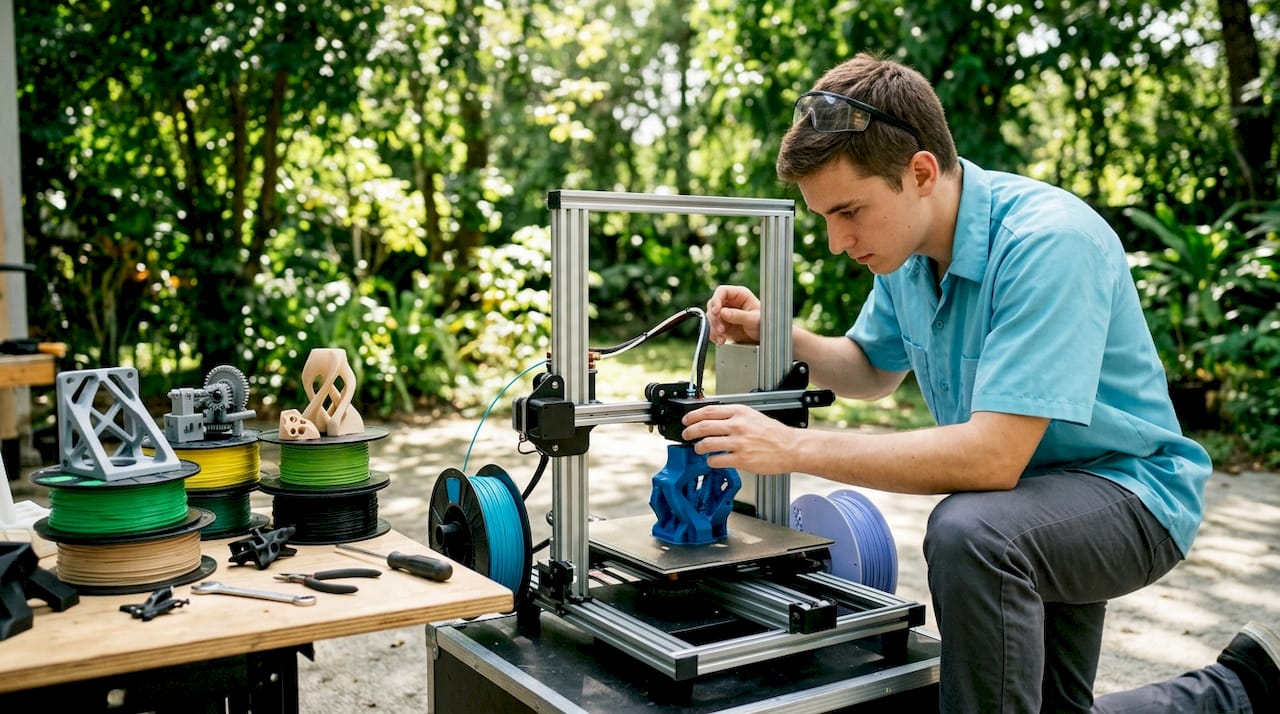
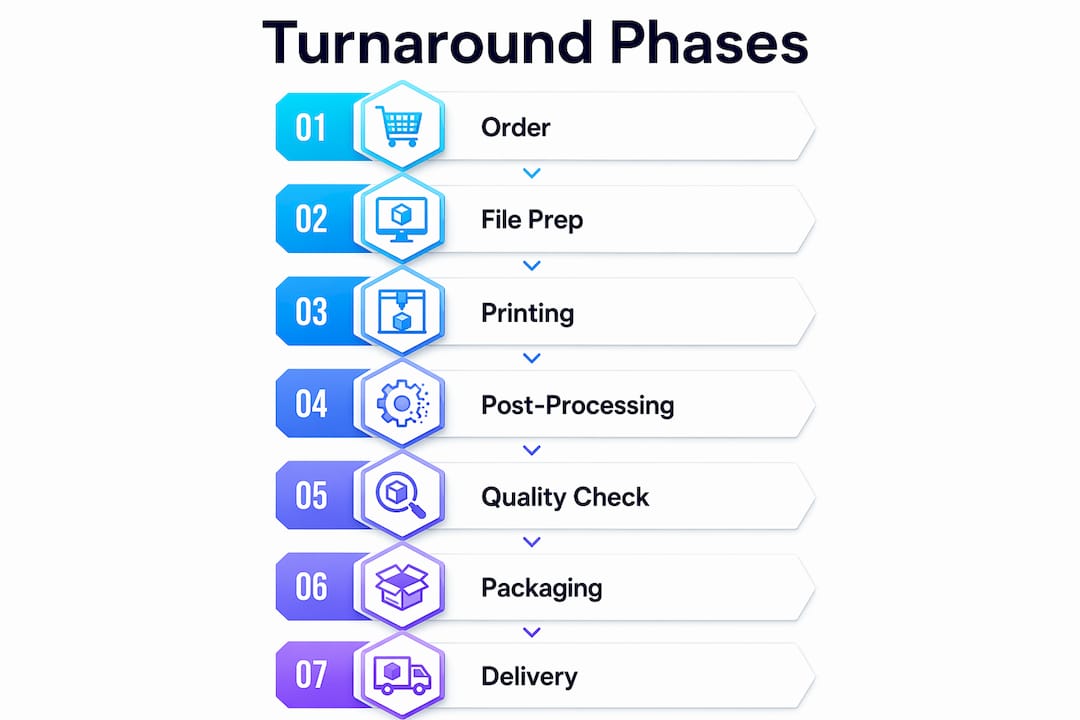
Most local 3D printing orders take a variable amount of time from the moment you place an order to the moment your part is in your hands, depending on many factors including technology, complexity, and administrative requirements. That range sounds wide, and it is, because turnaround time for 3D printing is not a single number. It is a chain of distinct phases, and each one adds time.
Here is what that chain typically looks like:
- Quote response: May take from same day up to several days, depending on part complexity and provider workload
- File review and approval: Typically requires several days for checking printability, tolerances, and material fit
- Production queue: Can involve waiting days before your job starts printing, based on current shop load
- Machine time: Ranges from a few hours to over a day, depending on size, layer height, and technology
- Post-processing: Involves hours to a couple of days for cleaning, curing, sanding, or finishing
- Shipping or local pickup: Pickup can be same day; shipping duration varies based on carrier and destination
One thing buyers consistently get wrong: they treat the entire timeline as “print time.” It is not. Administrative steps like vendor onboarding, purchase order processing, or NDA review can add days before production even begins, and those steps are separate from anything the print shop controls.
What are the phases that make up your local 3D printing turnaround?
Understanding where your time actually goes is the fastest way to stop being surprised by delivery dates. Each phase below has its own clock, and a delay in any one of them pushes everything that follows.
-
Quote and initial response (same day to 2 business days). A good local shop can often review your file and return pricing within hours for straightforward parts. Complex geometries, unusual materials, or jobs requiring design consultation take longer. Submitting a clean file with clear specs cuts this phase down considerably.
-
File review and approval (1–2 business days). Once you accept a quote, the shop checks your file for printability: wall thickness, overhangs, support requirements, and dimensional accuracy. If the file needs revision, this phase restarts. Shops that use automated file-checking tools move faster here.
-
Administrative processing (variable, often 1–3 business days). This is the phase most buyers forget to budget for. Professional shops separate quote turnaround from production start, and for good reason. If your company requires a purchase order, vendor onboarding, or tax form submission before work can begin, that paperwork runs on its own timeline. The print shop cannot start production until those steps clear.
-
Production queue (1–3 business days). Your job enters a queue behind whatever is already running. A shop with multiple printers and low volume might start your job the same day file review clears. A busy shop during a product launch season might have a 2–3 day wait before your job even loads onto a machine.
-
Machine time (hours to 24+ hours). Actual print time varies enormously. A small bracket in FDM might finish in under two hours. A large SLA part with fine detail can run overnight or longer. Layer height, infill density, and part orientation all affect how long the printer runs.
-
Post-processing (a few hours to 2 business days). Cleaning support material, curing resin under UV light, sanding surfaces, or applying a specific finish all add time after the printer stops. SLA and SLS parts typically require more post-processing than FDM parts. If you need a painted or primed finish, budget an extra day.
-
Shipping or local pickup (same day to 5 business days). Local pickup eliminates this phase entirely, which is one of the real advantages of using a nearby provider. Ground shipping within the continental United States typically runs 1–5 business days depending on carrier and destination.
What factors push your 3D printing delivery times longer?
Knowing the phases is half the picture. The other half is understanding what makes each phase take longer than expected.
-
Print technology. FDM (fused deposition modeling) is generally the fastest technology for simple, functional parts. SLA (stereolithography) produces finer detail but requires UV curing after printing. SLS (selective laser sintering) handles complex geometries without supports but involves powder removal and sometimes heat treatment. Each technology carries its own post-processing overhead.
-
Part complexity and size. A part with thin walls, internal channels, or overhanging geometry takes longer to print and longer to clean up. Large parts simply take more machine hours, and some require multiple print runs if they exceed the build volume of a single machine.
-
Order volume. A single prototype and a batch of 50 functional parts do not move through the shop at the same speed. Low-volume manufacturing runs still require setup, file nesting, and quality checks per part, so the per-unit time savings are smaller than most buyers expect.
-
Material selection. Some filaments and resins require drying before printing, longer cure times, or specific temperature profiles that slow the process. Engineering-grade materials like nylon or polycarbonate often need more careful handling than standard PLA, which adds time at both the production and post-processing stages.
-
Seasonal demand. Shops get busy around product launch cycles, trade show seasons, and the holiday period. A job that takes 3 business days in february might take 6 in november if the shop is running at capacity.
-
Administrative delays. Purchase orders, vendor onboarding, and NDA reviews are the most common sources of unexpected delay, and they have nothing to do with the printer. Flagging these requirements upfront, before the quote is even approved, keeps production from stalling while paperwork catches up.
-
Queue position. Walk-in or rush orders sometimes get priority at an additional cost. Standard orders go into the queue in the order they are received and approved. If your file review takes two days because of revisions, you lose your original queue position.
Pro Tip: Build a one-day contingency into every phase when you are planning a deadline-sensitive project. If the shop quotes 5 business days and your deadline is day 5, you have no room for a file revision request or a shipping delay. Plan for 6 or 7 and use the buffer only if you need it.
How to set realistic expectations and avoid common delays
The biggest source of friction in local 3D print services is not the printer. It is vague scope and late communication. A few habits make a real difference.

Submit clean files from the start. A properly formatted STL or STEP file with confirmed wall thicknesses and no non-manifold geometry moves through file review in hours, not days. If you are not sure whether your file is print-ready, ask the shop before submitting. Most will flag issues quickly.
Separate your administrative timeline from your production timeline. If your company needs a purchase order or vendor setup before approving work, tell the shop at the quote stage. A practical note to include: “Please quote this now, but note that production release depends on PO issuance and first-time vendor setup.” That one sentence prevents a week of confusion later.

Lock the scope before approving the quote. Once you approve a quote, confirm that the file version, material, finish, quantity, and delivery method are all finalized. Scope changes after approval restart parts of the process and push your delivery date. Clear early communication of these details is the single most effective way to reduce delays.
Ask for phase-specific updates. Instead of asking “when will it be done?”, ask for three separate confirmations: when production starts, when printing finishes, and when the order ships or is ready for pickup. That structure gives you real visibility into where the job stands.
Use local pickup when timing is tight. Shipping adds 1–5 business days and introduces carrier variables you cannot control. If the shop is within driving distance, pickup eliminates that entire phase and lets you inspect the part before you leave.
How Cc3dlabs approaches turnaround and reliability near Philadelphia
Cc3dlabs operates near Philadelphia and runs a workflow built around the kind of transparency that prevents the delays described above. Their filament-based 3D printing capabilities cover prototypes, functional parts, and batch production, while their professional handheld 3D scanning (accuracy to ~0.1 mm) supports quality verification at a level most local shops do not offer.
A few things that distinguish how Cc3dlabs handles the turnaround process:
- Precise online estimates available before you commit, so you know pricing and timing before the administrative clock starts
- Dedicated workflow that separates administrative onboarding from production scheduling, keeping your print job from stalling while paperwork processes
- Free design support to catch file issues before they delay the file review phase
- Local pickup and shipping options with clear delivery timelines communicated at the quote stage
- Multi-color printing and CAD modeling available in-house, reducing the need to coordinate with outside vendors
Cc3dlabs’ project gallery and customer testimonials reflect a consistent pattern: clients who communicate scope clearly and submit clean files get their parts on time. The shop’s proximity to Philadelphia also means local pickup is a real option for clients in the region, cutting the shipping phase entirely.
Ready to get a real number for your project? Cc3dlabs offers precise online estimates for custom 3D printing with no obligation, so you can plan your timeline before committing. Visit the 3D printing services page to start your quote.
Key Takeaways
Local 3D printing turnaround covers seven distinct phases, and the total time from order to delivery typically runs from same-day to over a week depending on technology, complexity, and administrative requirements.
| Point | Details |
|---|---|
| Turnaround has multiple phases | Quote, file review, admin processing, queue, machine time, post-processing, and shipping each add time. |
| Admin steps are separate | Purchase orders and vendor onboarding add days before production starts and are outside the shop’s control. |
| Material and technology matter | SLA and SLS parts require more post-processing than FDM, extending total delivery time. |
| Clean files save days | Submitting a print-ready file skips revision cycles and keeps your queue position intact. |
| Local pickup cuts shipping time | Choosing pickup over ground shipping removes 1–5 business days from the total timeline. |