

TL;DR:
- Prototype validation tests early product versions with real users to identify usability issues and confirm design choices. It helps prevent costly errors by focusing on specific risks and using evidence-based data rather than opinions.
Prototype validation is defined as the process of testing early, tangible versions of a product with real users to uncover usability issues, validate design choices, and refine concepts before full-scale development begins. The industry also calls this design validation, and the two terms are interchangeable in most product development contexts. Fixing issues after launch costs 10–100 times more than catching them during the prototyping phase. That single fact explains why prototype validation is not optional for product developers and entrepreneurs who care about shipping something that works.
What is prototype validation and why does it matter?
Prototype validation is a structured testing process that answers one question: does this design actually solve the problem it was built to solve? Without it, teams build on assumptions. With it, they build on evidence.

The importance of prototype validation shows up most clearly in cost. Every design flaw you catch before engineering commits to a solution saves weeks of rework and thousands of dollars. Teams that skip validation often discover problems only after launch, when the cost to fix them is highest and the damage to user trust is already done.
Validation also replaces opinion with data. Instead of debating which design is better in a conference room, your team watches real users interact with a prototype and lets behavior decide. That shift from subjective debate to evidence-based decisions is what validation introduces as a standard across product organizations.
What are the key objectives and benefits of prototype validation?
The core objectives of prototype validation are specific and measurable. Each one maps directly to a risk your product faces before launch.
- Uncover usability friction early. Real users reveal where a design breaks down, often in ways no internal review would catch.
- Confirm the design solves the right problem. A prototype can look great and still fail to address the user’s actual need.
- Reduce late-stage rework costs. Catching a structural design flaw in week two is far cheaper than catching it in week twelve.
- Build stakeholder confidence. Evidence from real user tests replaces gut-feel arguments and aligns teams around concrete findings.
- Prioritize features with data. Validation tells you which features users actually need, not which ones the team assumed they would.
Stat callout: Testing with just 5 users uncovers approximately 85% of usability issues in early prototype validation. That means you do not need a large sample to get actionable signal.
The role of prototypes in product development extends beyond testing. Prototypes serve as communication tools that align designers, engineers, and business stakeholders around a shared, tangible reference point.
Pro Tip: Define your success metrics before you build the prototype, not after. Teams that skip this step often lose credibility with stakeholders because they cannot prove whether the test passed or failed.
How does the prototype testing process work step by step?
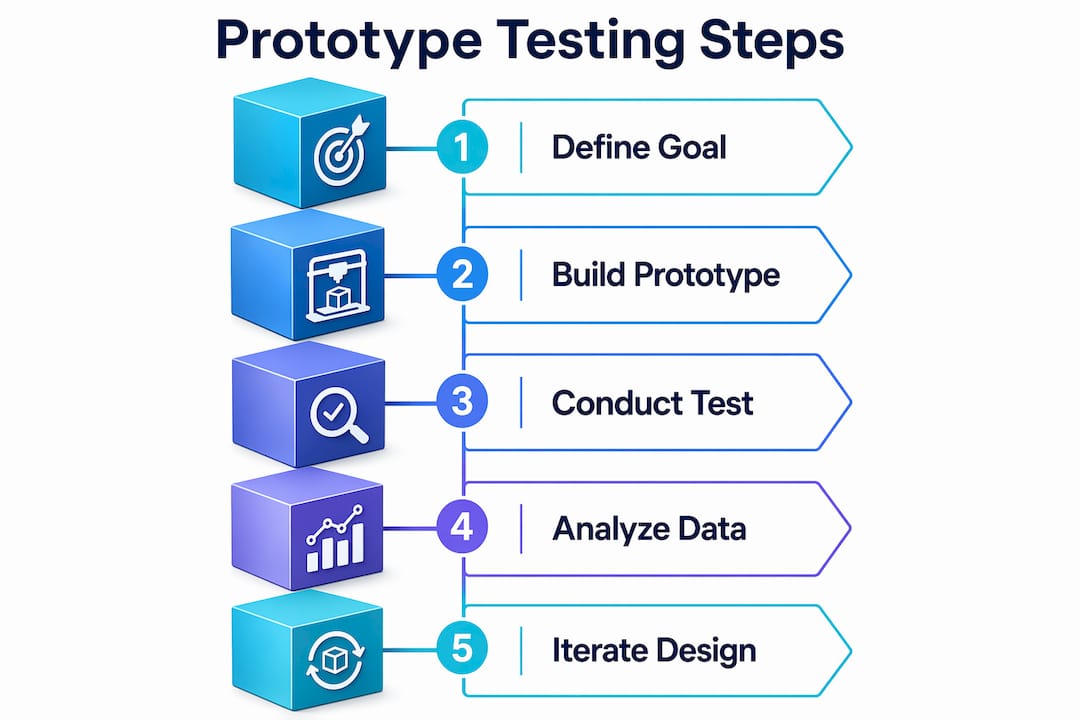
A well-run prototype testing process follows a repeatable cycle. Each step builds on the last, and skipping any one of them weakens the entire test.
-
Define a testable hypothesis. Write a specific, measurable statement before you build anything. For example: “Users will find the contact form in under 10 seconds, with an 80% success rate.” A testable hypothesis anchored to outcomes keeps your test focused on one risk at a time.
-
Choose the right prototype fidelity. Low-fidelity prototypes (paper sketches, wireframes) work well for testing information architecture and flow. High-fidelity prototypes (clickable, near-final designs) work better for testing usability and visual hierarchy. Prototype fidelity should match the risk type you are trying to retire, not default to whatever is easiest to build.
-
Recruit representative users. Recruit 5–8 users who match your target audience. Testing with the wrong users produces misleading results, no matter how well the session is run.
-
Run moderated or unmoderated sessions. Moderated sessions let you ask follow-up questions in real time. Unmoderated sessions scale faster and reduce moderator bias. Choose based on what your hypothesis requires.
-
Collect qualitative and quantitative data. Track task completion rates, time on task, error counts, and recovery rates. Record sessions when possible. Behavioral data outweighs verbal feedback every time.
-
Analyze and identify patterns. Look for repeated friction points across multiple users. One user struggling is an outlier. Three users struggling in the same place is a design problem.
-
Iterate and retest. Validation cycles should last 1–2 weeks per iteration to maintain speed. Three cycles of prototyping, testing, analysis, and adjustment typically produce a solid solution. If fundamental changes persist after five cycles, the problem definition likely needs revisiting.
Pro Tip: Treat each iteration as a separate experiment. Change one variable at a time so you know exactly what caused any improvement or regression in user behavior.
The iterative prototyping process is what separates teams that converge on good solutions quickly from those that spin in circles.
What common pitfalls should you avoid in prototype validation?
Most prototype validation failures trace back to a small set of repeatable mistakes. Knowing them in advance is the fastest way to avoid them.
- Over-polishing the prototype. When a prototype looks too finished, users focus on colors and fonts instead of functionality. Use just enough fidelity for the specific risk you are testing. Nothing more.
- Skipping success criteria. Running a test without predefined metrics means you cannot objectively interpret results. You end up with opinions, not findings.
- Testing too broadly. Trying to validate everything in one session produces shallow data on every question and deep data on none. Focus each test on one specific risk or assumption.
- Relying on what users say instead of what they do. Users often report confidence in tasks they actually struggle to complete. Behavioral observation beats self-reported feedback every time.
- Letting cycles run too long. Validation cycles that stretch beyond two weeks slow learning and invite scope creep. Speed is a feature of good validation practice.
Pro Tip: Before every test session, write down the one decision this test needs to inform. If you cannot name that decision, the test is not ready to run.
The functional prototyping guide covers how to match prototype type to test goal, which directly reduces the risk of over-building before you have validated the core concept.
How to interpret prototype validation results and apply insights
Reading test results correctly is where most teams leave value on the table. Raw data from a prototype session means nothing without a clear framework for interpretation.
Prototype validation metrics include task completion rate, time on task, error and recovery rates, system usability scores, and intent to use. Each metric tells a different story about where the design succeeds and where it fails.
| Metric | What it measures | How to use it |
|---|---|---|
| Task completion rate | Whether users can finish a goal | Compare against your predefined success threshold |
| Time on task | How long a task takes | Flag tasks that take significantly longer than expected |
| Error rate | How often users make mistakes | Identify design elements that consistently mislead users |
| System usability score | Overall perceived ease of use | Benchmark across iterations to track improvement |
| Intent to use | Whether users would adopt the product | Gauge product-market fit signal early |
Once you have the data, prioritize fixes by two factors: impact on user success and risk to the business. A friction point that blocks task completion ranks higher than one that slows a secondary flow. Linking test results to business metrics like activation or retention rates closes the feedback loop and keeps product decisions grounded in outcomes, not aesthetics.
Validation evidence also serves a second purpose: it builds stakeholder trust. When you walk into a product review with behavioral data instead of design opinions, the conversation changes. Decisions get made faster, and teams align around evidence rather than hierarchy.
Key Takeaways
Prototype validation is the most cost-effective way to confirm a design works before engineering commits, using real user behavior as the decision standard.
| Point | Details |
|---|---|
| Define metrics first | Set measurable success criteria before building any prototype to keep tests objective. |
| Match fidelity to risk | Use low-fidelity prototypes for flow testing and high-fidelity for usability validation. |
| Five users is enough | Testing with 5 users uncovers approximately 85% of usability issues in early validation. |
| Keep cycles short | Limit each iteration to 1–2 weeks to maintain learning speed and prevent scope creep. |
| Behavior beats opinion | Prioritize what users do over what they say to get reliable, actionable findings. |
Why I think most teams misuse prototype validation
Most product teams treat prototype validation as a checkbox. They run one test, collect some notes, and move on. That approach misses the entire point.
Prototype testing is a decision system, not a formality. Its job is to retire specific risks before engineering spends time and money building the wrong thing. Every test should be tied to a business-critical assumption. If you cannot name the assumption your test is retiring, you are running a demo, not a validation.
The teams I have seen get the most out of validation share one habit: they align each prototype to a single, specific risk. Not “does the user like this?” but “can the user complete checkout without help?” That specificity is what makes results usable.
I have also watched teams waste weeks building high-fidelity prototypes for feasibility tests that a paper sketch would have answered in a day. The highest-order use of a prototype is to discover a successful product solution, and that discovery happens faster when you resist the urge to over-build before you have validated the core assumption.
Iterative testing is not a sign of failure. It is the mechanism by which good products get made. Three focused cycles of build, test, and adjust will get you further than one exhaustive test that tries to answer every question at once.
— Justin
How Cc3dlabs helps you validate faster with 3D printing
Physical prototype validation requires physical prototypes. That is where speed and material accuracy matter most.
Cc3dlabs, based near Philadelphia, produces filament-based 3D printed prototypes with fast turnaround times for product developers who need to test form, fit, and function quickly. Whether you are running your first validation cycle or your fifth, having a reliable 3D printing service behind your process means you spend less time waiting for parts and more time learning from real user tests. Cc3dlabs also offers CAD modeling support and professional handheld 3D scanning (accuracy to ~0.1 mm), which means your prototype geometry stays accurate across every iteration. Request a free online estimate and keep your validation cycles moving.
FAQ
What is prototype validation in product development?
Prototype validation is the process of testing early product versions with real users to confirm that a design solves the intended problem before full development begins. It combines usability testing, behavioral observation, and measurable success criteria to produce evidence-based design decisions.
How many users do you need for prototype testing?
Testing with 5 users uncovers approximately 85% of usability issues in early prototype validation. That sample size is sufficient for qualitative friction point identification in most product development contexts.
What metrics should you track during prototype validation?
Key metrics include task completion rate, time on task, error and recovery rates, system usability scores, and intent to use. These metrics quantify how well a prototype meets usability and acceptance criteria against predefined thresholds.
How long should a prototype validation cycle take?
Each validation cycle should last 1–2 weeks per iteration to maintain rapid learning and prevent scope creep. Three cycles of prototyping, testing, analysis, and adjustment typically produce a solid product solution.
What is the difference between low-fidelity and high-fidelity prototypes?
Low-fidelity prototypes (wireframes, paper sketches) test information architecture and user flow. High-fidelity prototypes test usability and visual hierarchy. The right choice depends on which specific risk you are trying to retire in that iteration.