
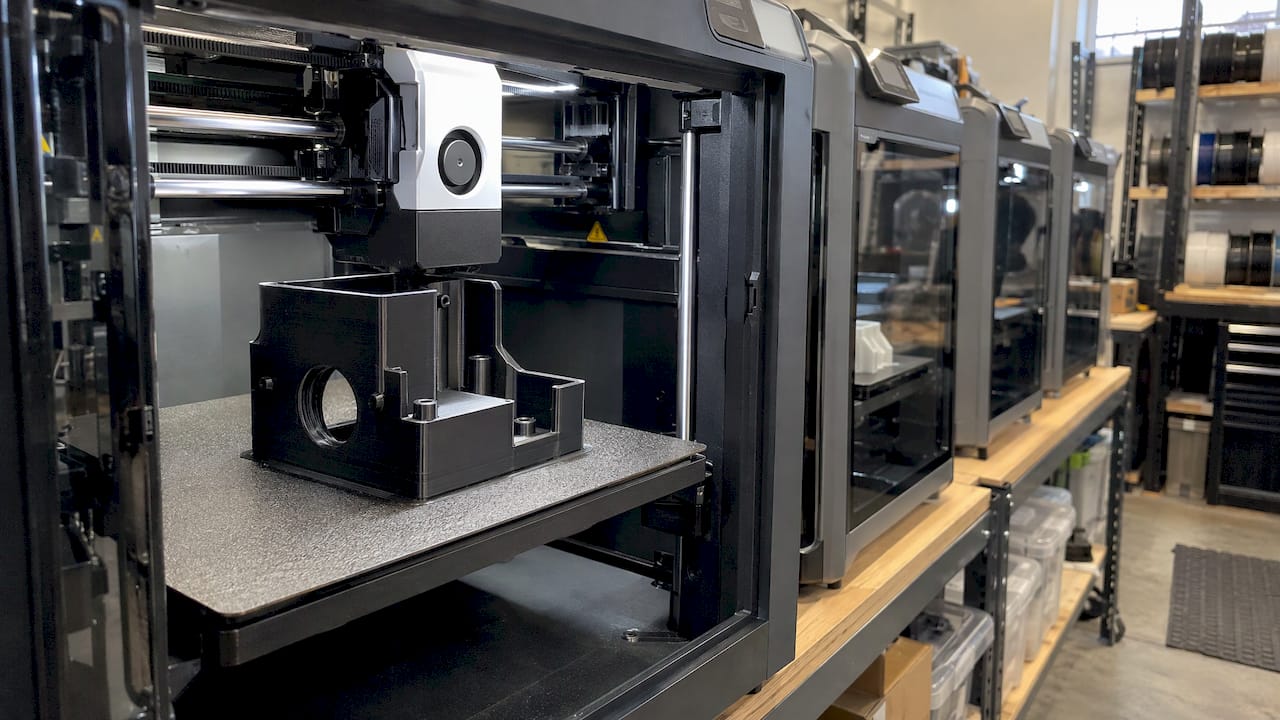
A 3D-printed prototype in the Philadelphia area usually costs somewhere between a few dollars and a few hundred dollars per part, depending on size, material, finish and quantity. The honest answer for any specific part is a quote based on the actual model. At CC 3D Labs, in Bucks County, we publish no fixed price list. Every production job is quoted individually after a test print of your model, so the figure you receive reflects real material use, real print time and the finish your prototype needs.
This guide explains what drives a prototype quote, what industry averages look like, how repeat prints change the price per part, and what to send so the first quote is close to the final one.
TL;DR
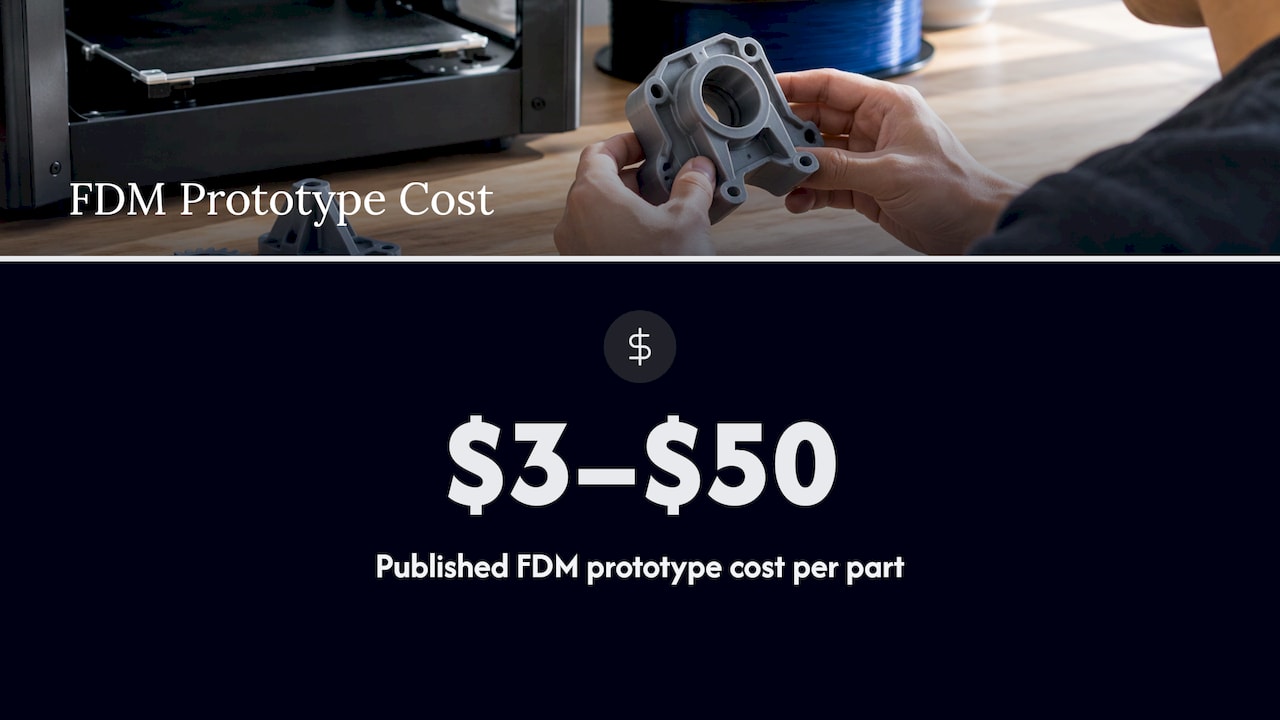
- Industry averages for FDM prototypes run from about $3 to $50 per part. Your part’s volume, material and finish decide where it lands.
- Part volume, supports, material, tolerance, finishing and quantity are the main price drivers. Geometry choices you control can move the quote more than any hourly rate.
- Setup work is spread across a batch, so the price per part usually falls as quantity rises, while material and machine time remain.
- We quote each job after a test print of your model and make no blanket turnaround promises. Send a STEP or 3MF file, material, quantity and function to get a precise number.
Table of Contents
- What a prototype costs: the averages and their limits
- The six factors that set your price
- How price per part changes with quantity
- What else can appear on a quote
- How to prepare a file for an accurate quote
- Ways to lower the cost of a prototype
- Our perspective on prototype pricing
- Get a quote from CC 3D Labs
- FAQ
- Sources
What a prototype costs: the averages and their limits
Published industry figures give a useful frame, not a quote. One startup-focused guide reports FDM prototypes at roughly $3 to $50 per part, published in March 2026 for the U.S. market. Treat that as an average across many providers and part sizes. A palm-sized bracket in PLA sits near the low end. A large housing in carbon-fiber nylon, printed with supports and finished by hand, can sit well above it.
There is no separate Philadelphia price for 3D printing. Machines, filament and software cost the same here as anywhere in the U.S. What local buyers do get is practical: you can talk to the person running the printers, hand over a physical part for scanning, and collect finished parts by residential pickup instead of paying freight. We have no walk-in storefront, so pickup is arranged per order, and completed orders ship anywhere in the United States.
Bucks County businesses ask what 3D printing typically costs for them. The answer is the same as for Center City: it depends on the part, and a no-obligation quote based on a test print is how you get a real number. The rest of this guide shows how to make that number small and predictable.
The six factors that set your price
1. Part volume and weight
FDM cost follows material consumed and time on the machine, and both scale with volume. HP’s costing guidance states that larger part volume generally means higher cost. Two parts with the same bounding box can differ by a factor of three in weight if one is a thin-walled enclosure and the other a solid block.
The settings that determine weight are the ones a slicer exposes: wall thickness (set as a number of perimeters multiplied by nozzle diameter), infill density and infill pattern. A prototype that only needs to check form and fit can use light infill. A part that will be clamped, loaded or threaded needs more perimeters and denser infill, and the quote reflects that.
2. Supports and orientation
Overhangs steeper than roughly 45 degrees generally need support material, which adds filament, print time and hand cleanup. HP notes that supports in several additive processes, FDM included, add material and post-processing cost. Orienting the part so that the critical face prints flat against the bed often removes supports and improves surface quality at the same time.
3. Material
Our Bambu Lab farm prints PLA, PETG, ABS, ASA, PC and carbon-fiber nylon. Material choice affects filament cost, print settings and failure risk, and it should follow the job the part has to do.
| Material | Typical use in prototyping | Approximate heat resistance |
|---|---|---|
| PLA | Form and fit models, presentation parts | About 60°C |
| PETG | Functional prototypes, enclosures, tougher parts | About 80°C |
| ABS / ASA | Heat-exposed parts, ASA for outdoor and UV exposure | About 100°C |
| PC | Stronger, stiffer functional parts | See quote discussion |
| Carbon-fiber nylon | Rigid, engineering-grade functional parts | See quote discussion |
Heat figures are typical material values, not guarantees for a specific print, since orientation and settings change real-world performance. If a prototype will sit on a dashboard, near an engine bay or in a sunlit window, tell us up front so we match the material to the environment. A cheaper material that warps in service costs more than the right one the first time.
4. Tolerance and fit
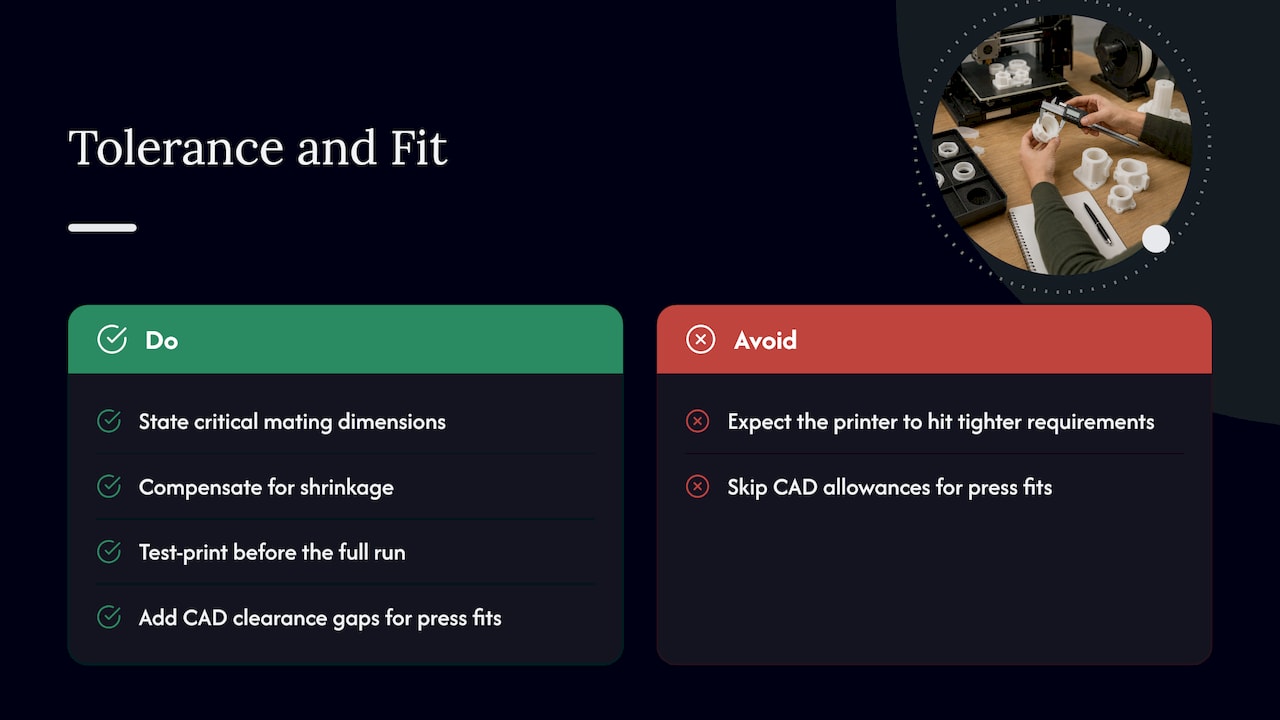
FDM parts typically hold about ±0.2 to 0.5 mm, depending on geometry, size and material. If your prototype mates with another component, state which dimensions are critical. We can compensate for shrinkage on those features, and a test print lets us check them before the full run. Tighter requirements may call for design allowances in the CAD, such as clearance gaps for press fits, rather than expecting the printer to hit a number it cannot.
5. Finishing
As-printed FDM parts show layer lines. For a functional prototype that is usually fine. For a part that goes in front of investors or customers, sanding, filling or a different layer height adds labor. Specify the finish you need, not the finish you hope for. A quote that assumes as-printed surfaces will differ from one that assumes a presentation-quality exterior.
6. Quantity
One part carries the entire setup effort: file checking, slicing, plate preparation and the test print. Ten parts share it. The next section shows how much that matters.
How price per part changes with quantity
Setup is a fixed cost, and printing is a recurring one. A published small-batch example from PrintCal assumes $24 of one-off setup and $3.50 of recurring cost per part. At 12 parts, that works out to $5.50 per good part, and at 48 parts $4.00. The setup is shared across more parts, while material, machine time and hand finishing stay constant.
That illustration uses the vendor’s own figures, so read it as arithmetic and not as our pricing. The pattern holds on any FDM farm: the first part is the most expensive per unit, and the curve flattens after a few dozen.
A practical way to use this:
- Print one validated part first to confirm fit and function.
- Fix any design problems in CAD before ordering more.
- Order the next run in a quantity that covers your actual needs for a test cycle, such as 10 to 25, so setup is shared.
- Ask for repeat-order quoting once the design is frozen, since the file is already proven.
If you plan to go beyond prototypes, our guide on small batch 3D printing cost covers why engineers look at the whole job and not just grams of filament. For procurement teams who want a framework for comparing quotes, per-unit cost math shows how to separate fixed and recurring costs across suppliers.
What else can appear on a quote
Beyond the printing itself, a prototype quote may include:
- Design or file repair. If you have a sketch, a mesh with errors or a broken part and no model, CAD work comes first. We offer 3D modeling and CAD services, and if you only have a physical part, we can capture it with professional handheld 3D scanning (accuracy to ~0.1 mm) and build a clean model from the scan.
- Test print. Every production job starts with one. It is how we confirm dimensions and settings before committing machine time to a run.
- Finishing. Support removal, sanding or assembly of multi-part prototypes.
- Shipping or pickup. Local clients can arrange residential pickup. Shipping within the U.S. depends on size, weight and destination.
Ask for these to be itemized. A good quote tells you what you are paying for, so you can decide whether a step is worth it at the prototype stage.
How to prepare a file for an accurate quote
The fastest route to a firm number is a complete request. Quotes slow down when basic details are missing, and each round of questions adds days.
The right file format
For a simple part, an STL or 3MF is usually enough. For a technical part that may need edits, a STEP file helps. A practical comparison of formats says that STL is common and sufficient for many simple prints, while color, multiple materials or tight fit make another format more useful. 3MF carries units, color and multi-material assignments more reliably than STL.
The project details we need
- Material, or the conditions it must survive (heat, UV, load, chemicals), so we can recommend one.
- Quantity, now and the likely next run.
- Critical dimensions and tolerances, marked on a drawing or in a note.
- Function: a visual model, a fit check, a working part, a load-bearing part.
- Finish: as-printed, sanded, multi-color.
- Timeline, with the date you actually need parts in hand. We make no blanket turnaround guarantees, but knowing your deadline lets us plan the schedule honestly. Our note on local 3D printing turnaround explains what affects lead time.
Pro Tip: Add the units to your request and the file name. A part exported in inches and read as millimeters is the most common avoidable error in a first print.
Ways to lower the cost of a prototype
- Print in stages. Use PLA for early form and fit, then move to PETG, ABS, ASA or nylon for the functional version.
- Hollow where you can. Lower infill and fewer perimeters on non-structural areas reduce weight and time.
- Remove supports by design. Chamfers in place of overhangs, and splitting a part so each half prints flat, can eliminate cleanup.
- Combine variants. If you are testing three versions of a bracket, putting them in one job shares setup.
- Settle the CAD first. Each design revision after a batch is paid for twice.
Our article on cutting 3D printing costs goes deeper into these tactics for product developers, and choosing the right 3D printing type helps you decide what the prototype stage actually needs.
Our perspective on prototype pricing
We quote every prototype after printing a test of the actual model, and we do it because a per-gram rate hides the things that decide cost: supports, orientation, tolerance on mating features and the finish you need.
Our Bambu Lab farm gives us consistent results across batches, which matters when a prototype turns into ten, then fifty parts. A single wrong dimension repeated across a run is expensive, so we would rather check it on one part first.
We are owner-operated, so you talk to the person who prints your part. We have taken on fragile and complex builds that other shops declined, and we say so plainly when a design needs a change to print well. Many of our automotive and restoration clients start with a scan of an existing part, then move to CAD and printing in the same project.
Our advice: send us the file, the material conditions and the quantity, and let the test print tell you the price.
Justin
Get a quote from CC 3D Labs
If you are a product developer, engineer, automotive shop or small manufacturer in Philadelphia or Bucks County, we can quote 3D printed prototypes and repair parts and on-demand 3D printing and manufacturing for small-batch runs, including engineering-grade materials and multi-color printing.
Our full list of services is on the services page. If you want to understand the steps before you submit, read our guide to getting a quote for a custom 3D print. Ready to go? Request your prototype quote at cc3dlabs.com/3d-print-quote/. For a scan of an existing part, use the 3D scan request form, and for CAD work, the 3D modeling and CAD estimate form.
FAQ
How much does a 3D-printed prototype cost in Philadelphia?
Industry averages put FDM prototypes at roughly $3 to $50 per part, though large, finished or engineering-material parts can exceed that. We publish no fixed pricing. Each job is quoted individually after a test print of your model.
Is 3D printing cheaper in Bucks County than in Philadelphia?
Not in a way you should plan around. Printer time and filament cost the same everywhere, so your quote follows the part, material, finish and quantity. The local benefit is direct communication with the printer operator and pickup without freight.
Does ordering more parts lower the price per part?
Usually, yes. Setup and preparation are shared across the run, as in a published example where cost per good part falls from $5.50 at 12 parts to $4.00 at 48. Material and machine time still apply to every part.
What should I send to get an accurate quote?
Send a STEP or 3MF file (or STL for simple parts), the material or operating conditions, quantity, critical dimensions, finish and the date you need parts. If you only have a physical part, we can scan it and build the model.
Can you ship prototypes outside the Philadelphia area?
Yes. Local customers can use residential pickup, and completed orders ship anywhere in the United States.
Sources
- 3D Printing for Hardware Startups: Guide, M Accelerator
- How to calculate the cost of 3D printed parts, HP
- Small batch 3D printing pricing: costs and discounts, PrintCal
- STL, 3MF, or STEP: which file to request before quoting a 3D print, PrintCal
- Per Unit Math for Procurement to Fix Contract Manufacturing Costs