
TL;DR:
- Reverse engineering 3D converts physical parts into parametric CAD models using scan-to-CAD workflows. It speeds up design, repair, and quality inspection by capturing complex geometries with 3D scanners. Restoring engineering intent ensures functional accuracy and manufacturability in industrial applications.
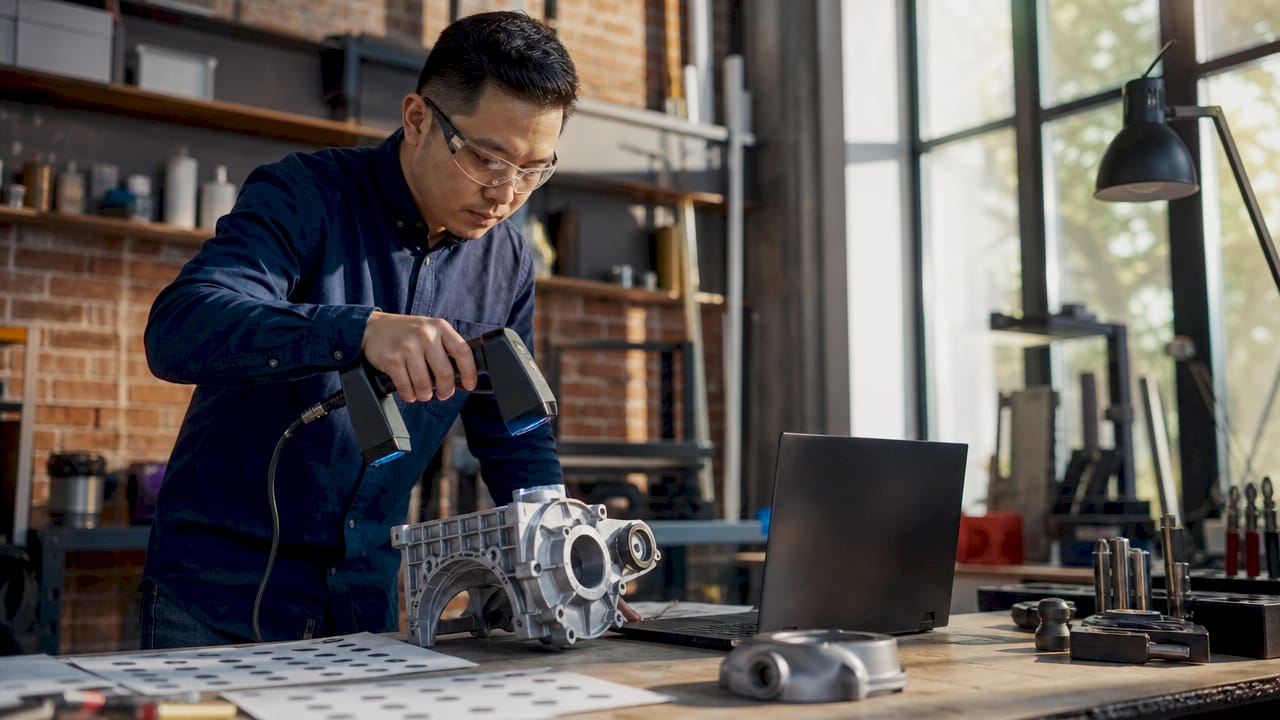
Reverse engineering 3D is defined as the process of capturing a physical object’s geometry and converting it into an editable, parametric CAD model for reproduction, redesign, or inspection. The industry standard term for this workflow is “scan-to-CAD,” and it relies on 3D scanning to collect surface data far faster than manual measurement ever could. Where traditional methods with calipers or coordinate measuring machines (CMMs) take days or weeks, scan-based reconstruction compresses that timeline to hours or days. Cc3dlabs applies this workflow daily for product developers, engineers, and designers who need production-ready digital models from physical parts.
What is the role of 3D scanning in reverse engineering?
3D scanning is the foundation of modern reverse engineering. Without it, capturing complex organic shapes or worn surfaces with enough accuracy for manufacturing is nearly impossible using hand tools alone.
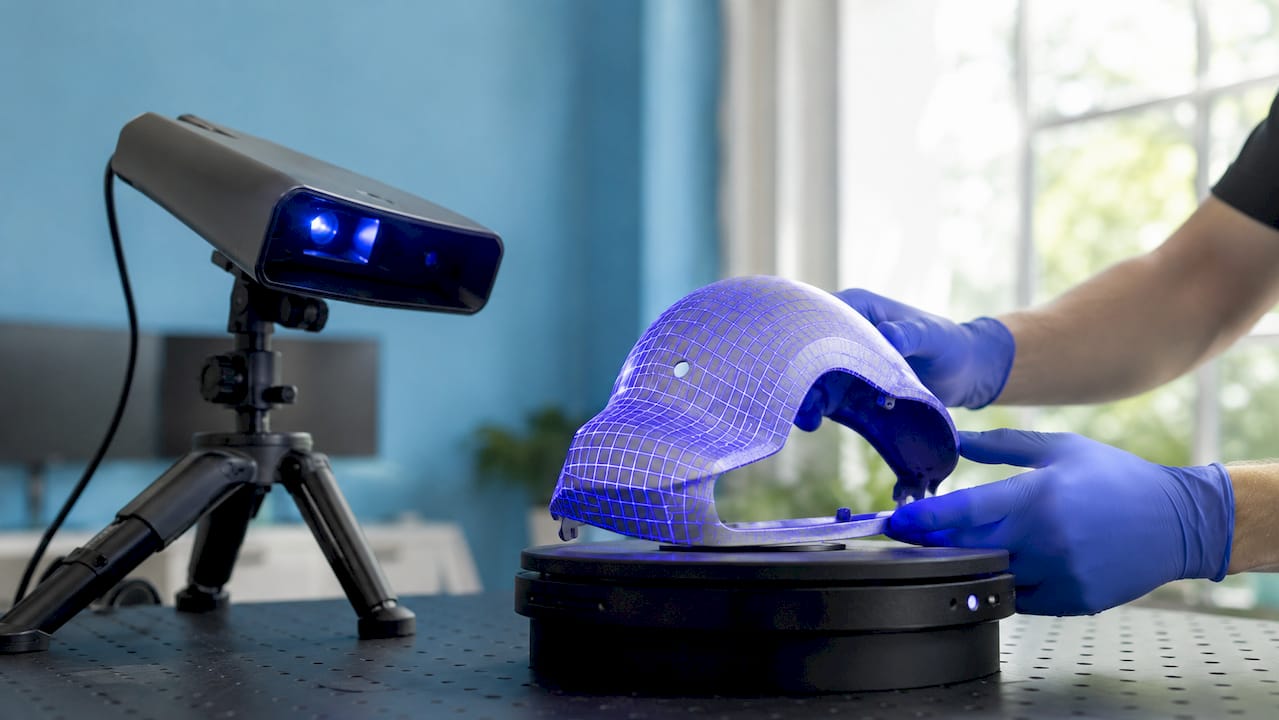
Two scanning technologies dominate professional workflows today. Structured light scanning projects a grid of light onto a surface and measures how it deforms to calculate geometry. Laser triangulation fires a laser line across the part and uses the reflection angle to build surface data. Both methods produce raw point clouds, which are dense collections of measured coordinates in three-dimensional space.
Standard scanning accuracy in professional settings falls between 50 and 100 microns (0.05–0.1 mm). That level of precision is sufficient for most industrial applications, from aerospace brackets to consumer product housings. Environmental factors like temperature shifts and vibration directly affect that precision, which is why controlled scanning environments matter.
Once the scanner collects enough data, the software stitches individual scans into a unified polygon mesh. A mesh is made of millions of small triangles that approximate the part’s surface. This mesh is not directly editable as a CAD model. It is a visual representation, not a parametric solid, and that distinction drives the next phase of the workflow.
- Structured light scanning: Best for small to medium parts with fine surface detail
- Laser triangulation: Effective for larger parts and industrial environments
- Point cloud output: Raw coordinate data requiring cleanup before modeling
- Polygon mesh: Processed surface geometry used as the reference for CAD reconstruction
- CMM comparison: Contact-based CMMs measure discrete points; scanners capture millions simultaneously
Pro Tip: Apply a thin, uniform matte spray to shiny or translucent surfaces before scanning. Reflective surfaces scatter laser or structured light, creating gaps and noise in the point cloud that are difficult to fix in post-processing.
What is the standard workflow for reverse engineering in 3D?
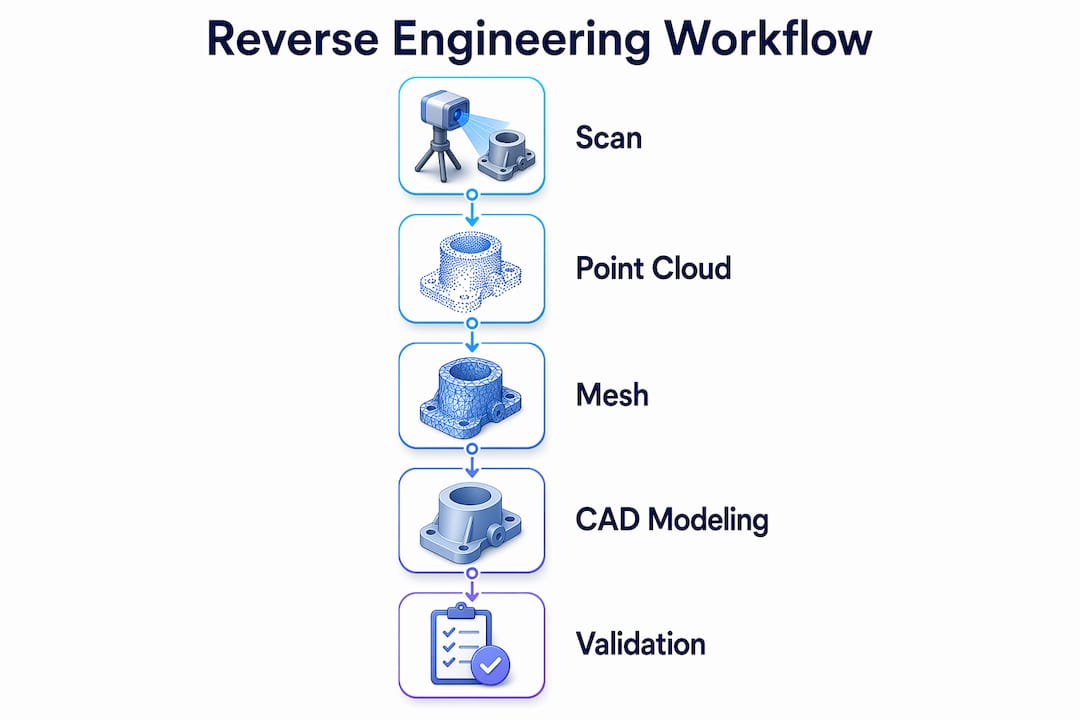
The reverse engineering workflow follows five sequential steps. Skipping any one of them increases the risk of producing a model that looks right but fails in manufacturing.
-
Part evaluation and preparation. Examine the physical part for wear, damage, and surface condition. Identify which features are functional and which are artifacts of use. Clean and prep the surface for scanning.
-
Data capture. Scan the part using structured light or laser triangulation. Capture multiple passes from different angles to cover all surfaces. Apply reference targets or markers if the part requires multi-position scanning.
-
Point cloud and mesh processing. Import raw scan data into processing software. Align multiple scans, remove noise, fill small gaps, and generate a clean polygon mesh. This step determines the quality ceiling for everything that follows.
-
CAD reconstruction. Use the mesh as a reference to rebuild the part as a parametric CAD model. Engineers fit geometric primitives, such as planes, cylinders, and fillets, to the mesh rather than simply wrapping it. This is where design intent is restored rather than copied.
-
Validation. Compare the finished CAD model back to the original scan data using deviation mapping. Color-coded deviation maps highlight where the model diverges from the scan. Deviations exceeding application-specific thresholds must be corrected before the model goes to manufacturing.
“The real challenge lies in the scan-to-CAD step, where engineers rebuild clean parametric models from raw meshes for manufacturing suitability.” This is where expertise separates a functional part from a failed one.
The scan-to-CAD workflow compresses what once took weeks into a process measured in hours. That speed advantage directly reduces product development costs and accelerates time to market for manufacturers and product developers alike.
How does reverse engineering 3D restore engineering intent beyond shape copying?
Engineering intent is the set of functional decisions the original designer made: specific tolerances, geometric relationships, and feature dimensions that make a part work. Simply tracing the scanned mesh does not recover those decisions.
A worn shaft, for example, may measure 24.87 mm in diameter after years of use. The original design called for 25.00 mm. If you model what you measure, you reproduce the wear. If you recognize the intent, you model 25.00 mm and restore the part to its functional specification. Distinguishing intended geometry from surface wear is one of the most critical skills in the entire process.
Common mistakes engineers make when skipping this step include:
- Replicating defects: Modeling cracks, dents, or wear as designed features
- Ignoring tolerances: Producing nominal geometry without fit or clearance specifications
- Over-trusting the mesh: Accepting scan noise as real geometry
- Missing symmetry: Failing to apply mirror or pattern constraints that the original design used
- Skipping feature recognition: Modeling freeform surfaces where the original used a simple cylinder or plane
Pro Tip: When reconstructing holes, always check whether the diameter corresponds to a standard drill size or thread specification. Parametric CAD modeling with standard feature dimensions makes downstream manufacturing far simpler than working from arbitrary measured values.
The balance between accuracy and simplification is deliberate. A model does not need to match the scan to within 5 microns everywhere. It needs to match within the tolerance that the application demands. Over-modeling wastes time and creates unnecessarily complex files. Under-modeling produces parts that do not fit. Experienced engineers know where each threshold sits.
What practical applications and industries benefit from reverse engineering 3D?
Reverse engineering 3D solves problems across a wide range of industries. The common thread is a physical object that needs a digital counterpart, whether for reproduction, modification, or quality verification.
- Legacy part reproduction: Mining and energy companies regularly use reverse engineering to reproduce parts for equipment that manufacturers no longer support. When original drawings do not exist, scanning obsolete parts is the only path to a replacement.
- Product redesign: Consumer product developers scan existing objects to understand their geometry, then modify the CAD model to improve ergonomics, reduce weight, or adapt for new manufacturing methods.
- Quality inspection: Deviation analysis compares manufactured parts to their CAD reference. This application uses the same scanning technology in reverse: the CAD model is the standard, and the scan reveals how closely production parts match it.
- 3D printing and CNC workflows: Reverse engineered CAD models feed directly into 3D printing services and CNC machining programs. The model must be parametric and clean for toolpaths to generate correctly.
- Prototyping acceleration: Designers scan a hand-built foam or clay model, convert it to CAD, and send it to production within the same day. That speed is not achievable with manual measurement.
The scan-to-CAD process also supports injection molding workflows, where precise wall thickness and draft angles must be modeled explicitly. A mesh alone cannot drive a mold design. A parametric CAD model can.
What are common challenges and tips for successful 3D reverse engineering projects?
Every reverse engineering project encounters friction. Knowing where the friction comes from lets you address it before it costs time or accuracy.
Surface condition is the most common source of scan failure. Shiny metals, clear plastics, and very dark surfaces all interfere with optical scanners. Matte sprays solve this for most materials, but the coating must be thin and uniform. Thick or uneven coatings add measurable geometry to the surface and skew results.
Environmental control matters more than most beginners expect. Temperature fluctuations and vibration introduce measurement error that accumulates across a multi-scan session. Professional scanning environments use stable lighting, controlled temperature, and vibration-isolated tables for critical work.
- Mesh cleanup: Remove floating points, fill holes, and smooth noise before starting CAD reconstruction. A poor mesh produces a poor model regardless of how skilled the engineer is.
- Feature recognition software: Tools that automatically detect planes, cylinders, and spheres in the mesh speed up reconstruction and reduce human error.
- Deviation thresholds: Set acceptable deviation limits before modeling, not after. Application-specific tolerances for aerospace differ from those for consumer goods.
- Expert review: Have a second engineer review the CAD model against the scan before releasing it to manufacturing. Deviation mapping catches errors that visual inspection misses.
Pro Tip: Break complex parts into logical sub-regions during reconstruction. Model each functional zone separately, then assemble them. This approach makes it easier to identify where the model drifts from the scan and correct it without rebuilding the entire file.
Key Takeaways
Reverse engineering 3D converts physical parts into parametric CAD models through a five-step scan-to-CAD workflow that restores engineering intent, not just geometry, making parts manufacturable and functionally accurate.
| Point | Details |
|---|---|
| Scanning replaces manual measurement | 3D scanners collect millions of data points in hours, replacing days of caliper and CMM work. |
| Mesh is not a CAD model | Raw scan output requires parametric reconstruction before it can drive CNC, molding, or printing. |
| Engineering intent must be restored | Model the original design specification, not the worn or defective scanned shape. |
| Validation is non-negotiable | Deviation mapping confirms the CAD model matches the scan within manufacturing tolerances. |
| Applications span every industry | From legacy part reproduction to quality inspection, reverse engineering serves manufacturing, design, and prototyping. |
Why engineering intent is the real deliverable in reverse engineering
Most articles about reverse engineering focus on the scanning hardware. That is the wrong place to put the emphasis. The scanner is just a measuring tool. The real work happens when an engineer sits down with a mesh and decides what the original designer intended.
I have seen projects where teams invested in high-end scanning equipment and still delivered unusable models. The scans were beautiful. The mesh was clean. But the CAD reconstruction copied the worn geometry faithfully, including a shaft that was 0.3 mm undersize from years of friction wear. The replacement parts failed immediately because the engineer modeled what existed rather than what was designed.
The scan-to-CAD step is where engineering judgment is irreplaceable. Software can detect that a surface is approximately cylindrical. Only an engineer can decide whether that cylinder should be 25.00 mm or 24.87 mm based on context, fit requirements, and standard sizing conventions. Technology accelerates the data collection. It does not make that call for you.
My advice to product developers and engineers entering this field: invest as much time learning CAD reconstruction and feature recognition as you do learning to operate the scanner. The 3D modeling process is where value is created. The scan is just the starting point. And always run deviation analysis before you sign off. A color map that looks green across the board is the only honest confirmation that your model is ready for production.
— Justin
Cc3dlabs scanning and CAD services for your reverse engineering needs
Cc3dlabs offers professional 3D scanning and CAD modeling near Philadelphia, with capabilities that cover the full reverse engineering workflow from initial scan to validated parametric model.
The team at Cc3dlabs works with product developers, engineers, and manufacturers who need accurate digital models from physical parts. Services include professional handheld 3D scanning (accuracy to ~0.1 mm), mesh processing, parametric CAD reconstruction, and deviation analysis. Whether you need a single legacy part reproduced or a batch of components digitized for redesign, Cc3dlabs delivers models built for manufacturing, not just visualization. Request a free online estimate to get your project scoped quickly.
FAQ
What is reverse engineering 3D in simple terms?
Reverse engineering 3D is the process of scanning a physical object and converting the scan data into an editable CAD model. The goal is a parametric digital file that can be used for manufacturing, redesign, or inspection.
How accurate is 3D scanning for reverse engineering?
Professional 3D scanners typically achieve accuracy between 50 and 100 microns (0.05–0.1 mm). Environmental factors like temperature and vibration affect that precision, so controlled scanning conditions are standard practice for industrial work.
What is the difference between a scan mesh and a CAD model?
A scan mesh is a surface made of millions of triangles that represents the object’s shape but cannot be directly edited or used to drive manufacturing. A parametric CAD model contains geometric features with defined dimensions and relationships, making it suitable for CNC machining, 3D printing, and injection molding.
Why does validation matter in a reverse engineering workflow?
Validation compares the finished CAD model to the original scan using deviation mapping. Color-coded maps reveal where the model diverges from the measured part, allowing engineers to correct errors before manufacturing begins and avoid producing faulty parts.
What industries use reverse engineering 3D most often?
Manufacturing, energy, mining, consumer product development, and aerospace all rely on reverse engineering to reproduce obsolete parts, inspect production quality, and accelerate product redesign. Any industry that works with physical parts and needs digital models benefits from the process.