
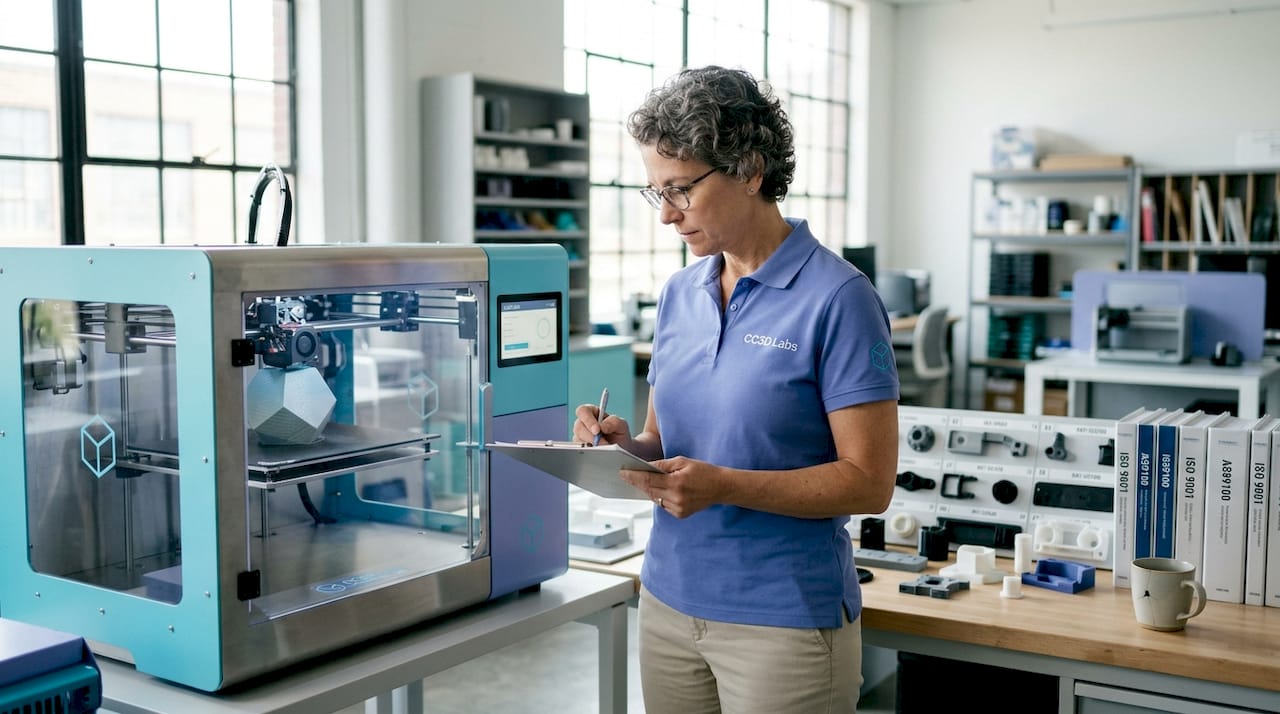
TL;DR:
- ISO certification verifies that a 3D printing business meets international standards for quality, security, and environmental management, unlocking access to key markets and improving operational efficiency. Achieving certification involves a comprehensive process of gap analysis, documentation, training, and audits, often taking six to eighteen months. Standardized file formats like 3MF enhance print quality and IP security, with ISO standards supporting scalable, secure additive manufacturing workflows.
If you’ve ever bid on a government contract, pitched to a medical device company, or tried to land a corporate manufacturing account, you’ve likely hit the wall: “Are you ISO certified?” Understanding what is ISO certification in 3D printing goes beyond answering that question. It’s about building a business that operates with documented, repeatable processes, earns measurable customer trust, and competes in markets that treat certification as a baseline requirement, not a bonus. This article breaks down the specific ISO standards that matter in additive manufacturing, the real operational benefits, and exactly how to pursue certification without losing momentum.
Table of Contents
- Key takeaways
- What is ISO certification in 3D printing
- Key ISO standards for 3D printing businesses
- Business benefits of ISO certification in 3D printing
- The ISO certification process: step by step
- File format standards and interoperability in 3D printing
- Challenges of implementing ISO certification for 3D printing
- My take: ISO certification is how 3D printing companies grow up
- How Cc3dlabs supports your quality and compliance goals
- FAQ
Key takeaways
| Point | Details |
|---|---|
| ISO 9001 drives revenue growth | Certified 3D printing firms see significant sales increases, with research pointing to major average uplifts. |
| Multiple standards apply | ISO 9001, ISO 13485, and file format standards like ISO/IEC 25422:2025 each serve distinct 3D printing needs. |
| Certification is a process, not a one-time event | Sustained compliance requires daily process discipline, documented workflows, and regular internal audits. |
| File format standards matter | ISO-standardized file formats directly impact print quality, interoperability, and IP security in production workflows. |
| Certification opens locked markets | ISO certification is often a mandatory entry requirement for government, defense, and healthcare contracts. |
What is ISO certification in 3D printing
ISO certification means an independent, accredited body has verified that your business meets the requirements of a specific International Organization for Standardization standard. In 3D printing, that could mean your quality management system meets ISO 9001:2015, your medical device processes meet ISO 13485:2016, or that your digital files conform to ISO-defined formats for additive manufacturing.
The significance of ISO in 3D printing is hard to overstate. The technology has matured fast. Additive manufacturing is no longer just for prototyping. It’s being used for end-use aerospace parts, surgical guides, dental prosthetics, and production-grade industrial components. When parts are being implanted in a human body or installed in a jet engine, “we follow best practices” is not enough. Customers and regulators want audited, documented proof.
What makes this nuanced for 3D printing specifically is that the technology cuts across many sectors, each with its own compliance expectations. A company printing architectural models has different obligations than one printing orthopedic implants. ISO certification creates a framework that applies regardless of the application, scaling from general quality assurance up to sector-specific medical or environmental standards.
Key ISO standards for 3D printing businesses
Not all ISO standards apply equally to every 3D printing operation. Here’s a breakdown of the standards most relevant to additive manufacturing professionals:
-
ISO 9001:2015 (Quality Management Systems): The foundational standard for any manufacturing business. It covers customer focus, process documentation, continual improvement, and leadership accountability. For 3D printing service providers, it provides the backbone for consistent output across machines, materials, and operators.
-
ISO 13485:2016 (Medical Device Quality Management): If your operation produces parts for medical or dental applications, this standard is non-negotiable. ISO 13485:2016 certification is the key regulatory benchmark for medical and dental 3D printing firms working toward FDA compliance, bridging the gap between prototype production and clinical-grade manufacturing.
-
ISO/ASTM 52915:2020 (Additive Manufacturing File Format): This is the official AMF file format standard replacing the decades-old STL format. The AMF standard supports color, texture, and complex material properties while maintaining backward compatibility with STL files, giving manufacturers a richer, future-proof data format.
-
ISO/IEC 25422:2025 (3MF File Format Suite): The newest entrant, published in 2025, defines the full 3MF specification for transmitting 3D models in additive manufacturing workflows. More on this in the file formats section.
-
ISO 14001:2015 (Environmental Management): Relevant for 3D printing operations concerned with material waste, emissions, and sustainability reporting, particularly when supplying to environmentally conscious enterprise clients.
-
ISO/IEC 27001:2022 (Information Security): Increasingly relevant as 3D printing becomes tied to valuable design IP, proprietary geometries, and sensitive client files.
Knowing which standard applies to your operation is the first real decision point in the ISO certification process. Pursuing the wrong scope wastes time and money. Start with ISO 9001 as your baseline and layer in sector-specific standards based on the markets you serve.
Business benefits of ISO certification in 3D printing
The benefits of ISO certification go well beyond putting a logo on your website. Let’s get specific.
Sales impact is measurable. Research analyzing World Bank data shows that ISO 9001 certification increases sales by 48.3% on average for certified firms, with the effect especially pronounced for small and mid-size businesses. That’s not a soft “brand value” metric. That’s revenue.

Access to locked markets. ISO certification is often a mandatory requirement for government tenders and corporate supply chains in sectors like defense, aerospace, and healthcare. Without it, your bid doesn’t get read.
Here’s what operational improvement actually looks like inside a certified 3D printing business:
- Print failure rates drop because material handling, machine calibration, and process parameters are documented and followed, not guessed at.
- Supplier qualification becomes systematic. You can audit your filament or resin suppliers against documented criteria rather than relying on vendor claims alone.
- Customer complaints trigger formal corrective actions. The process learns. The team learns.
- Onboarding new operators is faster because documented procedures reduce training burdens, replacing “how we’ve always done it” with written, version-controlled work instructions.
Marketing value is real too, but it’s secondary. Certified businesses consistently report that the internal operational improvements deliver more bottom-line value than the marketing credential alone. ISO certification should be viewed as an operational tool, not just a badge.
Pro Tip: Before pursuing certification, do a gap analysis against the standard’s requirements. Map your current processes and identify where you have no documentation. That gap list becomes your implementation roadmap and keeps you from over-engineering areas that are already in good shape.
The ISO certification process: step by step
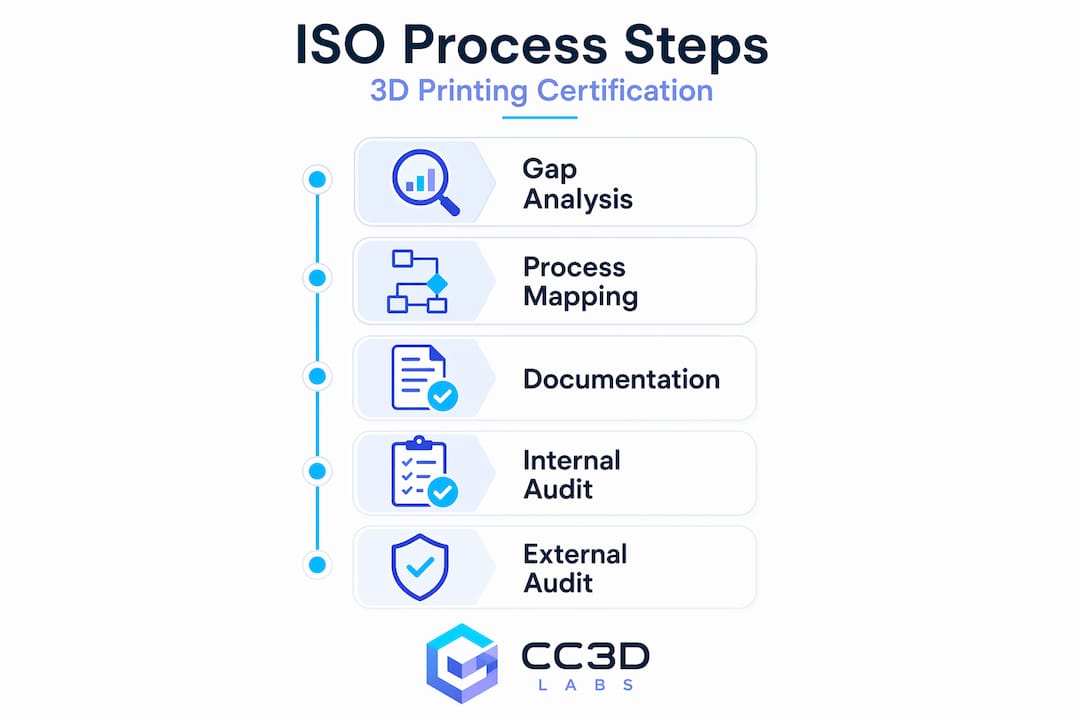
Getting ISO certified is not a weekend project. For most 3D printing SMEs, the full cycle from first gap analysis to achieving certification takes six to eighteen months depending on company size, existing process maturity, and which standard you’re pursuing.
Here’s the practical sequence:
-
Select your standard and define scope. Decide which ISO standard matches your business activities. Define the organizational scope clearly. Trying to certify your entire business when only one product line needs it inflates cost and audit complexity dramatically.
-
Conduct a gap analysis. Compare your current practices against the standard’s requirements. Document every area where you’re not yet meeting requirements. This is the foundation of your project plan.
-
Build and document your Quality Management System. Write the procedures, work instructions, and records the standard requires. For 3D printing, that includes equipment calibration logs, material traceability records, nonconforming product procedures, and customer feedback processes.
-
Train your team and run internal audits. Your staff need to understand the requirements and follow them consistently. Internal audits test whether your QMS works in practice, not just on paper. This step is where most companies underestimate time investment.
-
Select an accredited certification body and schedule a Stage 1 audit. The certification body reviews your documentation. They’re not checking your physical processes yet. They’re confirming your QMS is documented and ready.
-
Complete the Stage 2 (on-site) audit. Auditors visit your facility, observe operations, and verify that documented processes are actually followed. They sample records and interview staff. This is where over-scoping audits becomes expensive; a broader scope means more hours and higher fees.
-
Address nonconformities and receive certification. If auditors find gaps, you address them with documented corrective actions. Certification follows once all nonconformities are resolved.
-
Maintain through surveillance audits. ISO certification requires annual surveillance audits and a full recertification audit every three years. The certification process is a long-term investment, not a checkbox you complete once.
Pro Tip: Build internal ISO competence rather than relying entirely on external consultants. Consultants are useful for gap analysis and system design, but if only an outside party understands your QMS, you’ll fail the next surveillance audit.
File format standards and interoperability in 3D printing
This section is where many 3D printing professionals discover an aspect of ISO standards they had not considered. File format standardization is not just a technical detail. It has direct consequences for print quality, supply chain communication, and intellectual property protection.
Here’s how the three primary formats compare:
| Format | ISO Standard | Key Capabilities | Limitations |
|---|---|---|---|
| STL | None (legacy) | Basic geometry only | No color, material, or metadata support |
| AMF | ISO/ASTM 52915:2020 | Color, texture, materials, curved triangles | Limited adoption in mainstream slicer tools |
| 3MF | ISO/IEC 25422:2025 | Full fidelity, multi-material, encryption, metadata | Newer; not universally supported yet |
The ISO/IEC 25422:2025 3MF standard defines the full 3MF file format suite for transmitting 3D models in additive manufacturing. It handles multi-material and color fidelity, carries embedded process parameters, and includes encryption extensions for protecting proprietary design data. For production workflows, this matters more than most teams realize.
Consider a contract manufacturer printing parts for an aerospace client. If that client’s design IP is sitting in an unencrypted STL file traveling over email, the exposure is significant. The 3MF standard enables secure, interoperable, and scalable operations with encryption at the file level. That matters to enterprise clients and regulated industries.
For businesses looking to optimize their production workflows, understanding CAD file formats for 3D printing is a practical starting point before tackling formal ISO compliance at the file format level.
Challenges of implementing ISO certification for 3D printing
The path to certification has real friction. Businesses that know what to expect navigate it more efficiently than those who go in blind.
-
Infrastructure gaps surface late. Companies pursuing ISO 13485 for medical 3D printing routinely underestimate infrastructure requirements like cleanroom compliance, environmental monitoring systems, and humidity-controlled material storage. These are not minor additions. They can represent significant capital investment.
-
Documenting “tribal knowledge” is harder than it sounds. Most 3D printing shops run on institutional knowledge held by two or three experienced operators. Turning that into documented, auditable procedures takes time and requires those people to stop printing and start writing. Formalizing tribal knowledge into documented processes is one of the most time-consuming parts of building a QMS, but it’s also one of the highest-return activities for long-term operational stability.
-
Audits only sample your processes. A certification audit is not comprehensive coverage of everything you do. Auditors sample records and observe a subset of operations. The real quality improvement comes from daily process adherence, not from performing well during the audit week. Companies that “audit prep” instead of building genuine process discipline pass initially, then fail surveillance audits.
-
Maintaining certification costs ongoing resources. Annual surveillance audits, internal audit cycles, management reviews, and corrective action management require dedicated time. Treat it as operational overhead from day one, not as something you’ll figure out after you get certified.
-
Scope creep inflates complexity. Trying to certify every product line and every process at once is the most common mistake. Define a tight, meaningful scope, prove the model works, and expand from there.
My take: ISO certification is how 3D printing companies grow up
I’ve worked alongside enough 3D printing operations to say this plainly. The companies that treat ISO certification as a box to check for a specific contract tend to get certified, then quietly let it atrophy. The ones that grow, the ones that land the aerospace accounts and the medical device partnerships, treat certification as the moment they decided to run a real manufacturing business.
What I’ve seen consistently is that the documentation process reveals problems companies didn’t know they had. You sit down to write your machine calibration procedure and realize nobody wrote it down because everyone assumed everyone else knew it. That’s a quality risk you were living with every day. The ISO process surfaces it.
I’ve also seen the misconception that certification is primarily a marketing play. It isn’t. The companies getting the most value from it are using their QMS as a management tool, reviewing nonconformity data monthly, running internal audits that actually find things, and using the output to make real operational decisions.
My honest advice: don’t hire a consultant to write your QMS for you and hand it back. You’ll have documentation you don’t understand, a certification body will notice, and you’ll spend the next surveillance cycle scrambling. Build it internally with guidance from someone who knows the standard. You’ll understand it, your team will follow it, and the value compounds over time.
Understanding part validation in manufacturing is a natural next step once you have a QMS foundation in place.
— Justin
How Cc3dlabs supports your quality and compliance goals
If you’re building toward ISO compliance or simply need a 3D printing partner who understands what production-grade quality actually requires, Cc3dlabs is worth talking to. Based near Philadelphia, Cc3dlabs operates with the precision and process discipline that regulated industries expect, from metrology-grade scanning to custom filament-based production runs with documented quality checks.
Whether you need functional prototypes and custom parts for validation testing or full batch production with traceable output, Cc3dlabs brings the technical depth to deliver. Their team supports businesses at every stage, from initial design through production-ready output. Explore the full range at Cc3dlabs services and see how professional 3D printing supports your compliance and manufacturing goals directly.
FAQ
What does ISO certification mean for a 3D printing company?
ISO certification means an accredited third party has verified that a 3D printing company’s processes meet the documented requirements of a specific ISO standard, such as ISO 9001 for quality management or ISO 13485 for medical device production.
Which ISO standard matters most for 3D printing businesses?
ISO 9001:2015 is the most broadly applicable standard for 3D printing service providers, covering quality management systems, process documentation, and continual improvement. Sector-specific operations in medical or aerospace 3D printing will also need ISO 13485 or relevant aerospace standards.
How long does the ISO certification process take for a 3D printing company?
Most small to mid-size 3D printing companies complete the process in six to eighteen months, depending on existing process maturity, the standard being pursued, and the organizational scope of the certification.
How do ISO file format standards affect 3D print quality?
ISO-standardized formats like the AMF standard (ISO/ASTM 52915:2020) and the 3MF suite (ISO/IEC 25422:2025) carry material properties, color data, and process parameters that STL files cannot, directly improving print reproducibility and reducing errors in production workflows.
Is ISO certification required to operate a 3D printing business?
ISO certification is not legally required to operate, but it is often a mandatory condition for winning contracts in government, defense, healthcare, and aerospace sectors, making it effectively required for businesses targeting those markets.