
TL;DR:
- Durable 3D printed parts enable multiple realistic test cycles, reducing time and cost.
- Material choice and design orientation are crucial for achieving mechanical durability.
- Increased durability expands design possibilities and improves prototype credibility in development.
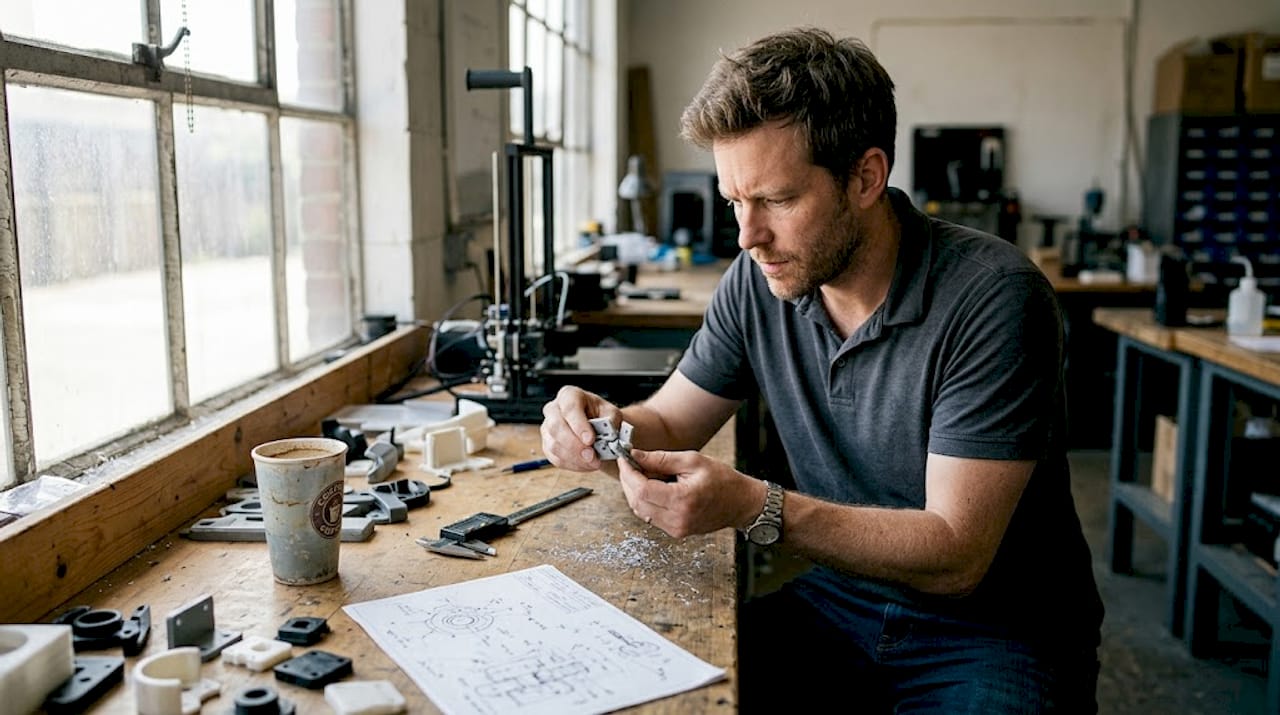
Part failure doesn’t just break a prototype. It breaks schedules, burns through budget, and erodes confidence in the entire development process. Many engineers still assume that 3D printed parts are only good for visual mockups, reserving “real” structural testing for machined or injection-molded components. That assumption costs teams time and money. Durable 3D printed parts have fundamentally changed what’s possible in functional prototyping and low-volume production. This guide breaks down why durability is central to successful product development, what actually makes a printed part durable, and how to apply that knowledge across your engineering workflow.
Table of Contents
- The cost of weak prototypes: Why durability drives development
- What makes a 3D printed part durable?
- 3D printed durability in practice: Unlocking new design freedoms
- When and why durability matters most: High-stakes applications
- A practical perspective: Stop underestimating durable 3D prints
- Discover durable 3D printing solutions for your next project
- Frequently asked questions
Key Takeaways
| Point | Details |
|---|---|
| Durability ensures success | Durable 3D printed parts speed up development and reduce costly failures. |
| Material and design matter | Choosing the right material and thoughtful design directly impacts durability and performance. |
| Complex features, real validation | Durable parts allow for complex mechanisms and repeated, realistic testing. |
| Broad application range | From rapid prototypes to functional parts, durability unlocks true value in 3D printing. |
The cost of weak prototypes: Why durability drives development
Weak prototypes don’t just fail. They mislead. When a snap fit breaks under light load, or a hinge cracks after three cycles, you’re not learning about your design. You’re learning about the limits of your material choice. That distinction matters enormously in engineering.
Consider what happens when a prototype fails mid-test. The team halts. You log a failure that may or may not reflect a real design issue. You reprint, wait, and re-run the test. In a tight development cycle, this sequence repeats enough times to push back launch dates by weeks. For startups or contract manufacturers under deadline pressure, that’s not a minor inconvenience.
Durable prototypes carry their weight across multiple test cycles. They allow teams to:
- Run repeated mechanical load tests without part replacement between cycles
- Validate snap fits, living hinges, and press fits under realistic conditions
- Compare design iterations side by side without variables introduced by part failure
- Ship samples to stakeholders or end-users for field feedback
- Generate reliable data for engineering sign-off
Understanding what 3D printers can make in terms of functional geometry is the first step toward choosing prototyping methods that actually support your testing protocol.
Here’s the part most teams overlook. Durable 3D printed parts don’t just survive more tests. They expand design freedom by enabling complex geometries, internal features, and moving mechanisms, which can deliver more engineering value than raw strength alone, as Stratasys functional prototyping guidance notes.
“The prototype that holds up through 200 test cycles tells you something real. The one that fails on cycle four tells you almost nothing useful.”
There’s a credibility dimension here too. When product development teams present durable functional prototypes to stakeholders or investors, those parts carry weight. A flimsy visual model gets polite nods. A part that clicks, flexes, seals, or rotates exactly as intended generates real confidence. Teams that prioritize designing reliable 3D prints from the start avoid the credibility gap that comes from presenting fragile early-stage models as proof of concept.
Durability isn’t a premium add-on in prototyping. It’s a prerequisite for any data you plan to trust.
What makes a 3D printed part durable?
Durability in 3D printing isn’t just about tensile strength. It’s a combination of mechanical toughness, thermal resistance, fatigue performance, and how well the part geometry supports load distribution. A part can be made from a strong material and still fail early if the design undermines it.
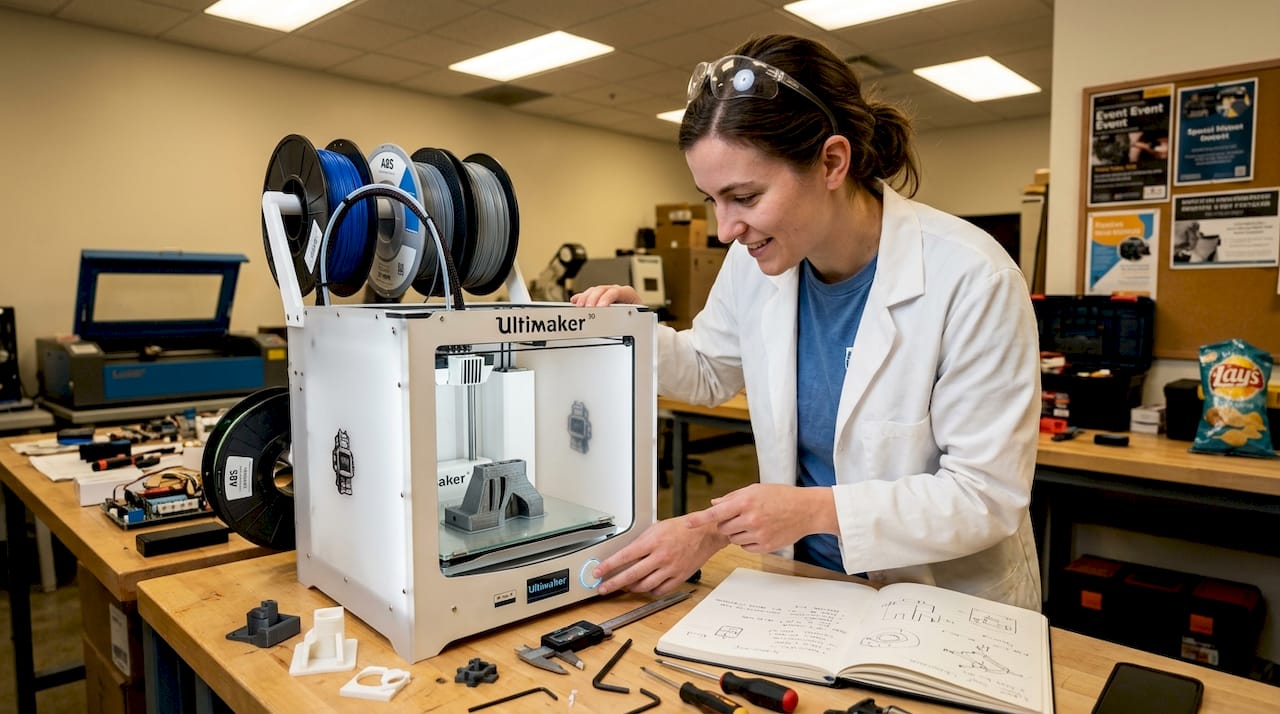
3D printing enables mechanically functional prototypes that support realistic validation, going well beyond what aesthetic models can prove. But getting there requires controlling several variables simultaneously.
Material selection is the most visible factor. Here’s how common filament-based materials compare:
| Material | Strength | Toughness | Heat resistance | Best use case |
|---|---|---|---|---|
| PLA | Moderate | Low | Low | Visual prototypes, low-stress parts |
| ABS | Good | Moderate | Moderate | Functional housings, structural parts |
| PETG | Good | High | Moderate | Snap fits, food-safe parts, enclosures |
| Nylon | High | Very high | High | Load-bearing, wear components |
| CF composites | Very high | Moderate | High | Structural, aerospace-grade parts |
For best materials for durability, PETG and Nylon consistently outperform PLA in real-world functional tests.
Design factors often matter just as much as material choice. The key variables include:
- Wall thickness: Too thin and you lose structural integrity; too thick and you introduce internal stress during cooling
- Infill pattern and density: Gyroid and honeycomb patterns distribute load more effectively than rectilinear at the same density
- Build orientation: Parts printed with load-bearing walls aligned to the Z-axis often perform differently than those oriented horizontally
- Feature geometry: Rounded interior corners reduce stress concentration points that cause crack propagation
Pro Tip: When designing for durability, orient your most critical stress surfaces perpendicular to the build plate. Layer adhesion is typically the weakest point in FDM parts, so controlling orientation controls where failure is least likely to happen.
Knowing which 3D printing type to choose for your application unlocks a much sharper set of decisions than just picking the cheapest option available.
3D printed durability in practice: Unlocking new design freedoms
Durability becomes most interesting when it stops being a constraint and starts being a capability. When your printed part can survive real use, your design space expands dramatically.
Durable 3D printed parts expand design freedom by enabling complex internal features and mechanisms, facilitating realistic validation that traditional manufacturing can’t match at prototype scale.
Here are five practical design freedoms that durable 3D printing unlocks for engineers:
- Integrated snap fit assemblies that click and unclick through hundreds of cycles, letting you validate engagement force and fatigue life before tooling
- Living hinges printed directly into the part, reducing assembly complexity and testing hinge performance in context
- Internal fluid channels that allow functional fluid routing in manifolds, housings, or medical devices without secondary machining
- Lightweight lattice structures that maintain stiffness while cutting mass, useful in aerospace and wearable applications
- Embedded feature testing where threads, inserts, and bosses are built into the same part and tested as an integrated system
Pro Tip: Use durable prints to do tolerance stack-up testing before committing to production tooling. Print your assembly at multiple tolerance offsets and test which combination gives the best fit and function. It costs a fraction of what a tooling revision does.
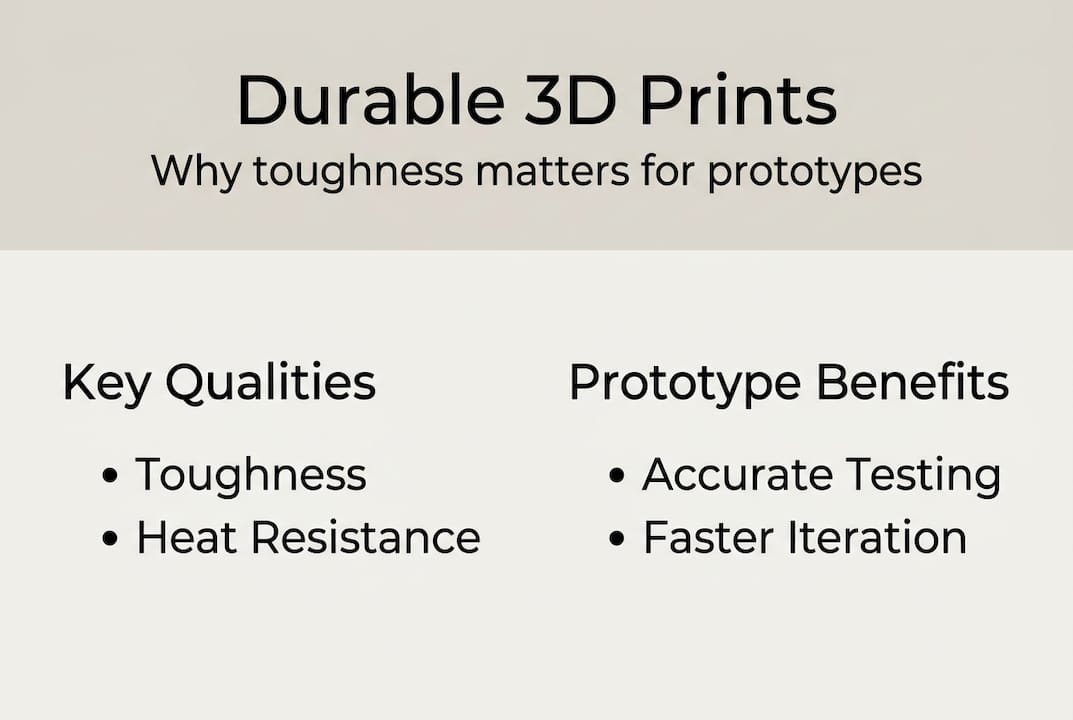
The time and cost advantage of this approach is significant. Consider a simplified comparison:
| Scenario | Traditional CNC prototype | Durable 3D printed part |
|---|---|---|
| Lead time | 2 to 4 weeks | 1 to 3 days |
| Design iteration cost | High (each change = new setup) | Low (file update + reprint) |
| Complex geometry | Limited by tooling access | No restriction |
| Functional testing readiness | Immediate after machining | Immediate after print |
Browsing real-world filament prototype examples shows how these advantages play out across industries, from consumer electronics enclosures to industrial jigs.
If you’re evaluating whether 3D printing can handle your next project, exploring custom prototype options early in the scoping phase avoids rework later.
When and why durability matters most: High-stakes applications
Not every prototype needs to be engineered for maximum durability. But when it matters, it really matters. These are the scenarios where part failure carries serious consequences.
Durable 3D printed parts support fully functional prototypes that reduce risk before committing to expensive production tooling. That risk mitigation is especially critical in:
- Jigs and fixtures: These parts are used repeatedly on the production floor. A jig that breaks after 20 uses creates quality control gaps and line stoppages.
- Medical device prototypes: Regulatory submissions often require proof of functional performance. Fragile parts can’t generate that evidence.
- Aerospace spare and support parts: Weight matters. Durability matters. These requirements have to coexist.
- Automotive fit-and-function testing: Clearances, assembly sequences, and part interactions are validated at this stage. A broken test piece delays the entire validation protocol.
- Field-use replacement parts: When the original component is discontinued, a durable 3D printed replacement needs to perform, not just look right.
“Every week spent reprinting a failed jig is a week the production line is working around a problem that should already be solved.”
For teams navigating limited production quantities, tips for low-volume manufacturing provide a practical framework for matching durability requirements to production strategy.
The pattern across all these applications is the same. Durable parts create reliable data. Reliable data creates confident decisions. And confident decisions reduce the cost and risk of moving from prototype to production.
A practical perspective: Stop underestimating durable 3D prints
Here’s what the data doesn’t fully capture. Many engineering teams still treat 3D printing as a visual communication tool. They print a model to show management, not to test mechanics. That habit is expensive, and it’s rooted in outdated assumptions about what printed parts can handle.
The teams getting the most value from 3D printing today are evaluating durability at the project scoping stage, before the first file is sent to print. They’re asking which mechanisms need to survive how many cycles, what load conditions apply, and what material properties are actually required. That thinking shapes every decision downstream.
The uncomfortable truth is that teams who focus only on cheap, fast visual prototypes often discover their design flaws at the worst possible time, during final validation or, worse, after tooling has been cut. Switching to durable functional prototypes earlier in the process catches those flaws when changes are still cheap.
For a sharper understanding of how this fits into the broader development cycle, rapid prototyping insights provide a solid foundation for rethinking your prototyping strategy from the ground up.
Discover durable 3D printing solutions for your next project
If this article has shifted how you think about durability in your prototyping workflow, the next step is putting that thinking into practice.
At CC 3D Labs, we specialize in custom filament-based 3D printing for engineers and product developers who need parts that actually perform. From single functional prototypes to small batch production runs, our professional 3D printing services are built around accuracy, material expertise, and fast turnaround. Explore on-demand prototype printing to get an estimate on your next part, or sharpen your technical vocabulary with our 3D printing terminology guide before your next project kickoff.
Frequently asked questions
What defines a ‘durable’ 3D printed part?
A durable 3D printed part can withstand mechanical stress, repeated use, and real-world conditions without failing. Functional validation with active mechanisms and stress points is the real test of durability, not just static load capacity.
How does durability impact prototype testing?
Increased durability allows for repeated, realistic testing cycles and accelerates design iteration. Mechanical testing and validation of complex features become far more reliable when the part itself isn’t the variable that fails.
Which 3D printing materials are most durable?
ABS, PETG, Nylon, and engineering composites are leading choices for mechanical durability. Material choice directly dictates functional performance and the mechanical properties your part can deliver under load.
Are durable 3D prints only for industrial applications?
No. Durable parts are valuable for real-world applications beyond visual prototypes, including custom end-use parts, low-volume manufacturing, field repairs, and consumer product development across many sectors.