

TL;DR:
- Proper filament selection and print parameter tuning are critical for functional prototype performance.
- Continuous fiber composites significantly enhance strength but require specialized equipment.
- Optimized settings for PLA variants yield stronger, more ductile, and application-specific prototypes.
Picking the right filament-based prototype for a functional part is harder than it looks. The wrong material or a poorly tuned print setup can mean a prototype that looks fine on the surface but fails under real load conditions. With so many filament options and FDM process variables in play, product developers and small manufacturing teams need more than gut instinct. They need evidence-backed comparisons. This article breaks down four real-world prototype examples, from continuous fiber composites to medical-grade PLA parts, with the specs, print settings, and performance data you need to make a confident decision.
Table of Contents
- Criteria for selecting filament-based prototypes
- Continuous fiber reinforced PLA/glass fiber prototypes
- Optimized PLA PRO1 prototype parts
- PLA-CF composite prototypes for structural applications
- Medical and engineering prototypes: PLA acetabular liners
- Our perspective: Rethinking how to choose filament-based prototypes
- Get high-quality filament-based prototypes from CC 3D Labs
- Frequently asked questions
Key Takeaways
| Point | Details |
|---|---|
| Material optimization matters | Fine-tuning FDM parameters and material choice directly affects prototype durability and performance. |
| High-strength examples | Continuous fiber PLA/glass fiber prototypes deliver industry-leading mechanical strengths for demanding applications. |
| Functional versatility | PLA PRO1 and PLA-CF composites enable fit-testing, small-batch manufacturing, and structural prototyping with tailored print settings. |
| Medical-grade potential | FDM-printed PLA parts, such as acetabular liners, meet load and quality requirements for medical and engineering uses. |
Criteria for selecting filament-based prototypes
Before you pick a filament, you need a clear framework. Not every prototype has the same job, and the criteria that matter for a structural bracket are very different from those for a medical implant analog or a fit-test housing.
Mechanical strength is usually the first filter. You want to know a material’s tensile strength (how much pulling force it can handle before breaking), flexural strength (resistance to bending), and load-bearing capacity under static or dynamic stress. These numbers directly predict whether a prototype will survive real-world testing.
Application-specific requirements come next. Functional prototypes used in product validation need different properties than structural components or medical device analogs. A jig for an assembly line needs rigidity and repeatability. A surgical guide needs dimensional accuracy and biocompatibility. Knowing your application narrows the field fast.
FDM process parameters are often underestimated. The same material can produce dramatically different results depending on how you print it. The key variables include:
- Extruder temperature (typically 190 to 230°C depending on material)
- Bed temperature (affects adhesion and warping)
- Print speed (slower usually means better layer bonding)
- Infill percentage (higher infill increases density and load capacity)
- Raster orientation (the angle of each layer relative to the load direction)
Optimized FDM parameters maximize tensile strength and deliver superior mechanical properties for functional prototypes. That finding reinforces something we see constantly: process tuning is not optional if you want reliable results.
Print quality metrics like porosity, surface finish, and ductility also matter. High porosity weakens a part internally even when the outer surface looks clean. Ductility determines whether a part bends before it breaks, which is critical for parts under cyclic or impact loads.
When choosing filament types, always map your mechanical requirements to both material properties and print settings together. One without the other leaves performance on the table.
Pro Tip: Before ordering a prototype run, define your minimum acceptable tensile strength and surface finish tolerance. These two numbers alone will eliminate most material mismatches before you spend a dollar.
Continuous fiber reinforced PLA/glass fiber prototypes
If your prototype needs to handle serious mechanical stress, continuous fiber reinforced PLA/glass fiber filaments are worth a close look. These are not standard PLA parts with a little filler mixed in. They are engineered composites where continuous glass fiber strands run through the printed part, dramatically changing how it behaves under load.
The performance numbers back this up. Tensile strength of 146.75 MPa and a Young’s modulus of 4.95 GPa have been achieved using a custom FDM setup at just 2.8% fiber volume. For context, standard PLA typically tops out around 50 to 65 MPa tensile strength. That is more than double the performance from a filament that is still fundamentally printable on an FDM machine.
“Continuous fiber reinforced PLA/glass fiber filaments produced via custom FDM setup achieve tensile strength of 146.75 MPa and Young’s modulus of 4.95 GPa at 2.8% fiber volume.”
This makes these composites ideal for rapid prototyping applications in demanding industries. Common use cases include:
- Automotive: Brackets, clips, and structural housings that need to survive vibration and thermal cycling
- Aerospace: Lightweight structural analogs for fit and form validation
- Medical devices: Rigid components that need to hold precise geometry under load
The trade-off is real, though. Printing continuous fiber composites requires a specialized FDM setup. Standard desktop printers cannot handle the fiber feed system. The material cost is also higher than commodity PLA. For small teams, this means either investing in the right equipment or partnering with a service provider that already has it.
The rigidity of these parts is a key advantage. A high Young’s modulus means the part resists deformation under stress, which is exactly what you want when a prototype needs to behave like the final production part during testing.
Optimized PLA PRO1 prototype parts
Not every prototype needs continuous fiber reinforcement. For functional housings, fit-test parts, and small-batch production components, PLA PRO1 printed with optimized FDM parameters delivers excellent results at a much lower cost and complexity.
PLA PRO1 is a modified PLA formulation designed for better toughness and layer adhesion compared to standard PLA. The key is dialing in the right process settings. Here is what the research supports:
- Extruder temperature: 200 to 220°C
- Bed temperature: 40 to 60°C
- Print speed: 50 to 60 mm/s
- Infill percentage: 30 to 70% depending on load requirements
- Layer height: 0.1 to 0.2 mm for a balance of speed and surface quality
Higher infill yields ductile fracture and superior mechanical properties in PLA PRO1 parts. This is a meaningful finding. Ductile fracture means the part deforms visibly before it breaks, giving you a warning rather than a sudden catastrophic failure. For functional prototypes under test loads, that behavior is far safer and more informative.
“Optimized FDM parameters for Ultrafuse PLA PRO1 maximize tensile strength, with higher infill yielding ductile fracture and superior mechanical properties.”
Practical applications for optimized PLA PRO1 prototypes include enclosures for electronics, snap-fit assemblies, ergonomic test parts, and low-volume production housings. The material is forgiving enough for iterative design cycles but strong enough for real functional validation.
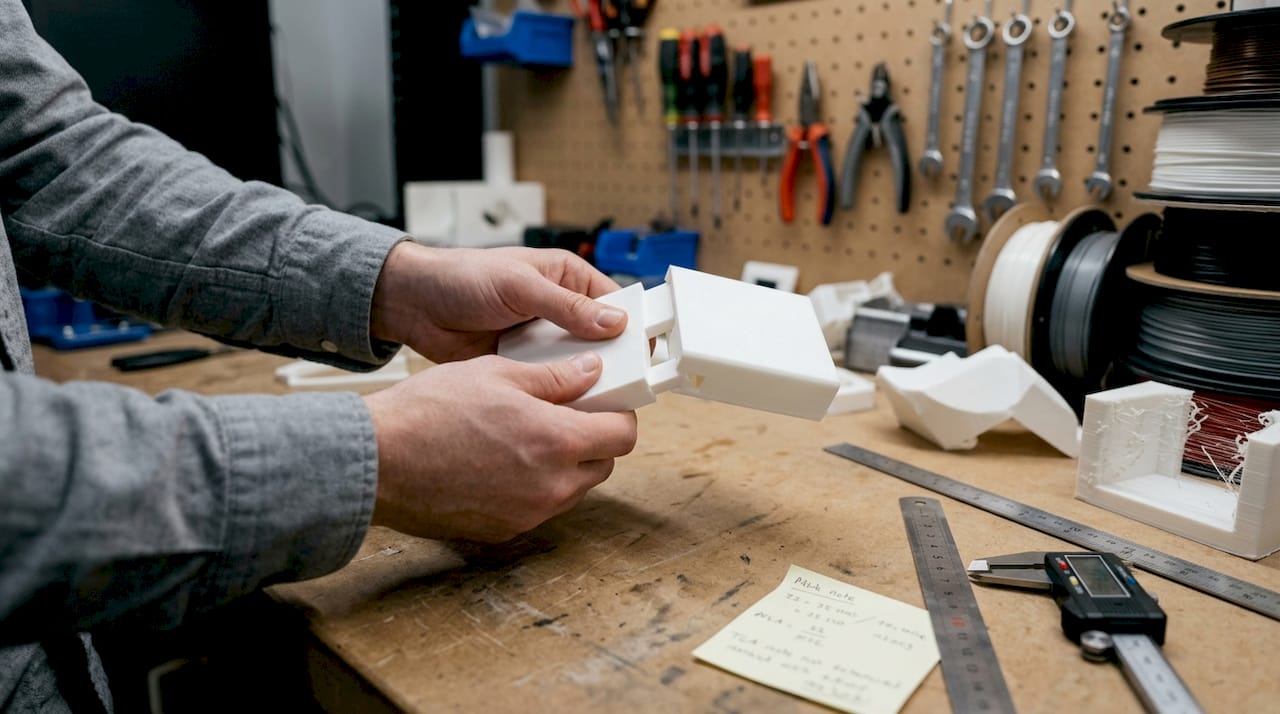
Our filament printing guide covers how to set up your files for the best results, and if you want to understand how to structure your print job optimization for a specific application, that resource walks through the decision points clearly.
Pro Tip: Run a small test matrix before committing to a full prototype batch. Print three samples at 30%, 50%, and 70% infill and do a simple bend test. The difference in ductility is immediately visible and will guide your final setting choice.
PLA-CF composite prototypes for structural applications
PLA-CF composites, meaning PLA reinforced with short chopped carbon fiber, sit between standard PLA and continuous fiber composites in terms of performance and complexity. They are printable on modified FDM machines without a full fiber-feed system, yet they deliver significantly better stiffness and flexural strength than plain PLA.
The numbers are compelling. PLA-CF composites achieve 81 MPa flexural strength when optimized using Taguchi methods, with raster orientation and layer thickness identified as the most influential variables. That flexural strength makes these parts well-suited for jigs, brackets, and load-bearing structural prototypes.
The optimal settings for maximum flexural performance are:
- Raster orientation: 0 degrees (aligned with the primary load direction)
- Layer thickness: 0.1 mm
- Nozzle temperature: 210°C
- Print speed: 30 mm/s
Here is a quick comparison of PLA-CF versus PLA PRO1 for structural prototype applications:
| Property | PLA PRO1 (optimized) | PLA-CF (optimized) |
|---|---|---|
| Primary strength metric | Tensile (ductile) | Flexural (rigid) |
| Best application | Functional housings, fit parts | Jigs, brackets, structural parts |
| Print complexity | Standard FDM | Modified FDM (hardened nozzle) |
| Surface finish | Smooth | Slightly textured |
| Cost per part | Lower | Moderate |
For teams working on assembly fixtures, tooling aids, or parts that must resist bending loads without deflecting, PLA-CF is the stronger choice. The workflow optimization required for carbon fiber filaments, particularly using a hardened steel nozzle, is a one-time setup cost that pays off across many print runs.
Medical and engineering prototypes: PLA acetabular liners
FDM-printed PLA acetabular liners represent one of the most demanding prototype applications in this comparison. An acetabular liner is the cup-shaped component in a hip replacement that sits between the femoral head and the pelvis. Printing a functional analog of this part requires both dimensional precision and meaningful mechanical performance.
The results from optimized FDM settings are striking. PLA acetabular liners reach 51 MPa UTS and a Young’s modulus of 3400 MPa, supporting loads equivalent to a 90 kg patient with reduced porosity. These are not cosmetic models. They are functional engineering prototypes.
The print settings that achieve these results:
| Parameter | Setting |
|---|---|
| Nozzle temperature | 210°C |
| Print speed | 30 mm/s |
| Layer thickness | 0.1 mm |
| Raster orientation | 0 degrees |
Key performance outcomes from this setup:
- UTS: 51 MPa
- Young’s modulus: 3400 MPa
- Load capacity: 90 kg static load
- Porosity: Significantly reduced compared to non-optimized prints
The overlap with PLA-CF settings is not a coincidence. Slow print speeds, thin layers, and aligned raster orientation consistently produce denser, stronger parts across multiple materials. Understanding the 3D printing terminology behind these parameters helps you communicate clearly with your print service provider and get consistent results. For a broader view of how these settings apply across materials, the prototype guide is a useful reference.
Our perspective: Rethinking how to choose filament-based prototypes
Here is something most product teams get wrong: they treat material selection as the primary decision and process settings as an afterthought. The evidence in this article tells a different story. The same PLA material printed at different infill levels, temperatures, or raster orientations produces parts that behave like entirely different materials under load.
Small teams have a real advantage here. You can iterate faster, test more parameter combinations, and apply prototyping insights directly to your specific application without the bureaucratic overhead of a large organization. The teams that win are not the ones with the most expensive filament. They are the ones that treat FDM settings as an engineering variable, not a default checkbox.
Our recommendation: document your process settings for every prototype run. When a part performs well, you need to know exactly why so you can reproduce it. When it fails, the same documentation tells you where to adjust.
Get high-quality filament-based prototypes from CC 3D Labs
Applying these insights to your next prototype run requires more than a good article. It requires the right equipment, calibrated processes, and someone who has already worked through the parameter optimization for the materials that matter to your project.
At CC 3D Labs, we bring that experience directly to your parts. Our 3D printing services cover the full range of filament-based prototypes discussed here, with process expertise tailored to functional and structural applications. Not sure what your design can handle? Explore what can be printed on our platform, or go straight to printing on demand for a fast, flexible path from CAD file to finished prototype. We serve product developers and small manufacturing teams locally near Philadelphia and ship nationally.
Frequently asked questions
What are the mechanical strengths of continuous fiber PLA/glass fiber prototypes?
They can achieve a tensile strength of 146.75 MPa and a Young’s modulus of 4.95 GPa at 2.8% fiber volume, making them suitable for high-performance automotive, aerospace, and medical applications.
Which print settings optimize PLA PRO1 prototype performance?
Use extruder temperatures of 200 to 220°C, bed temperatures of 40 to 60°C, speeds of 50 to 60 mm/s, and infill between 30 to 70% for best tensile strength and ductile fracture behavior.
How do PLA-CF composites compare in flexural strength?
PLA-CF composites achieve up to 81 MPa flexural strength with optimized raster orientation and 0.1 mm layer thickness, outperforming standard PLA in bending-critical structural applications.
Can FDM-printed PLA prototypes be used in medical applications?
Yes. PLA acetabular liners printed with optimal FDM settings support 90 kg loads with a UTS of 51 MPa and a Young’s modulus of 3400 MPa, demonstrating real functional potential for medical device prototyping.
Recommended
- Filament 3D printing: Guide for prototyping success
- Choose the right 3D printing type for prototypes & production
- What can a 3D printer make? Prototypes to functional parts
- Find the best 3D print job for custom prototypes & parts
- Lasermodell Entwicklung Guide: Prototypen effizient realisieren – Laserdienstleistungen