
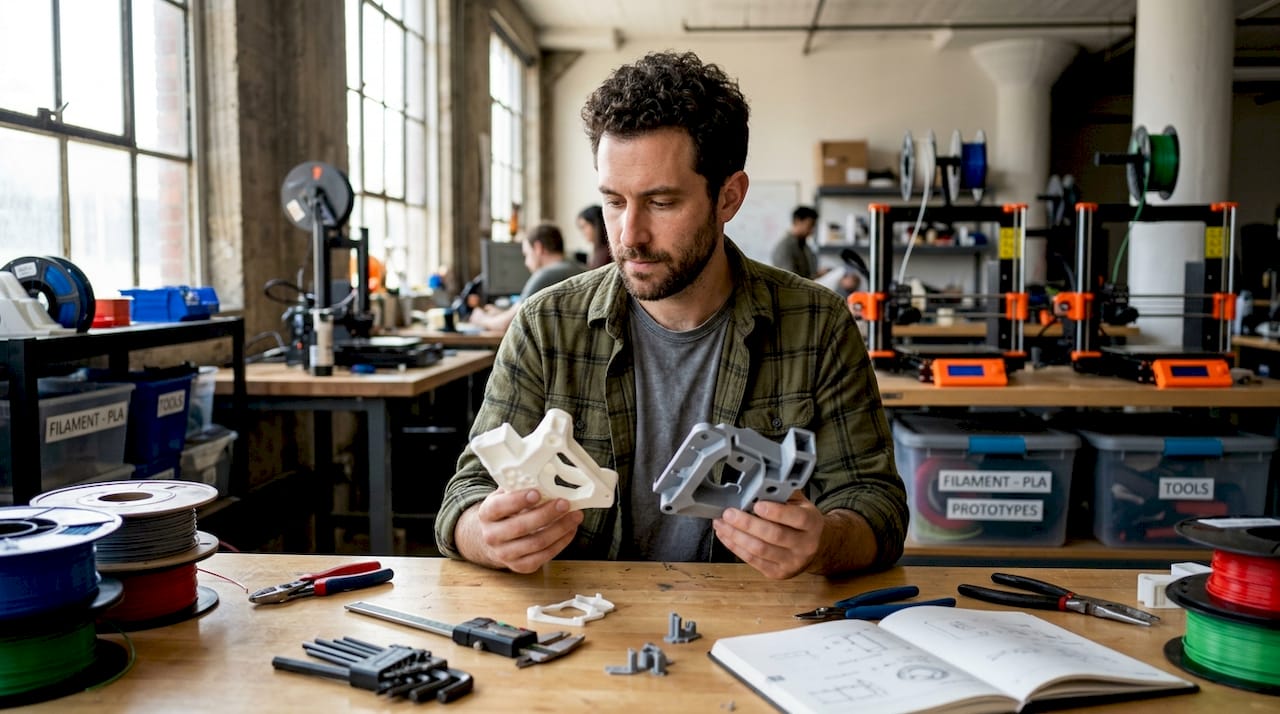
TL;DR:
- Selecting the appropriate 3D printing process based on project needs is crucial to avoid costly rework.
- FDM is cost-effective for prototypes and fixtures but has limitations in accuracy and strength direction.
- Resin-based methods like SLA/DLP excel in surface finish and detail, suitable for visual prototypes and casting masters.
Choosing the wrong 3D printing process can cost you weeks of rework and thousands in wasted material. For product developers moving from concept sketches to functional prototypes and into low to mid-volume production, the stakes are real. FDM, SLA, SLS, MJF, DMLS — each process delivers a different combination of accuracy, surface finish, material strength, and cost per part. Pick the wrong one and your prototype won’t test what you need it to test. This guide breaks down every major printing type, the technical benchmarks that separate them, and a clear framework for matching process to project goals.
Table of Contents
- How to evaluate 3D printing types: Key criteria
- Extrusion-based printing (FDM/FFF): Workhorse for prototypes and jigs
- Photopolymerization (SLA/DLP): Precision and surface detail
- Powder bed fusion (SLS, MJF, DMLS/SLM): From functional polymers to metal parts
- Quick reference comparison: Picking the right 3D printing process
- Our take: Why context matters more than specs in 3D printing selection
- Get expert 3D printing for your next project
- Frequently asked questions
Key Takeaways
| Point | Details |
|---|---|
| Selection framework | Match print process to function, tolerance, strength, and finish for best results. |
| FDM for prototypes | FDM/FFF offers the lowest cost and largest build volumes for design validation and jigs. |
| SLA/DLP for detail | SLA and DLP provide the finest accuracy and smoothest surface for visual prototypes. |
| Powder bed for function | SLS/MJF excel in functional nylon parts and DMLS/SLM leads for metal. |
| Comparison tools | Use quick-reference tables to compare tolerances, properties, and applications for each 3D printing type. |
How to evaluate 3D printing types: Key criteria
Before comparing technologies, you need a structured way to filter them. The right process depends on a combination of factors, and skipping this step leads to expensive mismatches between what the print can deliver and what your part actually needs.
Here are the core criteria to assess before selecting a process:
- Intended function: Is this a visual mock-up, a fit/form check, a functional stress test, or an end-use production part?
- Mechanical properties: Tensile strength, flexural modulus, impact resistance, and isotropy all vary significantly by process.
- Surface finish: Measured in Ra (roughness average), finish affects aesthetics, sealing, and post-processing requirements.
- Dimensional tolerance: Critical for mating parts, press fits, and precision assemblies.
- Part size: Build envelope limits differ widely — FDM machines can print large enclosures; resin printers are typically smaller.
- Material options: Engineering polymers, flexible TPU, high-temp resins, metal alloys — process determines what’s available.
- Budget and volume: Cost per part drops with some processes at volume; others stay flat.
A useful way to think about this: tolerance requirements alone can cut your list in half. Types of 3D printing for prototypes and production show that SLA achieves ±0.05mm, SLS and MJF land around ±0.2–0.25mm, and FDM typically runs ±0.5mm. If your part has tight mating tolerances, FDM is off the table immediately.
Anisotropy — the directional difference in mechanical strength — is another filter most teams miss early. Parts printed in FDM are significantly weaker in the Z direction. SLS and MJF are near-isotropic, meaning strength is consistent regardless of build orientation. Understanding this upfront shapes not just process selection but also part orientation strategy.
Post-processing needs matter too. Sanding, priming, dyeing, and support removal all add time and cost. Knowing how to pick the right process before you send a file saves iterations. For early-stage teams, a solid quick prototyping guide can clarify how process selection ties directly to development speed.
Extrusion-based printing (FDM/FFF): Workhorse for prototypes and jigs
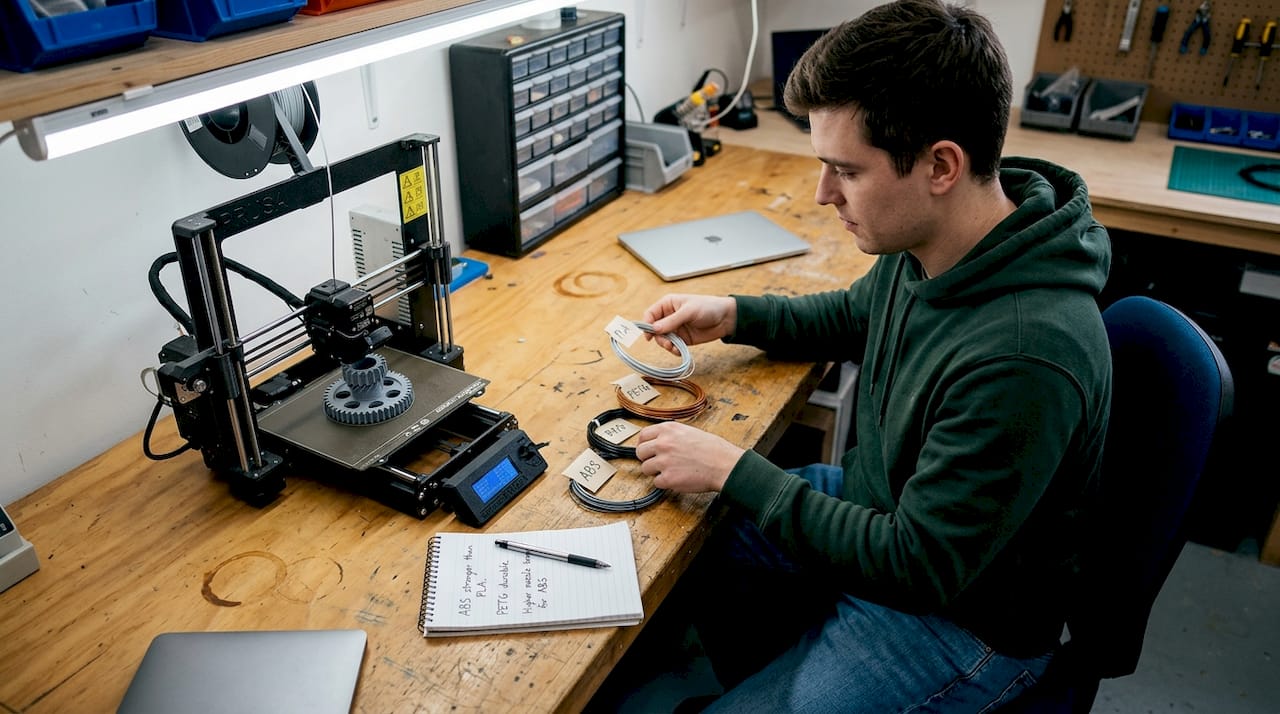
FDM (Fused Deposition Modeling) and its open-source counterpart FFF (Fused Filament Fabrication) work by melting a thermoplastic filament and depositing it layer by layer. The process is straightforward, scalable, and compatible with a wide range of engineering-grade materials including PLA, PETG, ABS, ASA, Nylon, TPU, and high-temp options like PEEK.
Strengths of FDM for engineering applications:
- Lowest cost per part among all major processes
- Widest range of build volumes — some industrial FDM machines exceed 1,000mm in a single axis
- Broad material library with well-documented mechanical properties
- Fastest turnaround for large, low-detail parts
Limitations to plan around:
- Visible layer lines require sanding or coating for smooth surfaces
- Z-axis weakness due to layer adhesion — parts can delaminate under load
- Tolerances of ±0.5mm limit use in precision assemblies
FDM is the cost-effective choice for jigs, fixtures, enclosures, and early-stage prototypes where geometry validation matters more than surface quality. The FDM process mechanics — including temperature control, support structures, and layer adhesion — are well understood, which makes troubleshooting predictable.
“FDM gives development teams the fastest path from CAD to physical object at a price point that supports multiple design iterations without budget pressure.”
Pro Tip: Reorienting a part 45 degrees and adjusting infill pattern can boost effective tensile strength by up to 20% without changing material or process. This is one of the most underused levers in FDM design.
For teams choosing between materials, understanding the tradeoffs between FDM materials like PLA, PETG, and ABS directly affects whether the prototype survives functional testing or fails at the first load cycle.
Photopolymerization (SLA/DLP): Precision and surface detail
SLA (Stereolithography) uses a UV laser to cure liquid resin point by point, while DLP (Digital Light Processing) flashes an entire layer at once using a projector. Both produce parts with exceptional surface quality, but the mechanics create meaningful differences in speed and accuracy.
Key advantages of resin-based printing:
- Surface finish as low as Ra 1–3µm — the smoothest of any common 3D printing process
- SLA achieves ±0.05mm tolerance, DLP typically ±0.10mm
- Excellent for fine features, thin walls, and complex organic geometry
- Ideal for casting masters, dental models, and visual presentation prototypes
Where resin processes fall short:
- Most standard resins are brittle and not suited for load-bearing applications
- UV exposure over time degrades mechanical properties — outdoor use is limited
- Build volumes are smaller than FDM, limiting large-part applications
- Post-curing is required, which adds time and affects final properties
A 2025 flexural study found SLA flexural strength at 93MPa, outperforming DLP at 70MPa — a meaningful gap when you’re validating parts that need to flex under load. DLP’s speed advantage makes it attractive for batch runs of small, detailed parts where per-layer cure time is the bottleneck.
Pro Tip: Post-curing under controlled UV exposure increases hardness and flexural strength, but over-curing increases brittleness. Run a calibration cure test on sample parts before committing to a full batch.
For teams who need to communicate surface finish definitions to clients or manufacturing partners, understanding Ra values and how they map to process output prevents misaligned expectations at review.
Powder bed fusion (SLS, MJF, DMLS/SLM): From functional polymers to metal parts
Powder bed fusion covers a family of processes that fuse material layer by layer from a powder bed. No support structures are needed for polymers — the surrounding powder acts as support — which enables highly complex geometries that other processes can’t achieve.
SLS (Selective Laser Sintering) uses a CO2 laser to sinter nylon powder. It produces parts with ±0.25mm tolerance and tensile strength around 48MPa for PA12. Parts are durable, chemically resistant, and suitable for functional testing and low-volume production runs.
MJF (Multi Jet Fusion) uses inkjet-deposited fusing agents activated by infrared energy. It’s faster than SLS, produces denser parts, and achieves near-isotropic mechanical properties — meaning orientation during printing has minimal effect on strength. This matters enormously for end-use parts.
DMLS/SLM uses a fiber laser to fuse metal powder — titanium alloys, stainless steel, Inconel, aluminum. Parts reach >99.5% density with tolerances of ±0.10mm, making them viable for aerospace, medical, and industrial end-use applications.
Powder bed processes offer the best combination of geometric freedom and mechanical isotropy for functional polymer and metal parts — a combination no other process family can match at this scale.
| Process | Tolerance | Key material | Relative cost | Best use case |
|---|---|---|---|---|
| SLS | ±0.25mm | PA12 Nylon | Medium | Functional prototypes, low-run production |
| MJF | ±0.20mm | PA12, PA11 | Medium-high | End-use parts, near-isotropic loads |
| DMLS/SLM | ±0.10mm | Ti6Al4V, steel | High | Metal qualification, aerospace, medical |
For teams working on functional polymer and metal prints, SLS and MJF are often the bridge between prototype validation and production-ready components. The SLS and MJF mechanics — including powder management, thermal stress, and post-processing — require more process knowledge than FDM but reward that investment with significantly better part performance.
Quick reference comparison: Picking the right 3D printing process
With all four major process families covered, here’s a consolidated view for engineering teams making a final call.
| Process | Tolerance | Surface finish | Cost tier | Production fit |
|---|---|---|---|---|
| FDM | ±0.5mm | Moderate (Ra 10–20µm) | Low | Prototypes, jigs, fixtures |
| SLA | ±0.05mm | Excellent (Ra 1–3µm) | Medium | Visual prototypes, casting masters |
| DLP | ±0.10mm | Excellent (Ra 1–3µm) | Medium | Detailed small parts, dental |
| SLS/MJF | ±0.20–0.25mm | Good (Ra 6–10µm) | Medium-high | Functional parts, low-volume runs |
| DMLS/SLM | ±0.10mm | Good (Ra 4–10µm) | High | Metal end-use, qualification parts |
Based on tolerance and cost benchmarks across processes, here are scenario-based recommendations:
- Visual prototype for stakeholder review: Use SLA or DLP. Surface quality and accuracy make the part presentation-ready without secondary finishing.
- Fit and form check on an assembly: FDM is fast and cheap enough to iterate. If tolerance is critical, step up to SLA.
- Functional part for stress or environmental testing: SLS or MJF. Near-isotropic nylon parts survive real-world loads and chemicals.
- Metal part qualification for production: DMLS/SLM. The density and tolerance match machined metal for most non-critical applications.
- Special cases: Binder Jetting works well for full-color models and metal sintering at lower cost than DMLS. PolyJet handles multi-material and overmold simulations. Both are worth considering when standard processes don’t fit.
Exploring real-world 3D printing applications across industries shows how these process choices play out in practice. For teams ready to act, reviewing on-demand project examples gives a concrete sense of what each process delivers at production scale.
Our take: Why context matters more than specs in 3D printing selection
Datasheets are a starting point, not a decision. We’ve seen engineers spend weeks comparing tolerance specs between SLS and MJF for a prototype that only needed to survive two weeks of fit testing. The 0.05mm difference was irrelevant. What mattered was turnaround time and cost per iteration.
The limitations people worry about most — anisotropy in FDM, brittleness in SLA resins — are often manageable with smart design choices. Anisotropy becomes an advantage when you orient a part so the load direction aligns with the strongest axis. Resin brittleness stops being a problem when the part is a casting master, not a structural component.
Our honest advice: run a test iteration before committing to a process for a full batch. A single test print reveals more than any datasheet. And revisit process selection as your design matures. What works for a first-round prototype often isn’t the right call for a 500-unit production run. Focus on fit-for-purpose, and let the design evolution guide the process evolution. For teams navigating that transition, working through bespoke 3D print jobs with experienced partners accelerates that learning significantly.
Get expert 3D printing for your next project
At CC 3D Labs, we work with product developers and engineers across every stage of the product lifecycle — from first-round prototypes to low and mid-volume production runs. Whether you need FDM for rapid iteration, SLA for presentation-quality parts, or specialty materials for functional testing, we match the process to your actual requirements, not just the closest available option.
We handle custom material requests, multi-color printing, and CAD support for teams that need more than a file upload and a quote. If you’re unsure which process fits your current project, explore our 3D printing services or browse what parts are printable for your application. Ready to move? Submit your file and project details through our on-demand custom projects page for a fast, accurate estimate.
Frequently asked questions
Which 3D printing type delivers the strongest mechanical properties for end-use parts?
SLS and MJF produce near-isotropic nylon parts that approach injection-molded strength, while DMLS/SLM yields metal components with greater than 99.5% density for demanding structural applications.
What are the main limitations of FDM versus SLS or SLA?
FDM is weaker along the Z axis and shows visible layer lines, while SLS offers better isotropy and SLA provides the best surface finish but lower load-bearing capacity. Each process has tradeoffs that make it better suited for specific applications.
How do I choose the best 3D printing type for visual prototypes?
SLA delivers the finest detail and smoothest surface finish for visual prototypes, making it the top choice when appearance and dimensional accuracy are the primary goals.
Are 3D printed materials suitable for outdoor or high-temperature use?
Engineering polymers like PEEK and metals like Ti6Al4V handle high temperatures reliably, but SLA resins degrade under prolonged UV exposure and are not recommended for outdoor applications without protective coating.
Can powder bed fusion create both polymer and metal parts?
Yes. SLS and MJF process nylon and other polymer powders for durable functional parts, while DMLS and SLM fuse metal powders to produce dense, high-strength metal components.