

Sourcing a reliable custom 3D print job sounds straightforward until you’re staring at a dozen providers, each promising fast turnaround and flawless quality. For product developers and businesses, the wrong choice means delayed launches, wasted budgets, and parts that fail in the field. The good news is that a clear, structured approach to evaluating providers cuts through the noise fast. This guide walks you through the exact criteria, options, and quality checks you need to confidently place your next order and get parts that actually perform.
Table of Contents
- Key criteria for selecting a 3D print job
- Popular options for custom 3D print jobs
- Comparison of major 3D print job options
- Ensuring quality for your 3D print job
- Making the right decision for your next 3D print job
- Where to find top custom 3D print jobs and services
- Frequently asked questions
Key Takeaways
| Point | Details |
|---|---|
| Selection matters | Choosing the right 3D print job provider ensures speed, quality, and cost-effectiveness. |
| Option diversity | Service bureaus, specialty providers, and online platforms offer varied strengths for custom projects. |
| Quality assurance | Request portfolios and verify protocols to guarantee the final product meets specifications. |
| Decision checklist | Match criteria and provider strengths to your unique project needs for best outcomes. |
Key criteria for selecting a 3D print job
Before you request a single quote, you need a firm grip on what your job actually demands. Not every provider is built for every application, and mismatching your requirements to a provider’s capabilities is the most common and costly mistake in custom manufacturing.
Rapid prototyping is increasingly central to modern product development cycles, which means the pressure to find the right provider quickly is real. Here are the core criteria to evaluate before committing:
- Material compatibility: Does the provider stock the specific filament or engineering-grade composite your part requires? ABS, PETG, nylon, and TPU all behave differently under load.
- Turnaround time: From quote approval to finished part in hand. Some jobs need 48 hours; others can tolerate a week.
- Dimensional accuracy and tolerances: What is the provider’s stated tolerance range? For functional parts, this is non-negotiable.
- Quality assurance process: Do they inspect parts before shipping, or is it print-and-ship?
- Portfolio and technical expertise: Has the provider handled jobs similar to yours in complexity, material, or volume?
- Cost structure: Per-part pricing, batch discounts, and setup fees all affect your total cost.
Pro Tip: Always ask a potential provider for a sample print of a geometry similar to your part before placing a full order. A small upfront investment in a test print saves significant rework costs later.
Popular options for custom 3D print jobs
Once you know what your job requires, the next step is understanding where to source it. The market has expanded significantly, and each type of provider comes with real trade-offs.
Local specialty shops offer direct communication, faster iteration cycles, and the ability to inspect parts in person before accepting delivery. For businesses near a capable provider, this is often the fastest path from design file to finished part.
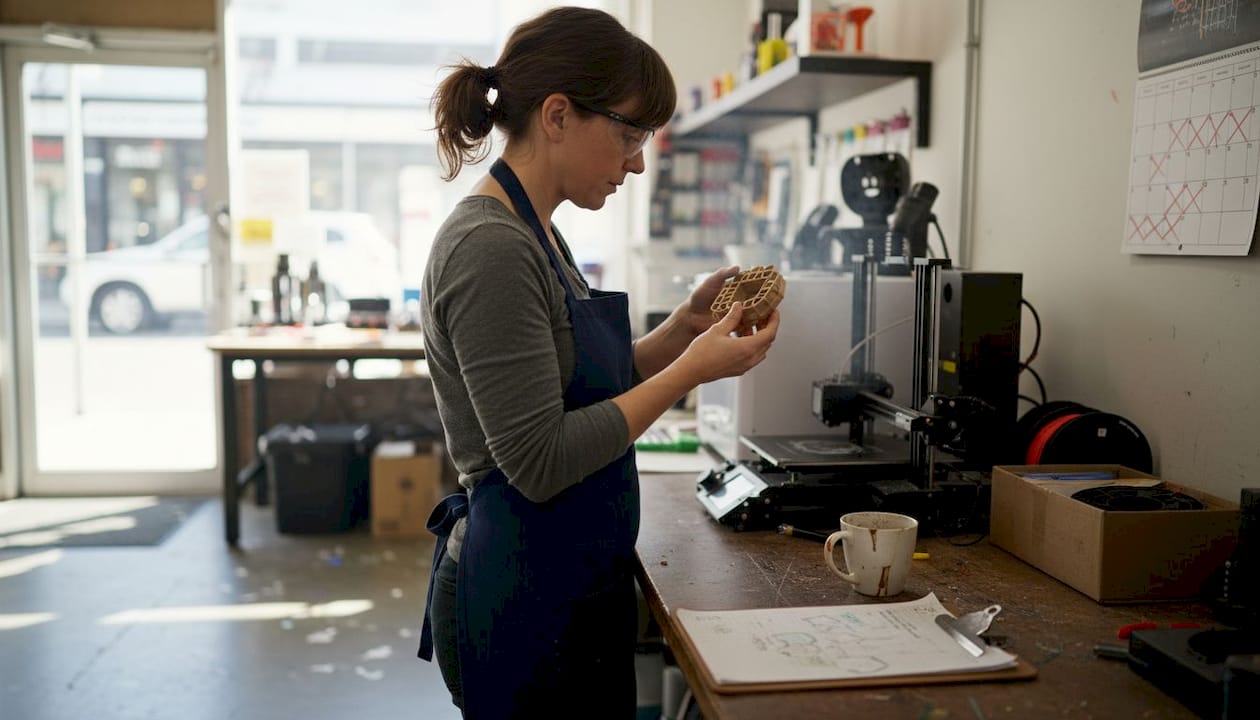
National service bureaus operate at scale, which means broader material libraries and competitive pricing on larger batches. The trade-off is less personalized support and longer communication chains when revisions are needed.
Online marketplaces and platforms connect you with a network of independent printers. They work well for simple, low-stakes jobs but can be inconsistent for precision engineering applications.
Specialty engineering shops are the right call when your part needs tight tolerances, specific certifications, or materials that general providers don’t stock. On-demand 3D printing services within this category offer the flexibility to source complex prototypes on tight timelines without sacrificing accuracy.
- Local shops: Best for fast iteration and hands-on communication
- National bureaus: Best for volume pricing and broad material access
- Online platforms: Best for simple, low-complexity jobs
- Specialty shops: Best for functional parts, prototypes and repair parts, and engineering-grade applications
Pro Tip: If your project involves multiple design iterations, a local or specialty provider with direct design support will save you far more time than a cheaper online platform that requires you to manage all revisions yourself.
Comparison of major 3D print job options
Side-by-side comparisons make trade-offs obvious. Use this table to quickly map your job requirements to the right provider type.
| Provider type | Speed | Quality level | Material range | Support | Pricing |
|---|---|---|---|---|---|
| Local specialty shop | Fast (1-3 days) | High | Moderate | Direct, personal | Mid to high |
| National service bureau | Moderate (3-7 days) | High | Wide | Limited | Competitive on volume |
| Online marketplace | Variable | Inconsistent | Variable | Minimal | Low to mid |
| Specialty engineering shop | Fast to moderate | Very high | Specialized | Expert, hands-on | Premium |
A few things stand out in this comparison. Online marketplaces look attractive on price, but the quality inconsistency makes them a risky choice for anything that needs to function under real-world conditions. Specialty shops carry a premium price tag, but engineering-grade prints deliver the precision and material performance that technical prototypes demand.
For most product developers running iterative design cycles, the sweet spot is a local or specialty provider that combines speed, quality, and direct technical support. Volume buyers may find national bureaus more cost-effective once designs are locked and validated.
Ensuring quality for your 3D print job
Quality assurance is not something you verify after the parts arrive. It starts before you place the order. Here is a practical sequence to follow:
- Request portfolio samples relevant to your application. Look for surface finish, dimensional consistency, and layer adhesion in the examples they share.
- Ask for tolerance documentation. A reputable provider will tell you their standard tolerance range (typically ±0.2mm to ±0.5mm for FDM printing) and flag when your design pushes those limits.
- Understand their post-processing steps. Does the provider sand, prime, or anneal parts? Post-processing affects both aesthetics and mechanical performance.
- Review inspection protocols. Do they use calipers, CMM (coordinate measuring machine) equipment, or visual inspection only? For critical parts, high-accuracy inspection matters.
- Check certifications and standards. ISO compliance or industry-specific certifications signal a provider that takes process control seriously.
“The difference between a good print and a great one often comes down to what happens after the print finishes, not during it.”
Strict scanning and design protocols are foundational to quality assurance in professional 3D printing. If you’re new to the technical side, reviewing 3D printing terminology before your first provider conversation will help you ask the right questions and evaluate answers accurately.
Making the right decision for your next 3D print job
All the criteria, comparisons, and quality checks come down to one practical question: which provider fits this specific job right now? The answer changes depending on where you are in your development cycle.
Additive manufacturing helps manufacturers reduce cost and accelerate innovation, but only when the right process and provider are matched to the job. Here is how to think through the final decision:
- Prioritize speed when you’re in early-stage prototyping and need fast design feedback. A 48-hour turnaround from a local shop beats a 7-day wait from a national bureau at this stage.
- Prioritize quality and accuracy when parts are moving toward functional testing or end-use applications. Tolerance errors at this stage are expensive.
- Prioritize price only after speed and quality requirements are confirmed. Cost optimization on a part that fails testing is not a saving.
- Prioritize support when your design is complex or still evolving. A provider with in-house CAD and design support is worth the premium.
Use this final checklist before placing any order:
- Material confirmed and available at the provider
- Turnaround time meets your project deadline
- Tolerance range documented and acceptable
- Sample or portfolio reviewed
- Post-processing and inspection steps confirmed
- Pricing structure understood including setup fees and batch rates
Matching provider to job type is not complicated once you have a clear picture of your requirements. The mistake most teams make is skipping the evaluation step and defaulting to the cheapest or most familiar option.
Where to find top custom 3D print jobs and services
When your project demands precision, speed, and a provider that actually understands engineering requirements, the choice of partner matters as much as the design itself.
At CC 3D Labs, we specialize in custom filament-based 3D printing services for product developers and businesses that need parts done right the first time. From single prototypes to batch production runs, our team handles material selection, design support, and quality inspection in-house. Browse our 3D print gallery to see the range and quality of work we deliver across industries. Ready to move forward? Request a free estimate for your custom 3D printing project and get a fast, accurate quote with no obligation.
Frequently asked questions
How fast can a 3D print job be completed?
On-demand services can produce prototypes within 24 to 48 hours, while more complex jobs typically take 3 to 7 days depending on part geometry, material, and finishing requirements.
What materials are available for custom 3D print jobs?
Most providers offer PLA, ABS, PETG, and nylon as standard options. Engineering-grade printing services extend that range to include high-performance composites and specialty filaments suited for functional and structural applications.
How do I ensure quality when ordering a 3D print job?
Request sample prints, review the provider’s stated tolerances, and ask for documentation on their inspection process. Strict scanning protocols and post-processing steps are strong indicators of a quality-focused provider.
Are 3D print jobs suitable for functional prototypes?
Absolutely. With the right material selection and a provider that maintains tight tolerances, prototypes and repair parts produced through 3D printing can meet demanding functional and mechanical requirements.