
TL;DR:
- Iterative prototyping is a cyclic process of building, testing, and refining prototypes to reduce uncertainty and improve product quality. It enables faster learning, stakeholder alignment, and cost savings by validating assumptions early and continuously throughout development. Proper fidelity selection and hypothesis framing are crucial to maximizing the benefits of each iteration cycle.
Iterative prototyping is defined as a cyclic process of building, testing, and refining prototypes to progressively improve a product’s quality and alignment with user needs. Each cycle produces documented learning that drives the next version forward. Methodologies like Agile, Lean Startup, and the Build-Measure-Learn loop all depend on this principle. Prototype fidelity ranges from paper sketches and Figma wireframes to functional 3D-printed models, and choosing the right level at each stage determines how much useful feedback you actually collect.
What is iterative prototyping and why does it matter?
Iterative prototyping is the structured practice of creating a prototype, exposing it to real testing conditions, analyzing what you learn, and feeding those findings directly into the next version. It is not a single event. It is a repeating cycle where each pass reduces uncertainty and sharpens the product’s direction.
The core value is risk reduction. Changes made early in development cost a fraction of what they cost after manufacturing or launch. A team that discovers a critical ergonomic flaw in a third-iteration 3D-printed model avoids the far greater expense of retooling production parts. This is why product teams at companies like Apple, IDEO, and Google have embedded iterative cycles into their standard development workflows.
Iterative prototyping also separates assumption from evidence. Before you test a physical or digital prototype, your product concept is a collection of guesses. After testing, it becomes a set of validated decisions. That shift from assumption to evidence is what iterative methods provide that sequential, waterfall approaches cannot.
“Prototypes shift stakeholders from imagining to observing and reacting to concrete designs, improving feedback specificity and decision-making.” — Medium, Prototyping Insights
The benefits of iterative prototyping extend beyond error prevention:
- Faster learning cycles. Short sprint-based iterations surface problems in days or weeks rather than months.
- Stakeholder alignment. Physical or interactive prototypes replace abstract descriptions with tangible objects, making feedback concrete and specific.
- Reduced development cost. Catching structural or usability issues before production tooling saves significant budget.
- Higher product-market fit. Repeated user testing ensures the final product reflects real needs, not internal assumptions.
Pro Tip: Set a clear learning objective before each prototype cycle. “Does this grip feel comfortable for extended use?” is a testable question. “Is this good?” is not. Specific questions produce specific answers.
How does the iterative prototyping cycle work?
The iterative design process follows a repeating four-step cycle. Understanding each step prevents teams from treating iteration as a vague concept and helps them execute it with discipline.
- Build the prototype. Create a version of the product or feature at the fidelity level appropriate to your current question. This could be a paper sketch, a foam model, a Figma mockup, or a functional 3D-printed part.
- Test with real users or stakeholders. Expose the prototype to the people who will actually use or evaluate the product. Observe behavior rather than just collecting opinions.
- Analyze the feedback. Identify patterns in what users struggled with, misunderstood, or responded positively to. Separate signal from noise.
- Refine and repeat. Apply findings to the next version. Document what changed and why, so the team builds institutional knowledge rather than cycling through the same problems.
Fidelity selection is where many teams make costly mistakes. Low-fidelity prototypes deliver the largest leverage early in development because they validate structure and core concepts before any significant investment is made. A paper sketch of a product’s assembly sequence costs an hour to create and can reveal fundamental workflow problems. A polished CAD render of the same product costs days and tends to attract feedback about surface finish rather than function.
The table below shows how fidelity maps to the type of question you should be asking at each stage:
| Fidelity level | Best for | Example format |
|---|---|---|
| Low fidelity | Validating flow, structure, and core concept | Paper sketches, foam models, rough wireframes |
| Mid fidelity | Testing layout, navigation, and component relationships | Figma wireframes, basic 3D-printed shells |
| High fidelity | Evaluating interaction, realism, and final usability | Functional 3D-printed parts, interactive digital prototypes |
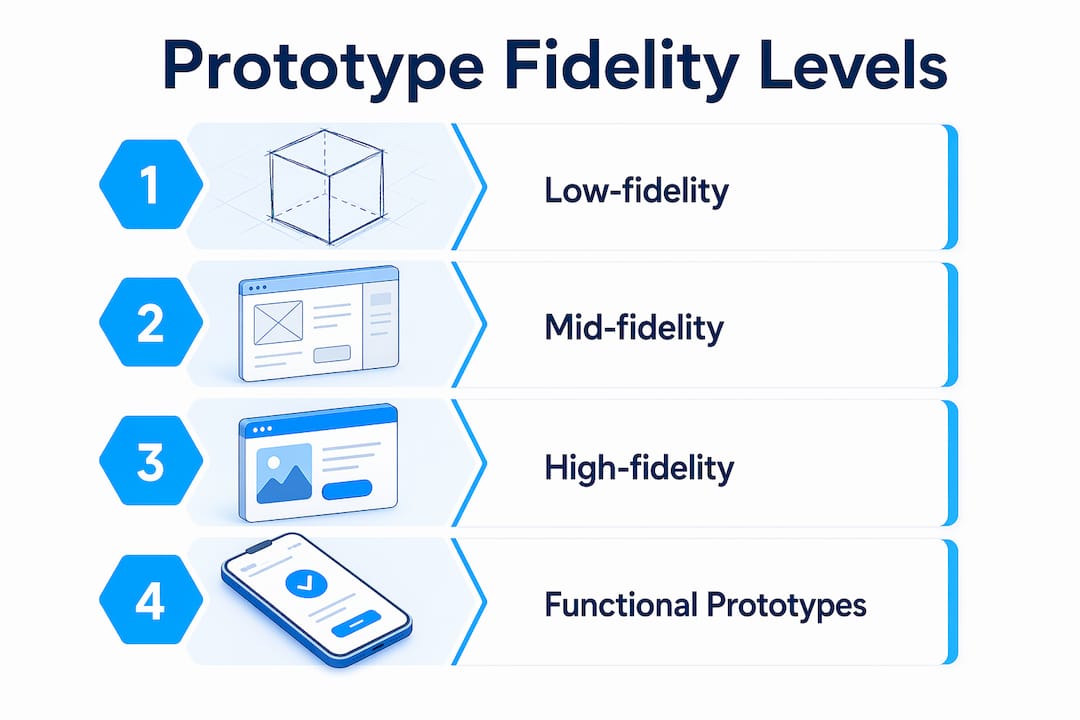
Matching fidelity to uncertainty type optimizes both learning quality and resource use. Premature high-fidelity prototypes shift stakeholder attention to visual polish and away from the structural or usability questions that actually matter at that stage.
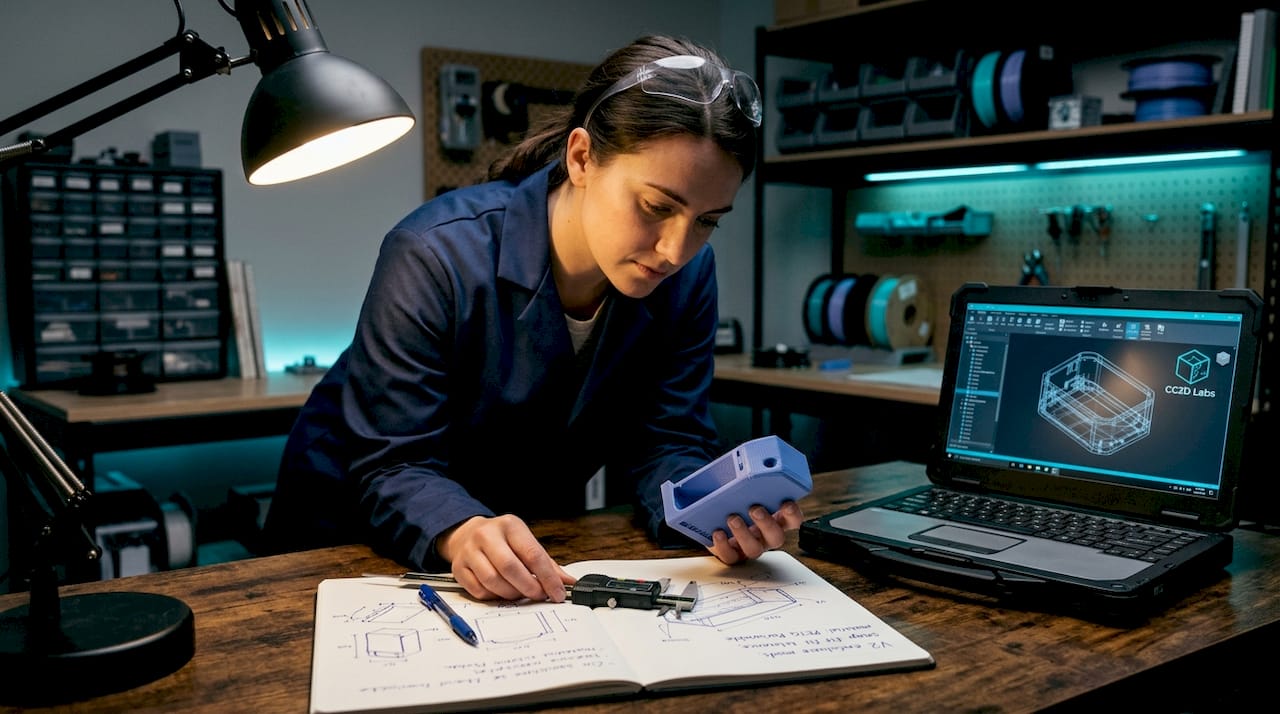
Pro Tip: When you move to high-fidelity physical prototypes, filament-based 3D printing gives you functional geometry at a fraction of injection-molded cost. You can test snap fits, wall thickness, and ergonomics before committing to hard tooling.
How iterative prototyping fits into Agile, Lean, and rapid development
Iterative prototyping does not exist in isolation. It is the practical engine inside the frameworks that modern product teams already use.
In Agile development, work is divided into sprints that permit feedback and adaptation at multiple stages. Prototyping within Agile serves as a discovery mechanism that runs ahead of or alongside development sprints. A team building a new hardware product might prototype the physical enclosure in parallel with firmware development, using each sprint review to validate both dimensions simultaneously.
Lean Startup’s Build-Measure-Learn loop is structurally identical to iterative prototyping. Build the simplest version that tests your riskiest assumption. Measure real user response. Learn whether to pivot or continue. The critical discipline in this loop is shortening iteration cycles to weeks rather than months, which compresses the time between assumption and validated knowledge.
Agile rapid prototyping treats prototypes explicitly as learning tools rather than deliverables. This is a meaningful distinction. A deliverable is judged by its finish quality. A learning tool is judged by the quality of the insight it generates. Teams that confuse the two tend to over-invest in prototype polish and under-invest in structured testing.
The contrast with waterfall development is stark. In a traditional waterfall process, prototyping happens once, early, and feeds into a specification that drives the entire build. Feedback arrives late, when changes are expensive. Iterative approaches distribute feedback across the entire development timeline, so validated learnings continuously feed back into the product backlog and refinement decisions.
You can explore the broader context of rapid prototyping frameworks to see how iterative cycles connect to manufacturing-ready development pipelines.
Common pitfalls in iterative prototyping and how to avoid them
Iterative prototyping produces results only when each cycle generates genuine learning. Several common patterns prevent that from happening.
- Faster waterfall thinking. Without framing each cycle as a testable hypothesis, iteration risks becoming a faster version of sequential development. You produce more versions but reduce no more uncertainty. The fix is to define a specific question before each build, not after.
- Confusing visual polish with design quality. A prototype that looks finished tends to receive feedback about aesthetics rather than function. Teams that present high-fidelity visuals too early get comments on color and typography when they need answers about usability and structure.
- Skipping documentation. Each iteration should produce a written record of what was tested, what was learned, and what decision was made. Without this, teams repeat the same experiments across cycles and lose institutional knowledge when team members change.
- Collecting vague feedback. Prototypes work best as conversation tools that generate honest, specific assessments. Asking “What do you think?” produces vague commentary. Asking “Walk me through how you would assemble this” produces observable behavior and concrete insights.
- Ignoring risk prioritization. Risk exposure should determine when and what to prototype. Prototype the highest-impact uncertainties first. Spending iteration cycles on low-risk details while structural assumptions remain untested is a common and expensive mistake.
Pro Tip: Before each iteration, write one sentence: “We believe [X]. We will test this by [Y]. We will know we are right if [Z].” This single habit eliminates vague iteration and produces decisions, not just versions.
Key takeaways
Iterative prototyping works because each cycle converts assumptions into validated decisions, and that compounding knowledge is what separates products that ship right from products that ship and fail.
| Point | Details |
|---|---|
| Define the cycle clearly | Build, test, analyze, and refine in documented cycles that produce specific decisions. |
| Match fidelity to the question | Use low-fidelity prototypes early for structure; reserve high-fidelity for interaction and realism testing. |
| Frame each iteration as a hypothesis | Write a testable claim before each build to avoid cycling without reducing uncertainty. |
| Integrate with Agile and Lean | Prototyping serves as the discovery engine inside sprints and Build-Measure-Learn loops. |
| Prioritize by risk exposure | Prototype the highest-impact unknowns first to allocate effort where it reduces the most uncertainty. |
Why fidelity decisions are the real skill in iterative prototyping
Most articles on iterative prototyping focus on the cycle itself. The harder skill, in my experience, is fidelity judgment. I have watched teams spend three weeks building a polished interactive prototype to answer a question that a two-hour paper sketch would have resolved. The result was not just wasted time. It was distorted feedback, because stakeholders reacted to the visual finish instead of the underlying structure.
The insight that changed how I think about this came from working on a physical product enclosure. We had two competing assembly approaches. Instead of modeling both in CAD, we built foam mockups in an afternoon. Users immediately showed us which approach created confusion during assembly. That single session saved weeks of CAD revision and tooling cost.
The other pattern I see consistently is teams treating iteration as output production rather than learning production. They measure success by how many versions they shipped rather than how many assumptions they resolved. The hypothesis-driven framing from Jasiri’s iterative design research is the most practical correction I know. Write the hypothesis. Run the test. Document the outcome. If you cannot state what you learned from a cycle, the cycle did not count.
For physical product teams, 3D printing has genuinely changed the economics of high-fidelity iteration. The ability to validate 3D designs with functional printed parts before committing to tooling is not a minor convenience. It compresses what used to be a months-long feedback loop into days.
— Justin
Accelerate your iterations with professional 3D printing
Physical prototypes close the gap between digital design and real-world performance faster than any other method. When your iteration cycle depends on functional parts, material accuracy, and fast turnaround, the quality of your printing service directly affects the quality of your learning.
Cc3dlabs, based near Philadelphia, provides professional 3D printing services built for product developers who iterate fast. From filament-based functional prototypes to multi-color concept models, Cc3dlabs supports every fidelity level your development cycle requires. You can get a free online estimate, request design support, or ship parts directly to your team. If you want to understand how 3D printing drives product innovation at each stage of development, Cc3dlabs has the capability and the expertise to support your next iteration.
FAQ
What is iterative prototyping in product development?
Iterative prototyping is a cyclic process of building a prototype, testing it, analyzing feedback, and refining the design across multiple rounds. Each cycle reduces uncertainty and improves product quality before final production.
How many iterations does a typical prototype cycle require?
There is no fixed number. The cycle continues until the highest-priority uncertainties are resolved and the product meets validated user and performance requirements. Most hardware products go through three to seven major iteration cycles before production readiness.
What is the difference between low-fidelity and high-fidelity prototypes?
Low-fidelity prototypes validate structure, flow, and core concepts using minimal resources, such as paper sketches or foam models. High-fidelity prototypes test realistic interaction and final usability using functional models or detailed digital mockups.
How does iterative prototyping connect to Agile methodology?
Agile divides development into sprints that allow feedback and adaptation at each stage. Iterative prototyping functions as the discovery mechanism within those sprints, testing assumptions before they become expensive development commitments.
What is the biggest mistake teams make in iterative prototyping?
The most common mistake is iterating without a defined hypothesis, which turns the process into a faster version of sequential development without genuine uncertainty reduction. Each cycle must begin with a specific, testable question to produce real learning.