
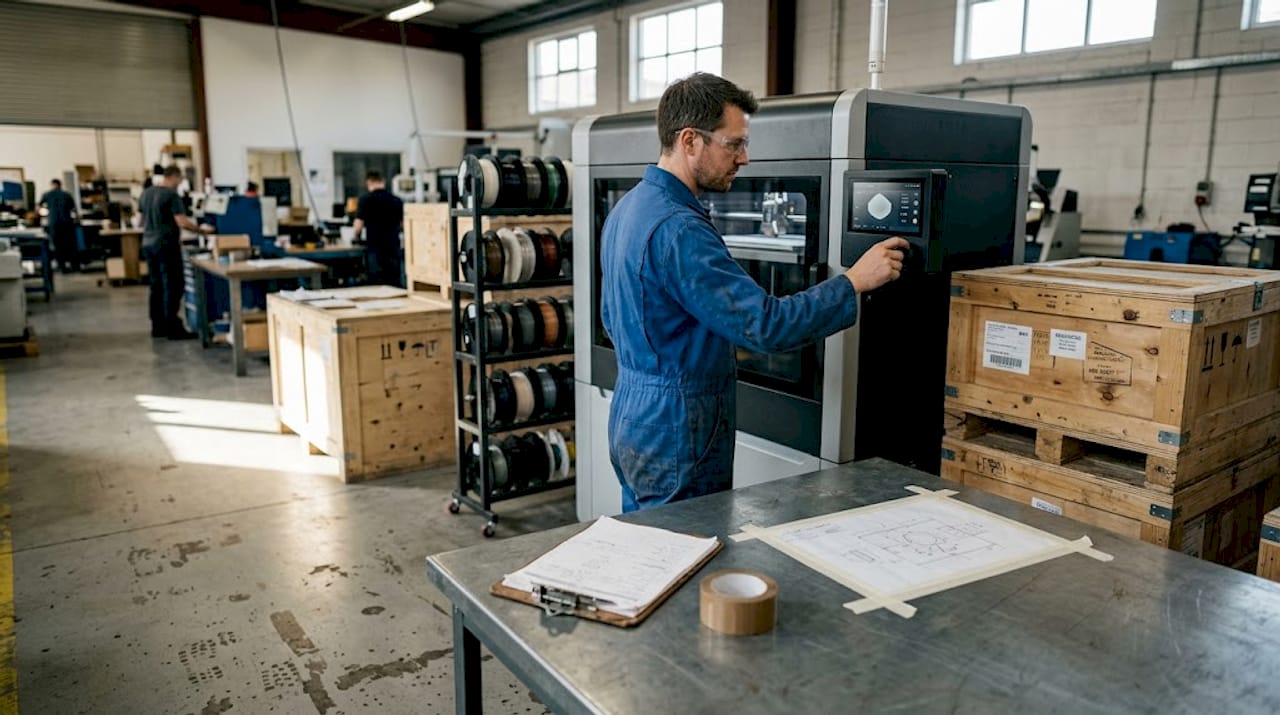
TL;DR:
- Manufacturing-grade 3D printers are designed for production with high repeatability and process control.
- Seven ISO/ASTM recognized AM processes match specific applications, materials, and accuracy needs.
- Successful industrial use depends on robust process validation and quality management, not just machine specs.
Most engineers assume any 3D printer can handle production work if the settings are dialed in correctly. That assumption costs time, money, and credibility. Manufacturing-grade 3D printing operates under an entirely different set of requirements, from material traceability and process repeatability to factory-floor integration and in-process quality monitoring. This guide breaks down exactly what separates industrial additive manufacturing (AM) from desktop and prototyping systems, covers the seven ISO/ASTM-recognized AM processes, compares equipment tiers side by side, and connects those facts to real-world applications in aerospace, medical, automotive, and electronics. By the end, you will know how to evaluate systems and make confident technology decisions for your next project.
Table of Contents
- Defining manufacturing-grade 3D printing
- Key methodologies: Seven core AM processes
- Manufacturing-grade vs. prototyping and consumer printers
- Applications and advantages of manufacturing-grade 3D printing
- Our perspective: What engineers miss about manufacturing-grade 3D printing
- Get expert help with manufacturing-grade 3D printing
- Frequently asked questions
Key Takeaways
| Point | Details |
|---|---|
| Not all 3D printers are alike | Manufacturing-grade 3D printers deliver high reliability, precision, and repeatability that desktop models can’t match. |
| Seven AM processes matter | Understanding ISO/ASTM methods unlocks the right manufacturing-grade solution for your application. |
| Accuracy and monitoring are crucial | Production-grade systems ensure process control for functional, end-use parts every time. |
| Choose methods for the outcome | Selecting the right AM technology accelerates prototyping and low-volume production with minimal compromises. |
Defining manufacturing-grade 3D printing
Not every machine that melts filament or cures resin qualifies as a manufacturing-grade system. The distinction matters enormously when you are designing parts that must pass validation, meet regulatory standards, or ship inside a finished product.
Manufacturing-grade 3D printing refers to industrial AM systems designed for production use, emphasizing repeatability, throughput, controlled materials, in-process monitoring, and auxiliary equipment for factory integration. That definition draws a hard line between systems built to produce consistent, documented output and systems built to make one-off prints quickly.
So what does that actually look like in practice? Here are the core elements that define a manufacturing-grade system:
- Repeatability: Part dimensions and mechanical properties remain consistent across a full production batch and across multiple build cycles over time.
- Throughput: Systems are designed to run continuously or at high duty cycles without compromising output quality.
- Controlled material handling: Feedstocks are qualified, certified, and handled under strict conditions to prevent moisture absorption, contamination, or property drift.
- In-process monitoring: Sensors, cameras, and closed-loop feedback systems catch deviations during the build, not after the part comes off the machine.
- Factory integration: Industrial AM equipment connects to ERP systems, quality management software, and downstream automation for traceability from raw material to finished part.
“Manufacturing-grade 3D printing is not about a single machine capability, it is about the entire production system operating predictably, documentably, and repeatably within a quality-controlled environment.”
For product developers, understanding 3D printing terminology is the first step toward making informed decisions about which systems belong in a manufacturing workflow. A printer that works brilliantly for a proof-of-concept prototype may introduce unacceptable variance the moment you scale to 500 units. That gap between prototyping capability and production reliability is where projects stall and where manufacturing-grade systems deliver their real value.
Key methodologies: Seven core AM processes
Having defined what makes a system manufacturing-grade, let’s look at the main additive manufacturing methods recognized by standards organizations.
ISO and ASTM jointly classify AM into seven process categories, each with distinct material compatibility, accuracy ranges, and production suitability. Understanding these categories helps you match the process to your part requirements rather than defaulting to whatever technology you have access to.
- Powder Bed Fusion (PBF): Includes SLS, HP Multi Jet Fusion (MJF), and DMLS. A laser or energy source selectively fuses powdered material layer by layer. This is the dominant method for industrial polymer and metal production.
- Binder Jetting: A liquid binding agent selectively joins powder particles. No heat during the build, which reduces warping. Used for metal, sand, and ceramic parts.
- Directed Energy Deposition (DED): Melts material as it is deposited, typically for large metal parts or repair applications. Common in aerospace and defense.
- Material Extrusion (industrial FDM): The industrial version of desktop FDM uses high-temperature materials like ULTEM and PEEK in enclosed, thermally controlled chambers.
- Material Jetting: Droplets of photopolymer are jetted and cured layer by layer, delivering extremely fine detail and multi-material capability.
- Sheet Lamination: Layers of material (metal foil, paper, or plastic) are bonded and cut to shape. Used in specialized tooling applications.
- Vat Photopolymerization (SLA/DLP): A UV light source cures liquid resin, producing high-surface-quality parts often used in dental, medical, and consumer product industries.
| Process | Primary materials | Typical accuracy | Best application |
|---|---|---|---|
| Powder Bed Fusion | Polymers, metals | ±0.1 to ±0.3 mm | Low-volume production parts |
| Binder Jetting | Metal, ceramic, sand | ±0.2 to ±0.5 mm | Complex metal geometries |
| DED | Metals | ±0.25 to ±1.0 mm | Large parts, repair |
| Material Extrusion | Engineering polymers | ±0.1 to ±0.5 mm | Functional prototypes |
| Material Jetting | Photopolymers | ±0.05 to ±0.1 mm | High-detail, multi-material |
| Vat Photopolymerization | Resins | ±0.05 to ±0.15 mm | Surface-critical parts |
For polymer production, powder bed fusion technologies like MJF and SLS are preferred for low-volume manufacturing because they produce isotropic parts without support structures, which reduces post-processing time and eliminates weak points common in support-dependent processes.
Pro Tip: When choosing the right process for a production application, prioritize isotropy and material qualification over surface finish. A slightly rougher surface is far easier to fix than unpredictable mechanical properties.
For developers exploring AM process terms for the first time, the takeaway is simple: process selection is a design decision, not an afterthought.
Manufacturing-grade vs. prototyping and consumer printers
With the methodologies in mind, it’s essential to see how industrial printers differ from more familiar kinds.
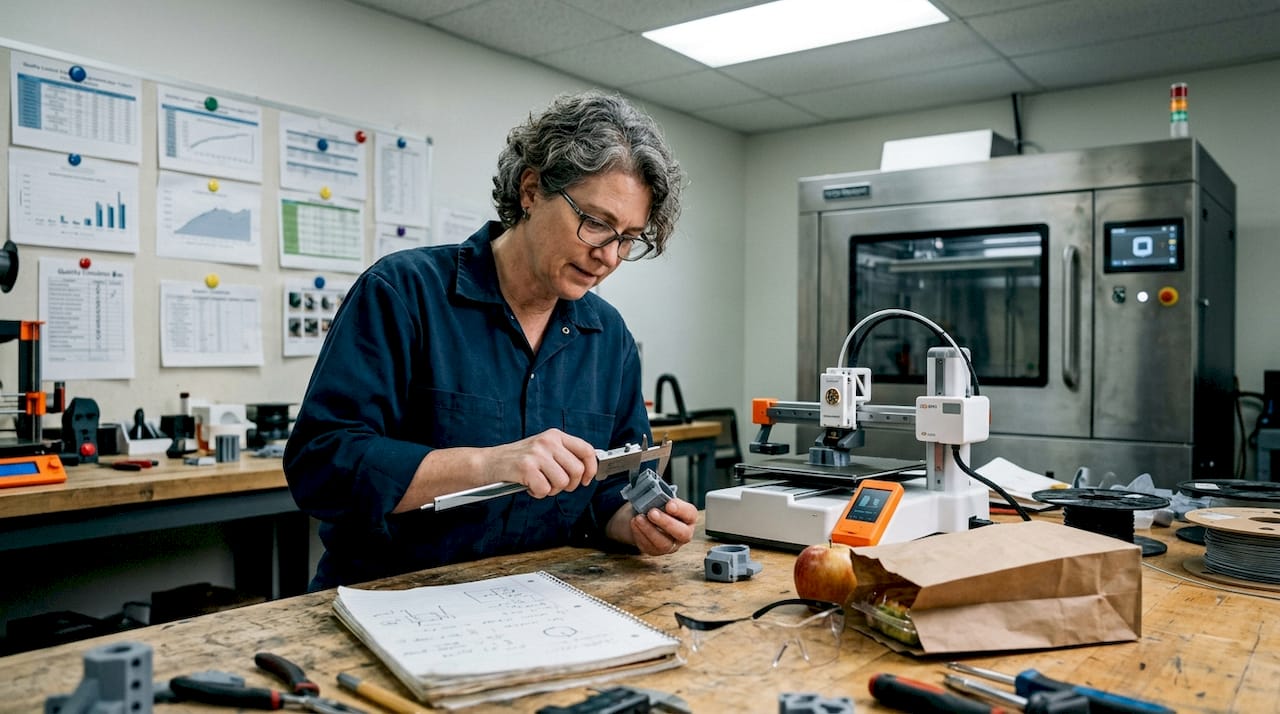
The gap between a consumer desktop printer and a manufacturing-grade industrial system is not just price. It is a fundamental difference in engineering purpose, process control, and output consistency.
| Feature | Consumer/desktop | Prototyping grade | Manufacturing grade |
|---|---|---|---|
| Dimensional accuracy | ±0.5 to ±2.0 mm | ±0.2 to ±0.5 mm | ±0.089 to ±0.2 mm |
| Repeatability | Low, batch variance common | Moderate | High, statistically validated |
| Material qualification | Open/unqualified | Limited qualified options | Certified, traceable feedstocks |
| In-process monitoring | None | Basic | Full closed-loop feedback |
| Build volume | Small | Medium | Large, multi-unit batches |
| Factory integration | None | Minimal | ERP, MES, QMS compatible |
Manufacturing-grade systems achieve tight tolerances like the ±0.089mm accuracy documented on the Stratasys F900, with high yield rates across production batches, while consumer printers show significant dimensional variance from print to print.
Here is where engineers most often run into trouble:
- Assuming prototyping accuracy translates to production: A printer that hits ±0.3mm on a single prototype may drift to ±0.8mm across a 200-unit batch because no process controls are in place.
- Ignoring material traceability: For regulated industries, you need to document the exact material lot, print parameters, and machine state for every part. Consumer printers cannot support this.
- Underestimating post-processing variance: Without controlled cooling, chamber temperature, and humidity, post-processing can introduce more variation than the print itself.
Understanding 3D printing quality from a systems perspective, not just a machine spec perspective, is what separates engineers who consistently deliver reliable parts from those who keep chasing print failures. If your project involves functional assemblies or end-use components, filament prototyping on a consumer machine may work for early validation, but it should never be the final production solution.
Pro Tip: Always ask your 3D printing service provider for documented Cpk values or repeatability data from actual production runs, not just machine spec sheets. That number tells you far more than advertised accuracy claims.
The importance of print accuracy cannot be overstated when you move from design exploration into production validation. Every decimal point on a tolerance spec represents real-world fit, function, and safety margin.
Applications and advantages of manufacturing-grade 3D printing
Understanding what makes manufacturing-grade equipment different, let’s explore the real-world impact and industrial benefits.
Manufacturing-grade AM systems are not a niche solution. They serve as core production tools in some of the most demanding industries on the planet.
Aerospace and defense use AM for lightweight structural components, ducting, brackets, and heat exchangers. Parts that previously required complex machining or multi-piece assemblies can now be produced as single, optimized geometries.
Medical device manufacturers rely on AM for patient-specific implants, surgical guides, and custom orthotics. The combination of geometric freedom and material traceability is essential for regulatory compliance in this sector.
Automotive teams use industrial AM for end-of-arm tooling, jigs, fixtures, and increasingly for low-volume production parts in electric vehicles and specialty vehicles where traditional tooling costs cannot be justified.
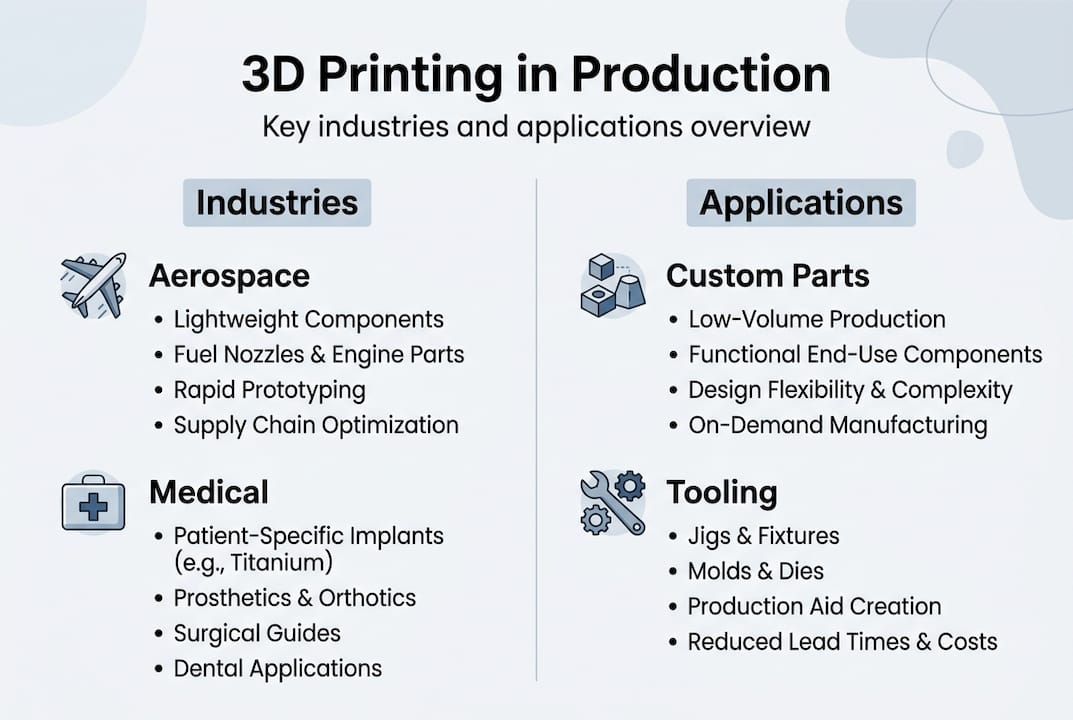
Electronics and consumer products benefit from AM’s ability to produce complex enclosures, custom connectors, and thermal management components in engineering-grade polymers.
Key advantages that matter for product developers:
- Geometric freedom: You can print internal channels, lattice structures, and organic geometries that are impossible to machine or mold at any cost.
- Speed to market: Industrial AM eliminates tooling lead times. Parts that would take 12 to 16 weeks through injection molding can ship in days.
- Part traceability: Every build is logged with material lot, machine parameters, and operator data, creating a complete quality record.
- Scalability: Run 5 units or 5,000 units from the same digital file with no retooling cost.
Statistic callout: Powder bed fusion systems like HP MJF produce layers as fine as 80μm while SLS operates around 120μm, delivering isotropic mechanical properties that make these parts suitable for functional, end-use manufacturing without secondary reinforcement.
For a clear view of types of parts possible with industrial AM, the range is broader than most developers expect. And when durability matters, selecting best materials for durability is as critical as selecting the right process.
Our perspective: What engineers miss about manufacturing-grade 3D printing
Most articles about manufacturing-grade 3D printing focus on machine specs, material options, and accuracy numbers. Those things matter, but they miss the deeper issue that experienced teams consistently run into.
The real failure point is almost never the printer. It is the lack of process validation, documentation standards, and quality system integration surrounding the printer. Engineers who move from consumer or mid-tier prototyping equipment to industrial AM often expect a plug-and-play upgrade. What they get instead is a system that demands the same rigor as any other regulated manufacturing process.
Material qualification, environmental controls, build parameter version control, operator training, and output inspection protocols are not optional extras on a manufacturing-grade setup. They are the system. The printer is just one component of it.
Conventional wisdom says, “get a better printer and get better parts.” The truth is, a well-run mid-tier system with disciplined process controls will consistently outperform a premium machine operated without them. Choosing correctly means choosing the right process and the right operational framework around it. Manufacturing-grade is about outcome assurance, not machine capability alone.
Get expert help with manufacturing-grade 3D printing
If you are ready to move your project from concept to production-quality output, the next step is working with a partner who understands both the technology and the engineering requirements behind it.
At CC 3D Labs, we provide manufacturing-grade 3D printing services for product developers and engineers who need reliable, documented results, not just fast prints. Whether you need functional prototypes, low-volume production runs, or on-demand custom parts, we bring process expertise and quality focus to every order. Explore parts you can print with industrial-grade filament systems and request a free estimate to get your project moving with confidence.
Frequently asked questions
What makes a 3D printer manufacturing-grade?
Manufacturing-grade 3D printers are designed for production environments, offering high repeatability, controlled material usage, in-process monitoring, and factory integration. They are built to document and validate every aspect of the production process, not just produce individual parts.
Which 3D printing method is best for low-volume polymer production?
Powder Bed Fusion technologies like SLS and HP Multi Jet Fusion are preferred for low-volume polymer manufacturing because they produce isotropic parts without support structures, which improves consistency and reduces post-processing.
Can manufacturing-grade 3D printers be used for end-use functional parts?
Yes. Systems like HP MJF and SLS produce isotropic end-use parts with fine layer resolution and material traceability, making them fully suitable for functional, production-intent components in aerospace, medical, and automotive applications.
Why is print accuracy important in manufacturing-grade systems?
Precise, validated accuracy ensures that parts meet dimensional tolerances consistently across an entire batch. The Stratasys F900 achieves ±0.089mm accuracy at a 95% yield rate, which is the kind of documented repeatability that production engineering actually requires.