
TL;DR:
- The 3D printed nanomaterials market is expected to reach $1.2 billion by 2026, indicating manufacturing is shifting to core strategy.
- Advanced nanomaterials like graphene and CNTs significantly enhance filament strength, widening application fields in aerospace, automotive, and medical sectors.
- AI-driven processes improve quality, reduce waste, and democratize additive manufacturing, enabling smarter, more efficient workflows.
The 3D printed nanomaterials market is projected to hit $1.2B in 2026, and that number alone tells you something important: 3D printing is no longer a prototyping curiosity. It is becoming a core manufacturing strategy. For product developers and engineers, the next 12 months will bring real decisions about materials, process economics, AI integration, and supply chain design. Getting these calls right separates teams that ship better products faster from those still debating which printer to buy. This article breaks down the four most consequential trends shaping additive manufacturing in 2026 so you can act on them with clarity.
Table of Contents
- The rise of advanced materials and nanotechnology
- Material extrusion and the economics of 3D printing farms
- AI-driven automation and smarter additive manufacturing
- Sustainability, supply chain resilience, and the new AM business model
- What most forecasts miss about 3D printing’s future
- Connect with advanced 3D printing solutions
- Frequently asked questions
Key Takeaways
| Point | Details |
|---|---|
| Nanomaterials boost strength | Cutting-edge filaments with graphene and CNTs can make 3D-printed parts 50-200% stronger. |
| Material extrusion leads production | FFF/FDM is now the most economical method for large-scale 3D printing, replacing more costly alternatives. |
| AI powers efficiency | AI-driven automation is improving print quality, reducing defects, and making advanced manufacturing more accessible. |
| ROI shapes equipment choices | Firms now choose 3D printing tools based on specific application ROI, not general capabilities. |
| Hybrid models enhance resilience | Combining in-house 3D printing with expert partnerships strengthens supply chains and sustainability. |
The rise of advanced materials and nanotechnology
Now that you see the market’s rapid escalation, let’s examine how new materials and nanotechnology are fundamentally changing what’s possible. The short version: filaments are getting dramatically stronger, and the applications that were once limited to metals are opening up to advanced polymers.
Nanomaterial-infused filaments are boosting tensile strength by 50 to 200%, depending on the base material and the additive used. Graphene and carbon nanotubes (CNTs) are the two most significant contributors here. Graphene adds conductivity and stiffness without adding meaningful weight. CNTs improve impact resistance and thermal stability, which matters enormously in aerospace brackets, automotive housings, and medical device enclosures.
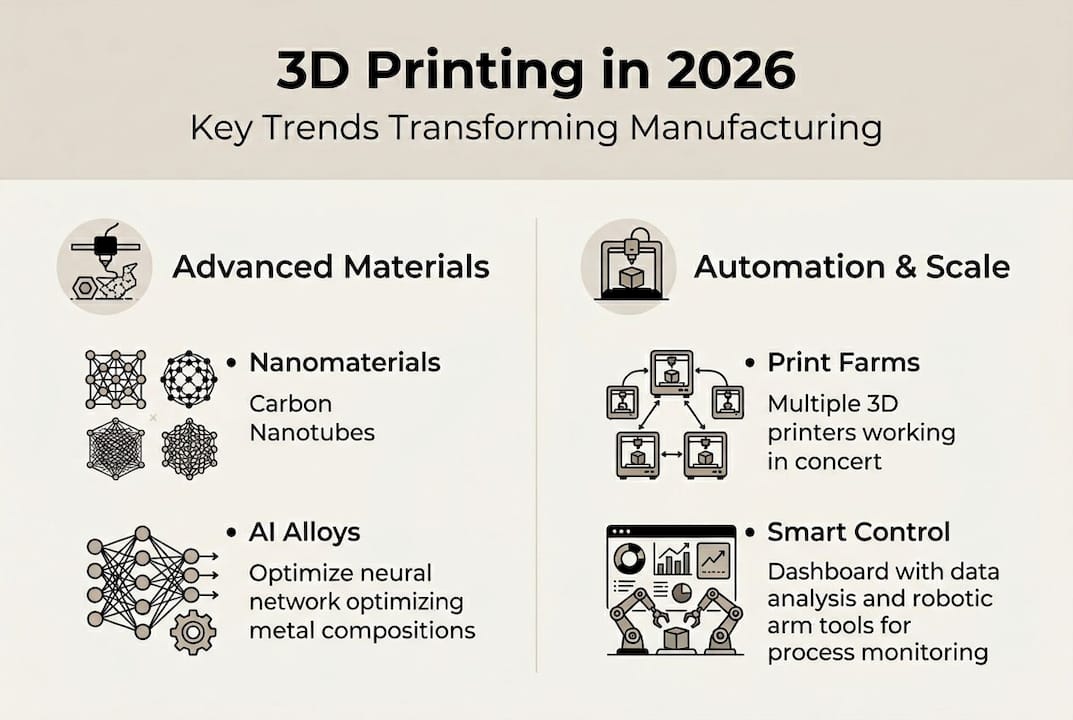
Beyond filament, artificial intelligence is now being used to design entirely new alloys from scratch. An AI-designed Fe-15Cr steel achieves 1,713 MPa tensile strength with 15.5% elongation, a combination that outperforms many conventionally developed steels. This is not a lab curiosity. It signals that the material design process itself is being automated, compressing the timeline from concept to production-ready specification.
Here is a quick look at how nanomaterial-enhanced filaments compare across key performance categories:
| Material type | Tensile strength gain | Key benefit | Primary application |
|---|---|---|---|
| Graphene-infused PLA | Up to 50% | Conductivity + stiffness | Electronics housings |
| CNT-reinforced nylon | Up to 150% | Impact resistance | Automotive components |
| Carbon fiber PEEK | Up to 200% | Thermal stability | Aerospace brackets |
| Nano-silica ABS | Up to 80% | Surface hardness | Medical device casings |
The industries moving fastest on this are aerospace, automotive, and medical devices. Each of these sectors demands parts that perform under stress, heat, or sterile conditions. Nanomaterial filaments are starting to meet those bars in ways standard polymers never could.
Key applications driving nanomaterial adoption:
- Lightweight structural brackets replacing aluminum in aircraft interiors
- Thermally stable housings for under-hood automotive sensors
- Biocompatible, high-strength implant guides in surgical planning
- Electrically conductive enclosures for embedded electronics
Pro Tip: If you are evaluating advanced filaments for a functional part, always request material data sheets with tensile, flexural, and thermal specs. A vendor who cannot provide them is not ready for production-grade work. Our filament 3D printing guide walks through what to look for when selecting materials for real-world applications.
Material extrusion and the economics of 3D printing farms
Material innovations are only as useful as the processes that make them practical. The economics of production are shifting too, especially in extrusion-based 3D printing. Fused filament fabrication (FFF), also called FDM, is gaining serious ground as a production technology, not just a prototyping tool.
Material extrusion is increasingly favored over SLS and MJF for large production farms because the economics simply work better at scale. Lower machine costs, cheaper feedstocks, and easier post-processing make FFF farms a compelling alternative for mid-to-high volume runs of functional parts.
High-filled polymers are a big part of this story. When you load a nylon or PEEK matrix with 30 to 50% carbon fiber or glass fiber, the resulting part can replace die-cast aluminum or zinc in many applications. The weight savings are real, and so is the cost reduction when you factor out tooling.
Here is how FFF stacks up against powder-based processes for production use:
| Factor | FFF/FDM | SLS | MJF |
|---|---|---|---|
| Machine cost | Low to medium | High | High |
| Material cost per kg | Low | Medium to high | Medium to high |
| Post-processing complexity | Low | High | Medium |
| Scalability (farm model) | Excellent | Limited | Limited |
| Part isotropy | Moderate | High | High |
| Best for | Functional parts, tooling | Complex geometries | High-detail production |
Large-format additive manufacturing (LFAM) is also expanding the FFF envelope. Systems that extrude high-filled polymers at scale are now being used for composite tooling, jigs, fixtures, and even mold cores. This is a direct replacement for CNC-machined tooling in some workflows, with lead times measured in hours rather than weeks.
Four reasons manufacturers are building FFF production farms in 2026:
- Faster iteration cycles without retooling costs
- On-demand production that reduces inventory overhead
- Compatibility with advanced composite filaments
- Lower operator skill requirements compared to powder-bed systems
If you are still deciding which process fits your production goals, reviewing choosing the right 3D printing method can sharpen that decision. And if you are working at lower volumes, low-volume manufacturing tips covers the practical side of making FFF work efficiently at smaller batch sizes.
AI-driven automation and smarter additive manufacturing
As production scales, ensuring quality and efficiency becomes crucial. Here’s where AI is accelerating change in 3D printing. The technology is moving from a novelty to a genuine process control tool, and the impact is measurable.

AI optimizes print paths and detects print anomalies, improving reliability across complex geometries and multi-material builds. This matters because traditional quality control in additive manufacturing has always been reactive: you print the part, inspect it, and scrap it if it fails. AI-driven monitoring catches problems mid-print, reducing waste and rework significantly.
Smaller powder particle sizes in powder-bed systems are also enabling smoother surfaces without additional finishing. When combined with AI-optimized scan paths, the result is a part that exits the machine closer to spec. That reduces post-processing time and cost, which is often where additive manufacturing loses its economic advantage.
Where AI is making the biggest difference in AM workflows:
- Real-time layer inspection using computer vision to flag delamination or warping
- Generative design tools that propose geometries optimized for both performance and printability
- Predictive maintenance on print farms to reduce unplanned downtime
- Automated support structure generation that minimizes material use
Pro Tip: When evaluating a 3D printing partner or in-house system, ask specifically about their quality control process. AI-assisted inspection is becoming a differentiator. If the answer is “we visually inspect after printing,” that is a flag for high-volume or critical-use parts.
“AI is lowering the entry barrier for in-house additive manufacturing,” making it practical for engineering teams without deep AM expertise to run reliable production workflows. (Source)
This democratization effect is significant. Teams that previously needed a dedicated AM specialist to manage process parameters can now rely on software-guided workflows. That does not eliminate the need for expertise, but it does lower the floor for getting started. For engineers exploring how 3D scanning integrates into quality-controlled workflows, achieving high-quality 3D scans covers the metrology side of the equation.
Sustainability, supply chain resilience, and the new AM business model
Digital transformation isn’t just about speed and quality. The business context is evolving as well, introducing new priorities for engineering leaders. Sustainability and supply chain flexibility are now core considerations in how companies structure their additive manufacturing programs.
Supply chain resilience and sustainability are driving adoption of additive manufacturing, with hybrid in-house and expert partnerships becoming the norm. The logic is straightforward: a distributed, on-demand production model is inherently more resilient than a centralized, inventory-heavy one. When a supply disruption hits, teams with AM capability can pivot faster.
“Investments are more cautious, emphasizing utilization and ROI, with a shift toward application-specific machines.” This signals a maturation in how companies approach AM spending.
The sustainability angle is equally real. Additive manufacturing generates significantly less waste than subtractive methods because you are only depositing material where it is needed. Recycled and bio-based filaments are improving in quality, and closed-loop material systems are emerging for powder-bed processes.
What the new AM business model looks like in practice:
- In-house printers for rapid iteration and low-volume runs
- Expert service partners for high-complexity or high-volume production
- Application-specific equipment investments tied to measurable ROI
- Eco-friendly material sourcing as part of product sustainability commitments
The shift toward application specialization is particularly important. Generalist AM programs that try to do everything with one machine type are losing ground to focused programs that match process to application with precision. If you want to understand how additive manufacturing for sustainability fits into a broader business strategy, that resource covers the foundational business case.
What most forecasts miss about 3D printing’s future
Most 2026 trend coverage focuses on what is new. New materials, new machines, new software. That framing is useful but incomplete, and it can lead engineering teams toward chasing capability rather than building advantage.
The organizations seeing real returns from additive manufacturing are not necessarily the ones with the newest equipment. They are the ones that have invested in specialist knowledge: understanding which material works for which load case, which process minimizes post-processing for their geometry, and which partnership model gives them flexibility without sacrificing quality.
Fast followers who adopt high-profile technologies without that foundational clarity often find themselves with expensive machines running at low utilization. The technology does not create ROI. The application strategy does.
The other thing most forecasts miss is the compounding effect of combining technologies. A team that integrates professional handheld 3D scanning (accuracy to ~0.1 mm) with FFF production and AI-assisted quality control is not just using three tools. They are building a closed-loop manufacturing system that gets smarter over time. That is the real disruptor, not any single technology in isolation.
If you want to see what that looks like in practice, 3D printing on demand is a good starting point for understanding how flexible production models actually function.
Connect with advanced 3D printing solutions
The trends covered in this article are not theoretical. They are shaping real production decisions right now, and the teams that move with clarity will build durable advantages in their markets.
At CC 3D Labs, near Philadelphia, we align directly with where manufacturing is heading in 2026. From advanced filament-based production to professional handheld 3D scanning (accuracy to ~0.1 mm) and CAD support, our 3D printing services are built for engineers who need precision, speed, and reliability. Whether you are developing prototypes to functional parts or scaling a production run, we offer free online estimates, design support, and fast turnaround. Let’s build something that performs.
Frequently asked questions
How are nanomaterials impacting 3D printing in 2026?
Nanomaterials are driving 50 to 200% strength gains in printed parts while expanding viable applications into aerospace, automotive, and medical sectors, backed by a $1.2B market in 2026.
Which 3D printing process is most economical for large-scale production?
FFF/FDM is favored for large-scale production farms in 2026 due to lower machine costs, cheaper materials, and simpler post-processing compared to SLS or MJF.
How is AI shaping additive manufacturing workflows?
AI is automating print path optimization, real-time anomaly detection, and quality control, making advanced AM more accessible to engineering teams without deep process expertise.
What business strategies are successful companies using in 2026’s 3D printing landscape?
Leading companies are investing in application-specific machines with clear ROI targets, combining in-house agility with expert service partnerships and prioritizing sustainable materials and on-demand supply chain models.