

TL;DR:
- Quality assurance in printing involves embedding defect prevention into every production stage to reduce waste and ensure consistency. It relies on documented procedures and objective measurements at pre-press, on-press, and post-press, replacing subjective judgment and reactive inspection. Standards like ISO 12647, G7, and GRACoL 2013 define measurable targets for maintaining high-quality, repeatable prints globally.
Quality assurance in printing is defined as the systematic process of embedding defect prevention into every production stage, from file preparation through final delivery. Unlike quality control, which catches defects after they occur, QA builds standards into the workflow itself. Industry bodies like the Printing Industries of America (PIA), ISO, and Idealliance have formalized this distinction through standards such as ISO 12647, G7, and GRACoL 2013. For printing professionals and quality control specialists, understanding what is quality assurance in printing means understanding how to prevent problems rather than react to them.
What is quality assurance in printing and why does it matter?
Quality assurance in printing is a proactive, process-integrated system that defines tolerances, monitoring intervals, and corrective actions before a single sheet runs. Quality control, by contrast, is the inspection activity that happens at defined checkpoints. Both are necessary, but QA is the architecture that makes quality control meaningful.
The practical stakes are significant. Waste and rework consume 10–15% of total production costs for printing companies without formal quality management systems. That figure represents real money lost on reprints, spoilage, and client credits. A formal QA system converts those losses into documented savings.
QA also protects brand integrity. When a client specifies a Pantone color or a tight registration tolerance, the QA system is what guarantees the press operator knows the target, measures against it, and acts when the output drifts. Without that system, consistency depends entirely on individual skill, which does not scale.
What are the critical stages of printing quality assurance?
Printing quality assurance divides into three stages: pre-press, on-press, and post-press. Each stage has distinct checks, and a failure at any one of them compounds downstream.
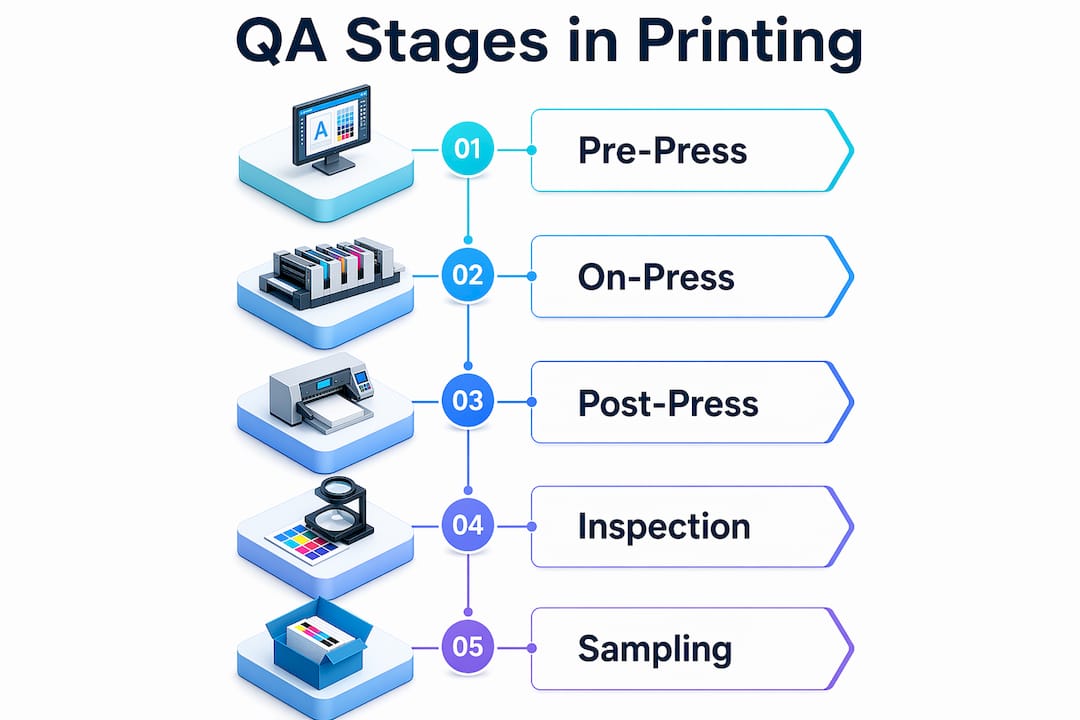
Pre-press: where most errors originate
Pre-press is the highest-leverage stage for error prevention. Checks at this stage include file verification (bleed margins, font embedding, image resolution, color profile assignment), specification confirmation against the client’s approved proof, and plate or digital file inspection. Prepress misalignments as small as 0.1mm create irreparable defects in the final product. No amount of on-press adjustment corrects a misregistered plate.
- Verify all files meet output specifications (300 dpi minimum for print, correct color space).
- Confirm bleed and safe zone margins match the job ticket.
- Check font embedding and outline conversion to prevent substitution errors.
- Review color profiles against the target print condition (GRACoL, FOGRA).
- Approve a contract proof before releasing files to press.
Pro Tip: Run a preflight check using a standardized checklist, not memory. Even experienced prepress operators miss embedded RGB images when working under deadline pressure.
On-press: real-time monitoring
On-press QA focuses on maintaining the approved proof condition throughout the run. Operators measure color density, dot gain, and registration at defined intervals, typically every 500–1,000 impressions. Deviations trigger documented corrective actions, not guesswork. The heat press production process follows a similar logic: consistent temperature, pressure, and timing parameters are monitored continuously to maintain output quality.
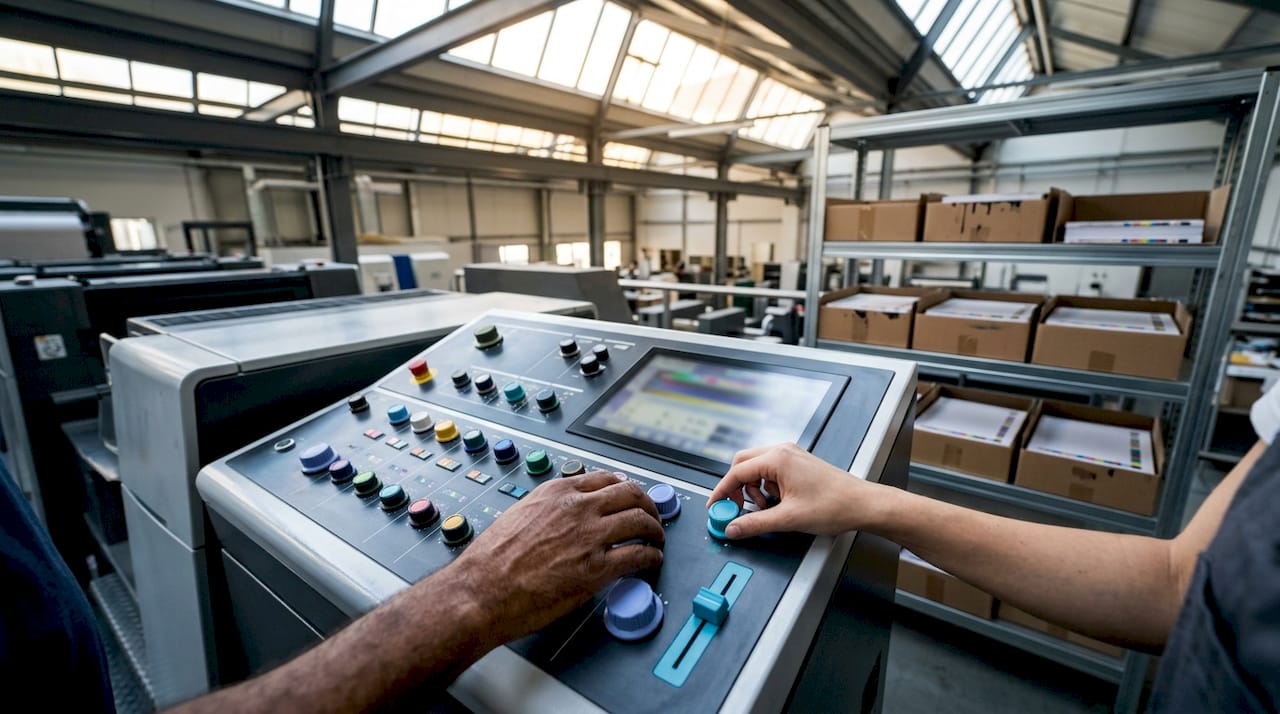
Post-press: final inspection and sampling
Post-press checks cover binding, trimming, folding, and packaging. For large runs, statistical sampling plans determine how many units to inspect and what defect threshold triggers a batch rejection. This stage confirms the product meets the client’s specification before it ships, not after a complaint arrives.
How do printing quality standards define QA criteria?
Professional print quality is categorized into five levels: Utility, Office, Informational, Library, and Prestige. Each level carries different tolerance expectations for color accuracy, registration, and substrate consistency. A Utility print job tolerates wider color variation than a Prestige job, which demands tight Lab* color matching and premium substrate control.
These levels align with formal standards that define the measurable parameters:
- ISO 12647 specifies ink density, dot gain, and color targets for offset printing across multiple substrate categories.
- G7 is a calibration method developed by Idealliance that aligns press output to a common gray balance, making color predictable across different presses and locations.
- GRACoL 2013 is a reference print condition used widely in North American commercial printing, defining the color space a press should reproduce.
- ISO 9001 governs the quality management system itself, covering documentation, process control, and continuous improvement.
- FOGRA certifications validate that a press profile matches a certified reference condition, used extensively in European and global supply chains.
Color consistency is now managed through standardized Lab* color metrics rather than subjective visual judgment. Lab* values describe color in a device-independent space, meaning a target defined in Lab* is reproducible on any calibrated press anywhere in the world. This shift from density-based to colorimetric measurement is the single most important technical change in print quality management over the past decade.
For brand owners, these standards translate directly into consistency. A brand color measured in Lab* and printed to GRACoL 2013 looks the same whether it runs in Philadelphia or Frankfurt. That repeatability is what high precision printing for manufacturers depends on.
What measurement tools and methods support printing QA?
Objective measurement replaces subjective judgment in a mature QA system. The core instruments are spectrophotometers, densitometers, and inline sensors.
- Spectrophotometers measure Lab* color values directly from printed output, comparing them against the target condition.
- Densitometers measure ink film density, a faster but less complete measurement than spectrophotometry.
- Inline sensors mounted on the press read color bars on every sheet, feeding data to a dashboard that flags drift in real time.
Statistical sampling plans like AQL/ISO 2859-1 govern how many units to inspect in large production runs. In a run of 10,000 units, 200 are sampled; if more than three defects appear, the batch is rejected. That threshold is not arbitrary. It reflects a calculated acceptable quality level that balances inspection cost against defect risk.
Documented SOPs turn craftsmanship into repeatable processes that any trained operator can execute consistently. An SOP for on-press color monitoring specifies which color bars to measure, at what frequency, which instrument to use, what the tolerance is, and what action to take when a reading falls outside tolerance. Without that documentation, quality depends on who is running the press that day.
Pro Tip: Calibrate your spectrophotometer against a certified reference tile before every shift. Instrument drift is a silent source of false readings that undermines your entire measurement system.
How does QA impact production efficiency and cost control?
The business case for systematic QA is direct. Without a formal quality management system, waste and rework consume 10–15% of total production costs. That loss compounds across every job, every shift, and every client relationship. A single costly reprint can erase the margin on an entire account.
| QA investment area | Production impact |
|---|---|
| Pre-press file verification | Eliminates plate remakes and press downtime |
| On-press color monitoring | Reduces ink waste and substrate spoilage |
| Statistical sampling (AQL/ISO 2859-1) | Prevents full-batch rejections on large runs |
| ISO 9001 certification | Qualifies the operation for enterprise and government contracts |
| FOGRA/Idealliance certification | Validates press profiles for global brand clients |
Early-stage QA prevents the most expensive corrections. A plate remake costs a fraction of a full reprint. A reprint costs a fraction of a lost client. The math consistently favors investment in pre-press and on-press controls over reliance on post-press inspection to catch what went wrong.
Certifications like ISO 9001 and FOGRA also open commercial doors. Enterprise buyers and brand owners increasingly require documented quality systems as a condition of supplier qualification. A certified operation competes for contracts that uncertified shops cannot access. The ISO certification framework applies this same logic across manufacturing disciplines, including 3D printing, where documented process control drives both quality and commercial credibility.
What best practices should QA specialists watch for in printing?
The most common QA failure in printing operations is treating inspection as a substitute for process control. Final inspection finds defects. It does not prevent them. A QA system that relies on end-of-line checks will always produce waste, because defective product has already consumed materials, press time, and labor before the inspector sees it.
If a print supplier cannot clearly describe their QC process, that is a red flag. Buyers should ask specific questions: What is your on-press measurement interval? What instrument do you use? What is your color tolerance in Delta E? What triggers a press stop? Vague answers indicate a reactive operation, not a controlled one.
Common error sources to monitor actively include:
- Misregistration: caused by plate mounting errors, paper stretch, or press mechanical wear.
- Color shift: caused by ink viscosity changes, temperature variation, or substrate inconsistency.
- Substrate defects: caliper variation, moisture content, and coating inconsistency all affect ink absorption and color.
- Binding and trimming errors: caused by incorrect die settings or accumulated sheet-to-sheet variation in post-press.
Monitoring frequency matters as much as the checks themselves. Measuring color every 500 impressions catches drift before it becomes a defect. Measuring only at makeready and end-of-run misses everything that happens in between. DTF and digital print technologies have raised the bar on color consistency expectations, making frequent measurement a baseline requirement rather than a premium practice.
Key Takeaways
Quality assurance in printing is a process-integrated system that prevents defects through documented controls at pre-press, on-press, and post-press stages, reducing waste and protecting brand consistency.
| Point | Details |
|---|---|
| QA prevents, QC detects | Build quality into the process; do not rely on final inspection to catch failures. |
| Pre-press is highest leverage | Misalignments as small as 0.1mm at pre-press create irreparable downstream defects. |
| Standards define measurable targets | ISO 12647, G7, and GRACoL 2013 replace subjective judgment with objective Lab* color metrics. |
| Sampling plans protect large runs | AQL/ISO 2859-1 sets reject thresholds so defective batches do not reach clients. |
| Waste costs are avoidable | Formal QA systems eliminate the 10–15% of production costs lost to rework and spoilage. |
The shift I keep watching in print QA
The printing industry spent decades treating quality as a craft skill. The best press operators were the ones who could read a sheet by eye and know what to adjust. That era is functionally over, and I think that is a good thing.
What I have seen work consistently is the move to objective, repeatable measurement tied to documented corrective actions. When a press operator has a spectrophotometer reading, a defined tolerance, and a written procedure for what to do when the reading is out, quality stops depending on who showed up that morning. It becomes a system property, not a personal one.
The operations that struggle are the ones that adopted the instruments without the documentation. They measure, but they do not act on a defined protocol. The measurement data sits in a log that nobody reviews until a client complains. That is not QA. That is expensive record-keeping.
The next shift I am watching is the harmonization of global print standards. GRACoL and G7 are already creating a common color language across North American supply chains. As more brand owners specify Lab* targets rather than press-specific density values, the ability to hit a defined color condition on any calibrated press anywhere becomes the competitive differentiator. Shops that have built their QA systems around colorimetric standards are positioned for that world. Shops still running to density targets are not.
My practical advice: start with the SOPs. Document what you measure, when you measure it, what the tolerance is, and what you do when it fails. That documentation is the foundation everything else builds on.
— Justin
How Cc3dlabs applies precision thinking to production quality
Quality assurance principles that govern commercial printing apply directly to advanced manufacturing, including 3D printing. Cc3dlabs, based near Philadelphia, builds the same process control logic into every production run: defined tolerances, documented workflows, and inspection at each stage before a part ships.
For product developers and manufacturers who need parts that meet tight dimensional and surface quality specifications, Cc3dlabs offers custom 3D printing services covering filament-based production, multi-color printing, CAD modeling, and metrology-grade scanning. Whether you need a single prototype or a batch production run, the same QA discipline that defines professional print quality applies to every part Cc3dlabs produces. Request a free online estimate and see what process-controlled manufacturing delivers.
FAQ
What is the difference between quality assurance and quality control in printing?
Quality assurance is the system of planned procedures that prevents defects throughout production. Quality control is the inspection activity that detects defects at defined checkpoints. QA is proactive; QC is reactive.
What does ISO 12647 cover in printing?
ISO 12647 specifies ink density, dot gain, and color targets for offset printing across multiple paper and substrate categories. It provides the measurable parameters that define acceptable print output.
How often should color be measured during a press run?
On-press color measurement should occur every 500–1,000 impressions. This frequency catches color drift before it produces defective product, rather than discovering the problem at end-of-run.
What is the G7 calibration method?
G7 is an Idealliance calibration method that aligns press output to a common gray balance target. It makes color predictable and repeatable across different presses, facilities, and geographic locations.
What are the five quality levels in professional printing?
The five levels are Utility, Office, Informational, Library, and Prestige. Each level defines different tolerance expectations for color accuracy, registration, and substrate quality, guiding both production standards and client expectations.