
TL;DR:
- 3D printing significantly improves student understanding and engagement in STEM subjects.
- Successful integration relies on curriculum-first planning, teacher training, and proper workflow.
- Common challenges include high costs, resource management, and curriculum alignment, but solutions exist.
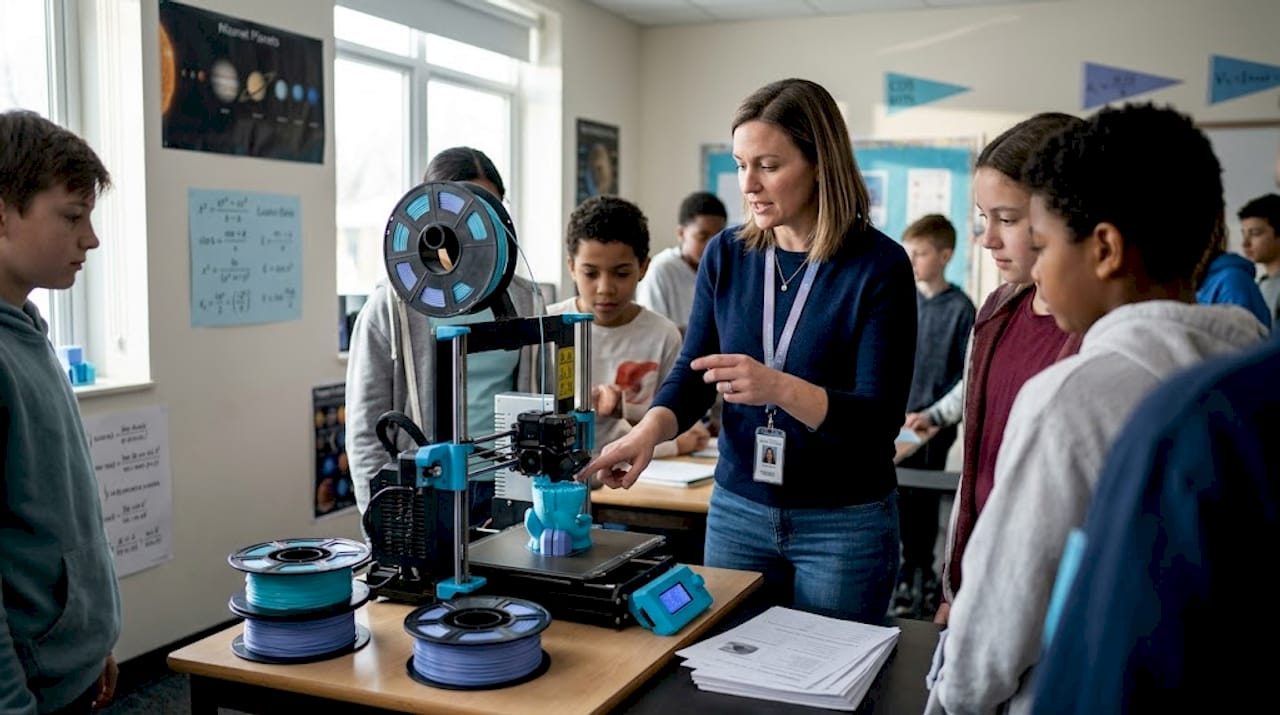
A recent pre-post study with 32 Grade 6 students found significant academic gains in space science after using 3D-printed models, and that result should make every educator pause. 3D printing in schools is no longer a novelty reserved for tech showcases or maker fairs. It has become an evidence-based instructional tool that strengthens student understanding, sharpens problem-solving, and bridges the gap between abstract content and hands-on discovery. This guide walks educators and administrators through the research, the practical frameworks, the real challenges, and the curriculum strategies that make 3D printing actually work in learning environments.
Table of Contents
- The evolution of 3D printing in education
- How 3D printing transforms learning outcomes
- Implementing 3D printing: Practical methods and proven frameworks
- Real-world challenges and sustainable solutions
- Why a curriculum-first mindset matters for 3D printing success
- Explore 3D printing solutions for your school
- Frequently asked questions
Key Takeaways
| Point | Details |
|---|---|
| 3D printing boosts engagement | Integrating 3D printing increases student engagement and skill development in STEM and beyond. |
| Teacher preparation is key | Educator training and curriculum-first planning enable effective and sustainable classroom integration. |
| Overcome barriers wisely | Address cost, training, and durability challenges with evidence-backed, practical solutions and material choices. |
| Focus on learning goals | Success comes from aligning technology with meaningful curriculum objectives, not just using flashy tools. |
The evolution of 3D printing in education
Early 3D printers entered schools as expensive curiosities. They sat in corners of computer labs, printed plastic trinkets, and impressed visitors at open houses. Teachers rarely had time to integrate them meaningfully, and students used them for show rather than learning. That era is largely behind us.
Over the past decade, falling hardware costs, open-source design software, and a strong push toward project-based learning (PBL) and challenge-based learning (CBL) shifted the role of the printer from novelty to instructional asset. PBL asks students to investigate real-world problems and create tangible outputs. CBL pushes them further, requiring them to tackle an authentic challenge with measurable results. In both models, a physical, touchable prototype is far more powerful than a slide deck.
The S.T.E.M. emphasis in K-12 and higher education also accelerated adoption. Schools needed tools that connected science, technology, engineering, and mathematics in visible, tactile ways. A 3D-printed model of a cell, a bridge stress-test prototype, or a scaled architectural model does exactly that.
Key drivers behind classroom adoption include:
- Project-based and challenge-based learning requiring physical deliverables
- S.T.E.M. curriculum mandates that reward cross-disciplinary application
- Lower-cost FDM printers (FDM stands for fused deposition modeling, the most common filament-based printing method) making entry more accessible
- Open-source design tools like Tinkercad and Fusion 360 reducing the design learning curve
- Maker culture normalizing fabrication as a core academic skill
The TPACK framework (Technological Pedagogical Content Knowledge) has become a critical guide for teacher professional development. TPACK helps educators think about three overlapping skill areas: knowing the technology, knowing how to teach, and knowing the subject matter. When schools train teachers using TPACK, they produce instructors who can confidently connect the printer to a learning objective rather than using it as a standalone activity.
Research confirms the pattern. A systematic review of 20 studies on 3D printing in teacher education found that while the technology clearly enhances skill development and student engagement, schools consistently face challenges around resource availability, time constraints, and curriculum integration.
“The technology is not the lesson. The lesson is the lesson. 3D printing is a powerful vehicle, but only when the driver knows where they’re going.”
For those curious about what creative 3D printing applications look like in practice, the range is genuinely surprising, from working mechanical assemblies to anatomical models that students can hold and examine.
How 3D printing transforms learning outcomes
Evidence for measurable gains keeps building. In the Grade 6 space science study mentioned earlier, students who used 3D-printed models of planets, lunar phases, and orbital systems scored significantly higher on post-tests than they did on pre-tests. The models gave abstract content a physical form. Students could rotate, compare, and manipulate objects that would otherwise exist only as textbook images.
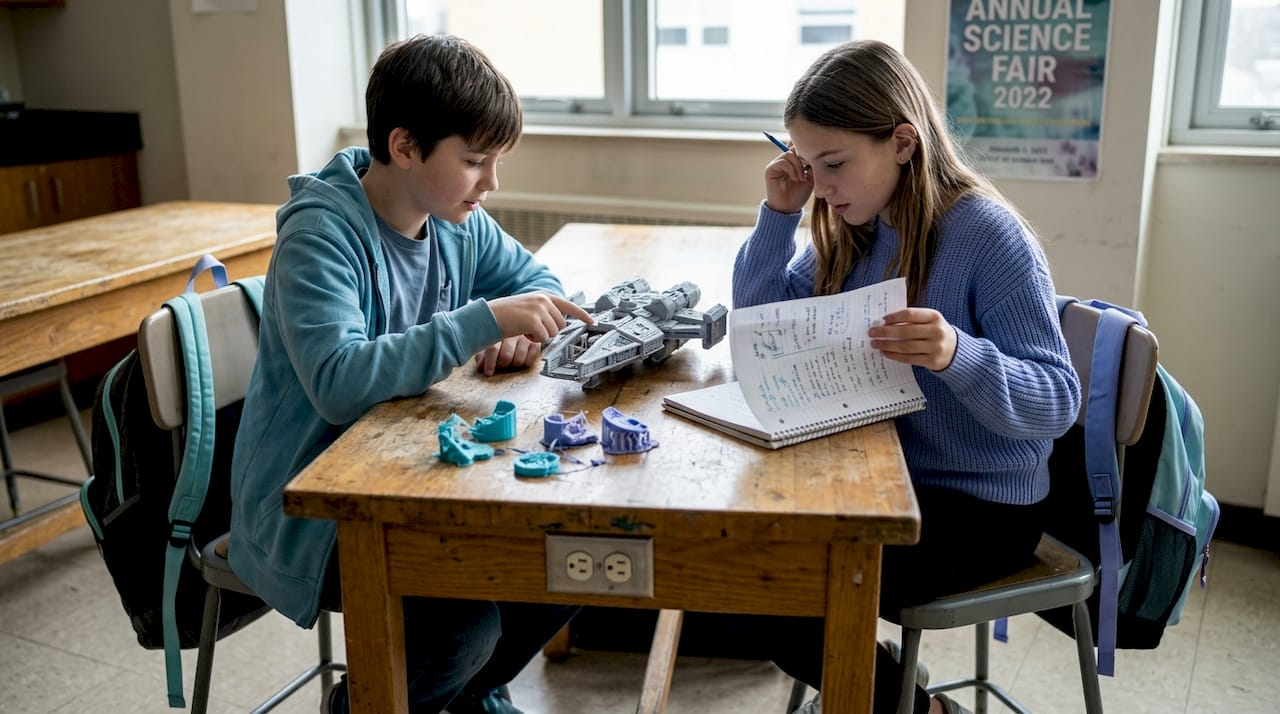
At the university level, the impact shifts slightly. Rather than boosting content recall, 3D printing in higher education tends to strengthen design thinking, iterative problem-solving, and the connection between theoretical knowledge and functional prototypes. Engineering programs that integrate challenge-based learning with 3D prototyping report improvements in prototype quality alongside stronger critical thinking and creativity outcomes.
Here is a snapshot of documented outcomes across educational levels:
| Setting | Subject area | Outcome measured | Finding |
|---|---|---|---|
| Grade 6 K-12 | Space science | Academic performance | Significant pre-post improvement |
| University engineering | Mechanical design | Prototype quality, creativity | Improved with CBL integration |
| Teacher education | Cross-disciplinary | Skill development, engagement | Enhanced, with noted resource challenges |
| Secondary STEM | Physics/engineering | Spatial reasoning | Measurably improved |
Beyond academic scores, students who work with 3D printers regularly develop skills that traditional instruction struggles to build. These include:
- Spatial reasoning, the ability to mentally rotate and visualize objects in three dimensions
- Iterative design thinking, understanding that a first attempt is a starting point, not a final product
- Technical communication, translating an idea from words to a CAD model that a machine can execute
- Material awareness, learning how real-world choices like wall thickness and infill density affect function
Prioritizing quality in educational 3D prints matters more than many educators initially expect. A poorly printed model with visible layer delamination or warped geometry can actually confuse students rather than help them. When the physical artifact is accurate and well-made, the learning it enables is far more reliable.
Key stat: The Grade 6 study used a structured pre-post test design, one of the strongest formats for measuring actual learning gains, making its findings more credible than typical anecdotal classroom reports.
Implementing 3D printing: Practical methods and proven frameworks
Moving from theory to practice requires a clear process. Most successful classroom implementations follow a consistent workflow that educators can adapt regardless of subject area or grade level.
- Define the learning objective first. Before anyone opens design software, identify what students need to understand or be able to do. The print should serve the objective, not the other way around.
- Model and design. Students create or modify a 3D model using tools like Tinkercad (beginner-friendly) or Fusion 360 (more advanced). This stage builds CAD literacy and spatial thinking.
- Slice the model. Slicing software (such as Cura or PrusaSlicer) converts the 3D design into printer instructions. Students learn about layer height, print speed, support structures, and infill, all legitimate engineering considerations.
- Print and evaluate. The physical object emerges, and students immediately compare it against their intentions. Does it match? If not, why? What would they change?
- Iterate. Redesign based on findings. This is where the deepest learning happens, when students treat failure as data.
This workflow maps naturally onto both PBL and CBL frameworks. In PBL, students might design a water filtration prototype over several weeks. In CBL, they might be given a specific structural challenge, like building a bridge that holds a set weight using minimal material, and iterate until they meet it.
The TPACK model recommends that teacher training programs focus on design intent and materials science alongside printer operation. A teacher who understands why a model is printed a certain way can guide students far more effectively than one who only knows how to press “print.”
For higher education specifically, DfAM (Design for Additive Manufacturing) coursework offered by organizations like ASTM International and Wohlers Associates provides a rigorous, industry-aligned curriculum framework that engineering departments can integrate directly.
| Approach | Best for | Key benefit | Limitation |
|---|---|---|---|
| PBL (Project-Based Learning) | K-12 through undergrad | Authentic deliverables, sustained engagement | Requires significant planning time |
| CBL (Challenge-Based Learning) | University engineering | Real constraints, iterative improvement | Needs access to reliable printers |
| TPACK-driven PD | Teacher training | Balances tech, pedagogy, and content | Requires ongoing professional development |
| DfAM coursework | Higher education | Industry-ready skills, materials knowledge | Specialized, less accessible for K-12 |
Pro Tip: When designing reliable prints for classroom use, orient models to minimize overhangs and maximize contact with the build plate. This reduces failed prints dramatically, which is critical when class time is limited.
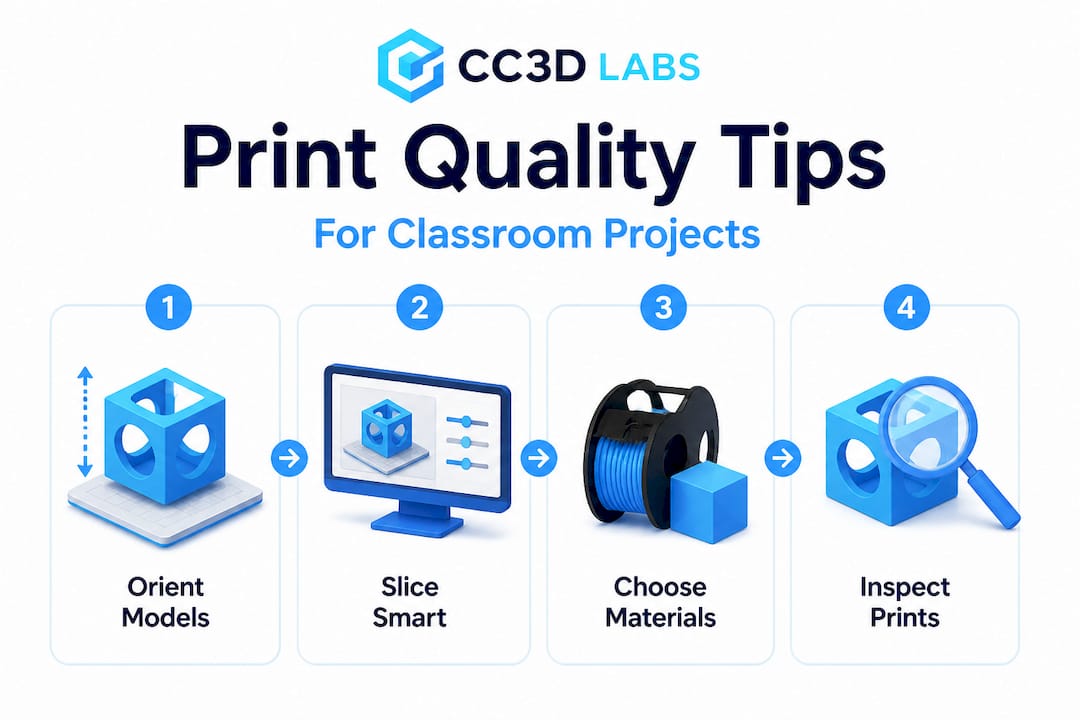
Choosing classroom 3D printing materials is equally important. PLA is beginner-friendly and biodegradable, making it a sensible starting point. PETG offers better durability and impact resistance for models students will handle frequently. ABS is harder to print reliably without an enclosure and is better suited to university engineering labs than middle school classrooms.
Real-world challenges and sustainable solutions
The research is clear, and the frameworks are solid. But every administrator knows that implementation is where the best plans meet real friction. Understanding the most common barriers lets you address them before they derail your program.
School 3D printing challenges documented in research include:
- High upfront cost for hardware, filament, and software licenses
- Insufficient teacher training, leaving educators unsure how to connect printing to curriculum
- Equipment maintenance, as consumer-grade printers require regular calibration and part replacement
- Time pressure, since even a small print can take 30 to 90 minutes, creating scheduling challenges
- Model fragility, where thin-walled or poorly designed prints break during normal classroom handling
- Curriculum misalignment, where printing becomes a standalone activity disconnected from learning standards
Each of these has a practical solution.
For cost, start with one or two reliable FDM printers rather than a lab full of cheaper units. A single, well-maintained Prusa or Bambu machine produces better outcomes than five poorly supported alternatives. Apply for S.T.E.M. grants, many of which specifically list additive manufacturing as a fundable technology.
For teacher training, invest in hands-on workshops before any printer arrives. Teachers who have designed, sliced, and printed something themselves before teaching it are far more confident and effective. Schedule dedicated prep time in the weeks before launch.
For maintenance, designate a student “print crew” or a faculty tech lead responsible for machine upkeep. Clear protocols for calibration, bed leveling, and nozzle cleaning extend printer lifespan significantly.
For model fragility, material selection for durability is the first line of defense. PETG prints tend to survive classroom handling far better than PLA when models will be passed around repeatedly. Increasing wall thickness and infill percentage in the slicing settings also improves resilience without adding major print time.
Pro Tip: Pre-slice and pre-queue print jobs during the week before a project unit. Running printers during non-class hours, overnight or on weekends, eliminates the in-class wait time problem entirely and keeps the learning momentum high.
Why a curriculum-first mindset matters for 3D printing success
Here is the uncomfortable pattern we see repeatedly: schools invest in printers, run a few exciting demo sessions, generate some social media buzz, and then watch utilization drop sharply after the first semester. The printers gather dust. Teachers feel guilty they’re not using them. The technology gets blamed.
The technology is rarely the problem. The planning is.
Most failed 3D printing programs start with the machine and work backward toward a justification. They buy the printer, then ask, “What can we print?” The better question is always, “What do students need to understand, and can a physical model help?” When the answer to that second question is yes, 3D printing becomes a powerful instructional tool. When it’s no, the printer should sit this one out.
Research reinforces this. Expert guidance on DfAM integration emphasizes curriculum-first thinking over tool-centric approaches. The most effective university programs start by teaching design intent and materials science, then introduce the printer as the tool that makes the design real. The machine serves the curriculum, not the other way around.
This mindset shift has real consequences for administrators making purchasing decisions. Before buying equipment, map out at least one full semester of curriculum units where 3D printing has a clear, documented role. Identify the learning standard, the student output, and the assessment. If you can’t fill a full semester with purposeful use, start smaller.
The creative integrations in curriculum that generate the best student outcomes share a common trait: the teacher designed the learning experience before opening any design software. The printer was the final step in a well-planned instructional sequence, not the starting point.
Students don’t benefit from 3D printing because it’s exciting. They benefit because it gives their thinking a physical form, and that physical form reveals gaps, errors, and insights that no worksheet ever could.
Explore 3D printing solutions for your school
Whether you’re building a new maker program, scaling an existing one, or looking to print higher-quality models than your current equipment allows, professional support makes a real difference.
At CC 3D Labs, we work with educators and institutions to produce precise, durable educational 3D printing applications ranging from anatomical models and engineering prototypes to visual aids and architectural scale models. Our filament-based 3D printing services for schools include multi-color prints, CAD support, and quick turnaround times that work around your academic schedule. When you need custom 3D prints that meet specific dimensional or material requirements, we can help you get them right the first time. Request a free online estimate and find out what’s possible for your program.
Frequently asked questions
What skills do students gain from 3D printing in school?
Students develop problem-solving, creativity, spatial reasoning, and design thinking, particularly in STEM subjects. Research shows that challenge-based learning with 3D printing specifically improves prototype quality and fosters iterative, critical thinking in engineering courses.
What are the biggest challenges for schools adopting 3D printing?
Key challenges include high costs, teacher training gaps, equipment maintenance, time management, and ensuring curriculum alignment. These documented barriers are consistent across K-12 and higher education settings, but each has a practical solution when addressed proactively.
How should schools train teachers for 3D printing integration?
Effective training uses hands-on workshops, curriculum-first planning, and frameworks like TPACK to build confidence and skills. Programs that follow structured teacher development methodologies produce educators who can connect the technology to specific learning outcomes rather than using it as a standalone activity.
What materials are recommended for classroom 3D printing?
PETG is a strong choice for school environments because it offers durability, impact resistance, and manageable print settings. Guidance for administrators recommends prioritizing PETG filament alongside accessible FDM printers for the best combination of cost-effectiveness and classroom durability.