
TL;DR:
- Advanced 3D modeling involves precision parametric design, organic sculpting, and AI workflows that ensure models are production-ready. It relies on geometric representations like polygon meshes, NURBS, and parametric constraints to create models that survive manufacturing, animation, and visualization processes. Mastering topology, UV mapping, and hybrid workflows enables professionals to produce high-quality models efficiently across industries.
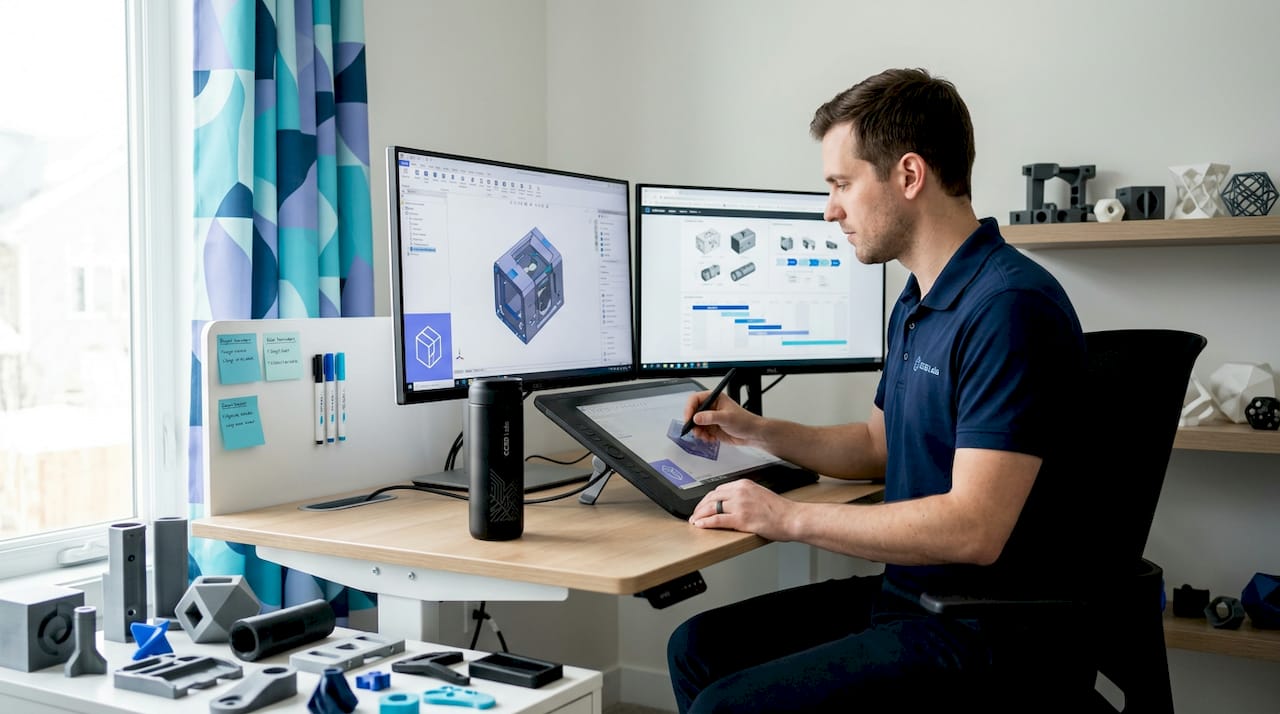
Advanced 3D modeling is far more than placing shapes on a digital canvas. When you ask what is advanced 3D modeling, the real answer involves precision parametric design, organic sculpting, intelligent topology management, and AI-assisted workflows that together produce models ready for manufacturing, animation, and architectural visualization. At its core, 3D models represent shape, size, and texture through polygon meshes and mathematical surfaces. This article breaks down the techniques, tools, real-world applications, and emerging trends you need to understand if you want to apply advanced modeling skills to serious design and prototyping work.
Table of Contents
- Key Takeaways
- What advanced 3D modeling actually means
- Advanced 3D modeling techniques and workflows
- Benefits and practical applications
- Challenges and what comes next
- My take on mastering advanced 3D modeling in 2026
- Turn your advanced models into physical reality with Cc3dlabs
- FAQ
Key Takeaways
| Point | Details |
|---|---|
| Beyond basic shapes | Advanced 3D modeling combines parametric precision, sculpting, and AI workflows rather than simple geometry creation. |
| Technique diversity matters | Professionals merge CAD, NURBS, and freeform sculpting in hybrid workflows to solve complex spatial and artistic problems. |
| AI assists but does not replace | AI tools accelerate base modeling and texturing while skilled artists handle refinement and production standards. |
| Applications span industries | Manufacturing, gaming, architecture, and virtual production all rely on advanced modeling for prototyping and visualization. |
| Fundamentals drive AI success | Mastering topology and UV mapping remains critical even when AI-generated assets enter the pipeline. |
What advanced 3D modeling actually means
Most people associate 3D modeling with creating a rough shape and slapping a texture on it. Advanced 3D modeling sits in a completely different category. It is the discipline of constructing digital geometry with intentional precision, structural logic, and production readiness baked into every decision you make from the first polygon to the final export.
The mathematical foundation matters here. Advanced models rely on three primary geometric representations:
- Polygon meshes: Grids of vertices, edges, and faces that define surface geometry. Fast to render but require careful topology management to deform cleanly and print accurately.
- NURBS (Non-Uniform Rational B-Splines): Mathematically smooth curves and surfaces used heavily in industrial CAD. They produce watertight, precise geometry ideal for engineering tolerances.
- Parametric constraints: Rules and relationships embedded in the model so that changing one dimension automatically updates dependent features throughout the entire design.
The gap between basic and advanced 3D modeling is not just about software complexity. It is about whether your model can survive a real production pipeline. An advanced model transfers cleanly between software environments, holds up under manufacturing tolerances, animates without mesh artifacts, and can be iterated without rebuilding from scratch.
Advanced modeling software today covers a spectrum from parametric CAD platforms to freeform sculpting environments. Each serves a different purpose, and understanding when to use which is part of what separates professionals from beginners. AI’s emerging role in this field is shifting artists from manual geometry creation toward high-level prompt engineering and iterative refinement, but the underlying principles of good modeling have not changed.
Pro Tip: If you are evaluating whether your modeling skills qualify as “advanced,” ask yourself this: can your models survive a file format conversion, a topology audit, and a manufacturing review without significant rework? If the answer is no, that is your learning roadmap.
Advanced 3D modeling techniques and workflows
The techniques that define professional-grade advanced 3D modeling are not learned in isolation. They layer on top of each other in workflows that combine structure, detail, and artistic expression. Here is how the major techniques build on each other in practice:
-
Parametric modeling. You define geometry through constraints and relationships rather than direct manipulation. Change the wall thickness of a housing component and every connected feature updates automatically. This is the backbone of product design and engineering work, where parametric and generative design solve spatial problems with precision rather than aesthetic guesswork.
-
Freeform sculpting. Digital sculpting tools let you manipulate virtual clay-like geometry using symmetry, layers, and dynamic remeshing. The priority at this stage is artistic freedom before technical constraints. Characters, organic products, and architectural details all benefit from sculpting workflows that capture nuance no parametric tool can match.
-
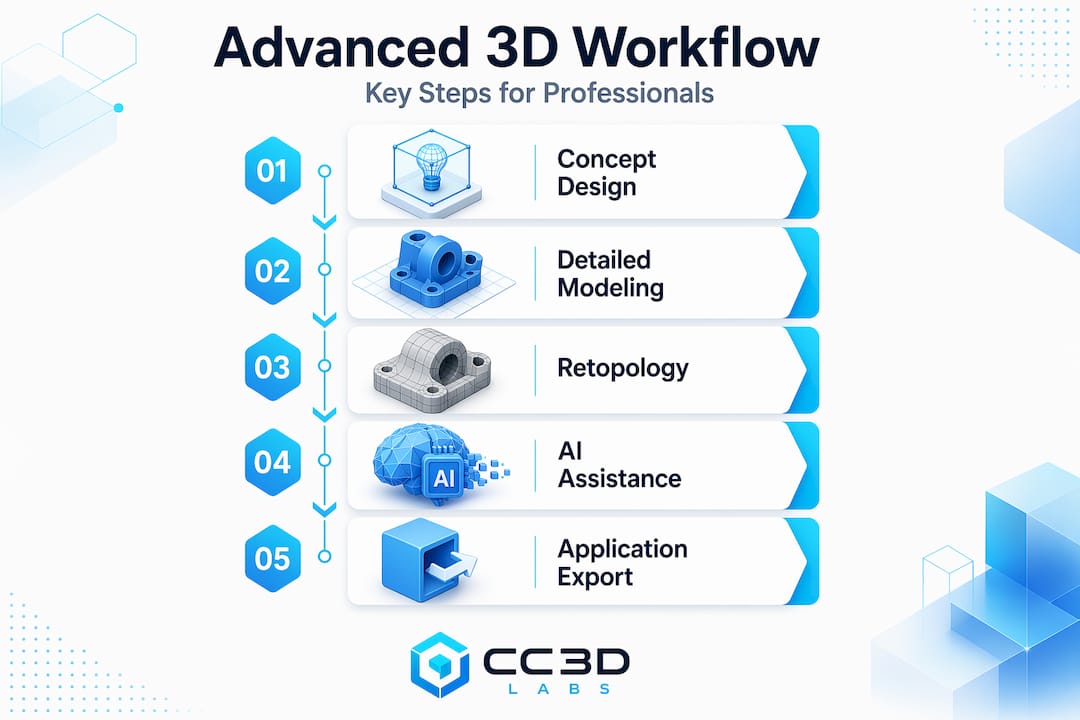
Hybrid CAD-sculpt integration. This is where advanced workflows get genuinely complex. Hybrid workflows use CAD for structural precision and sculpting tools for high-detail organic surfaces, requiring careful translation between NURBS and polygon mesh formats. A product designer might build the structural shell in a CAD environment, export to a sculpting tool for surface detailing, and then retopologize before returning to CAD for final manufacturing prep.
-
Topology and UV mapping. Clean topology means your mesh deforms predictably for animation and prints without internal geometry conflicts. UV mapping unfolds the 3D surface into a 2D space so textures apply correctly without stretching. These two disciplines are unglamorous but are the difference between a model that works and one that causes problems downstream.
-
Texture baking and iterative refinement. Baking transfers high-resolution surface detail from a dense sculpt onto a lighter mesh, preserving visual quality without the polygon count that would slow rendering or fail in a game engine. Iterative refinement means reviewing the model at each stage, catching problems before they compound.
Pro Tip: Learn retopology before you need it urgently. Most professionals wish they had learned proper edge flow earlier. Bad topology is the most common reason a client’s model gets rejected at the manufacturing or rigging stage.
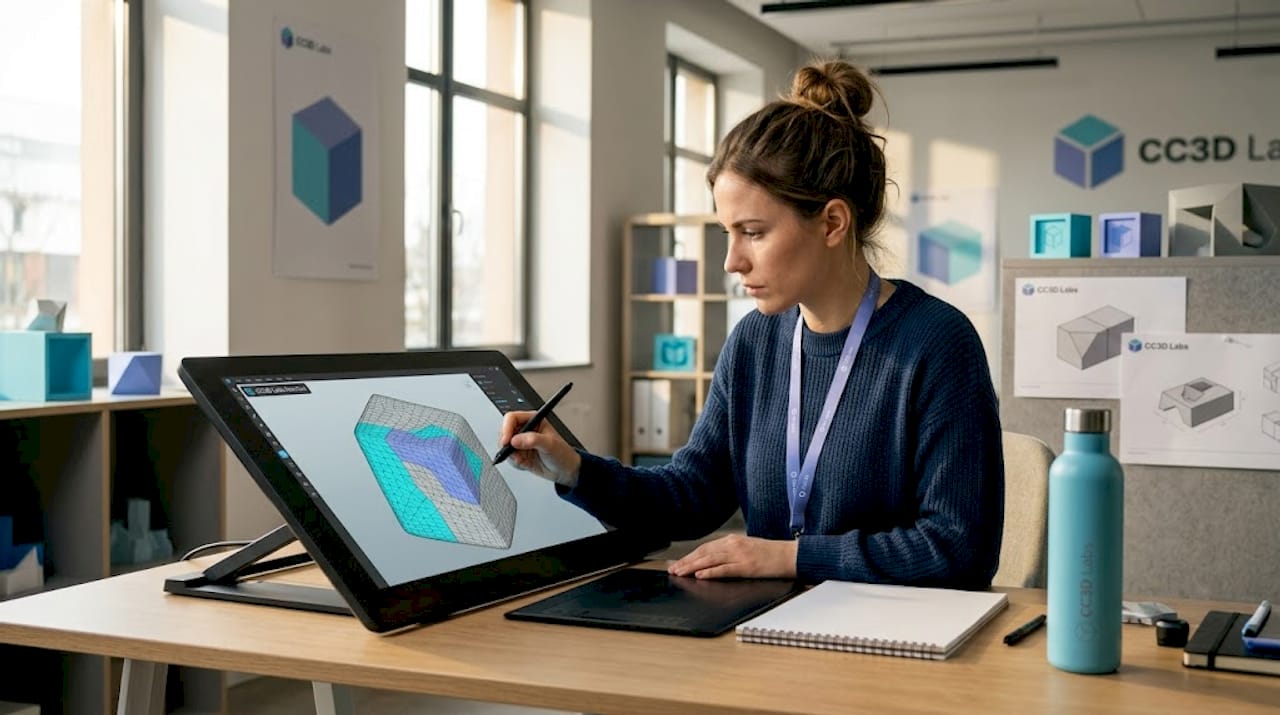
AI tools are now entering every step of this workflow. AI-assisted features like automated retopology and intelligent mesh deformation compress timelines significantly. Tools like Meshy.ai produce multiple model variations rapidly for stylized and mid-polygon assets, making iteration faster than ever for the right project types.
Benefits and practical applications
Understanding the benefits of advanced 3D modeling is straightforward once you see where it connects to real project outcomes. Advanced modeling is not a luxury skill. It is how serious design and manufacturing work gets done.
Here is where the practical value shows up most clearly:
- Product prototyping. Advanced modeling improves manufacturing and design processes by enabling precise, adaptable, high-fidelity models. Instead of discovering a fit problem during physical assembly, you catch it in the parametric model and update the design in minutes.
- Architecture and spatial design. Architects using parametric tools can test structural configurations and aesthetic variations within the same model file, reducing costly design revisions. Digital tools in construction can reduce project costs measurably when modeling accuracy drives early-stage decisions.
- Gaming and virtual production. Character artists combine sculpting for hero detail and retopology for real-time game engines. The same pipeline feeds into virtual production environments where physical accuracy and visual fidelity both matter.
- Manufacturing visualization. Engineers use advanced 3D models to simulate assembly sequences, stress test components virtually, and communicate design intent across global teams before a single physical part is produced.
| Application Area | Primary Modeling Approach | Key Benefit |
|---|---|---|
| Product design | Parametric CAD | Precise tolerances, fast iteration |
| Character and creature art | Freeform sculpting | Organic detail, artistic control |
| Architecture | Hybrid parametric and mesh | Spatial problem solving, visualization |
| 3D printing and prototyping | CAD to mesh pipeline | Printable geometry, manufacturing accuracy |
| Gaming and real-time environments | Retopologized sculpts | Optimized poly count, clean deformation |
The creative freedom argument is real too. Sculpting gives artists control that box-modeling never could. But the most powerful outcome of advanced 3D modeling is speed with quality. When your workflow is solid, you can go from concept to print-ready or render-ready file faster than any earlier generation of designers.
Challenges and what comes next
Advanced 3D modeling is not a skill you pick up over a weekend. The challenges are genuine, and the field is changing fast enough that even experienced modelers need to keep adapting.
The persistent technical challenges include:
- Topology cleanup. AI-generated models often require significant retopology before they are production ready. Post-generation cleanup includes retopology and fixing non-manifold geometry to ensure compatibility with rendering engines and 3D printing workflows.
- Format interoperability. Moving models between CAD, sculpting, and rendering environments often introduces data loss or geometry errors. Managing NURBS and polygon meshes without losing design intent is one of the most technically demanding aspects of hybrid workflows.
- Skill gaps in texture pipelines. Junior artists often need mentorship to master topology, UV mapping, and texture pipelines even when they are working with advanced software. The tools do not teach the judgment.
“AI effectively lowers the skill floor and compresses timelines significantly, but the ceiling is still defined by the human who refines and directs the work.”
Looking forward, the field is moving toward real-time sculpting in collaborative cloud environments, spatial computing interfaces that let designers manipulate geometry physically, and AI that can handle increasingly complex base model generation. The artists who will succeed are those treating AI as a skilled collaborator rather than a replacement for foundational knowledge.
My take on mastering advanced 3D modeling in 2026
I have watched a lot of people approach advanced 3D modeling the same way. They jump to the most sophisticated software they can find, spend weeks learning its interface, and then produce work that falls apart the moment a client needs it to be printable or rigged. What I have learned is that the fundamentals are not the boring part. They are the part that makes everything else possible.
The most capable modelers I know are not the ones who adopted AI tools first. They are the ones who understand why topology flows a certain way, what happens when geometry is non-manifold, and how UV seams affect texture quality. Because they understand those things, they can direct AI tools effectively and fix what the automation gets wrong. My honest advice: spend real time on topology, spend real time on the math behind your surfaces, and then let AI speed up the work you already understand. The 3D modeling and CAD project gallery at Cc3dlabs is a good place to see what production-ready advanced modeling actually looks like in practice.
— Justin
Turn your advanced models into physical reality with Cc3dlabs
Advanced 3D modeling is where precision design begins. But the real test of any model is whether it survives contact with the physical world. Cc3dlabs, located near Philadelphia, works directly with designers, engineers, and product developers to take advanced 3D models through to high-quality printed parts. Their 3D printing services cover everything from single prototypes to batch production runs, with filament-based printing capable of meeting tight tolerances for functional parts. They also offer professional handheld 3D scanning (accuracy to ~0.1 mm), which feeds directly into advanced modeling workflows when you need to capture existing geometry accurately. If you are ready to validate your design in the real world, Cc3dlabs offers free online estimates and local pickup for Philadelphia-area clients.
FAQ
What is advanced 3D modeling?
Advanced 3D modeling is the practice of creating production-ready 3D geometry using parametric constraints, freeform sculpting, and topology management techniques that go beyond basic shape creation. It encompasses both CAD-driven precision and artistic sculpting workflows, often combined in hybrid pipelines.
How is advanced 3D modeling different from basic 3D modeling?
Basic 3D modeling produces simple geometry for visualization purposes. Advanced 3D modeling produces models with clean topology, accurate tolerances, proper UV mapping, and the structural integrity needed for animation, manufacturing, or 3D printing.
What software is used for advanced 3D modeling?
Professionals use a range of advanced modeling software depending on the application, including parametric CAD platforms for engineering and sculpting tools for organic design. Many advanced workflows combine multiple software environments, translating between NURBS-based and polygon-based geometry.
How does AI fit into advanced 3D modeling workflows?
AI tools generate base models and automate tasks like retopology and mesh deformation, but post-generation cleanup is still required for production-ready assets. AI shifts the artist’s role toward high-level direction and refinement rather than eliminating the need for technical skill.
How do I learn advanced 3D modeling?
Start by building a strong foundation in topology, UV mapping, and at least one parametric CAD platform. Then layer in sculpting tools and hybrid workflows. Working with real production constraints, such as preparing models for 3D printing, accelerates learning faster than purely artistic projects.