
TL;DR:
- Proper print settings, like raster angle, significantly impact part strength and reliability.
- High-quality 3D prints enhance prototype performance, surface finish, and business confidence.
- Investing in precise printing technologies like SLA reduces rework, improves testing, and speeds up development.
A single print setting change can destroy a part before it ever reaches testing. When the raster angle in a PLA or ABS print sits at 90°, flexural strength drops by more than 40%, turning what looks like a solid component into a liability waiting to crack under load. For businesses and product developers, that kind of failure doesn’t just waste filament. It delays launches, burns through revision budgets, and undermines confidence in your entire development process. This article breaks down exactly how quality decisions in 3D printing ripple through your prototype performance, surface finish, and business outcomes, with data to back it up.
Table of Contents
- What defines quality in 3D prints
- How quality affects prototype performance and outcomes
- Surface finish, aesthetics, and functionality: Why they matter
- Business case: High-quality 3D printing for innovation and investment
- Our take: The hidden risks and rewards of prioritizing 3D print quality
- Unlock high-quality 3D printing with CC3DLabs
- Frequently asked questions
Key Takeaways
| Point | Details |
|---|---|
| Print quality drives reliability | High-quality prints are essential for functional and durable prototypes that can withstand testing and daily use. |
| Surface finish affects perception | Smooth and precise finishes enhance both the usability and professional appearance of 3D printed parts. |
| Invest in quality upfront | Businesses save time and resources when they prioritize quality from the start rather than fixing issues later. |
| SLA outperforms FDM for precision | For the highest accuracy and best surface finish, SLA printing is preferred, especially for critical business prototypes. (A note on scope: production at CC 3D Labs runs on a calibrated FDM print farm — when a prototype genuinely needs SLA-level finish, we’ll say so and point you to the right process.) |
What defines quality in 3D prints
Quality in 3D printing is not a single number on a spec sheet. It’s a combination of measurable parameters that together determine whether a part performs the way your team designed it to perform. Understanding each parameter helps you make smarter decisions before a single layer is printed.
The three pillars that define quality in business and product development contexts are dimensional accuracy, surface finish, and material consistency. Each one affects a different stage of your product cycle.
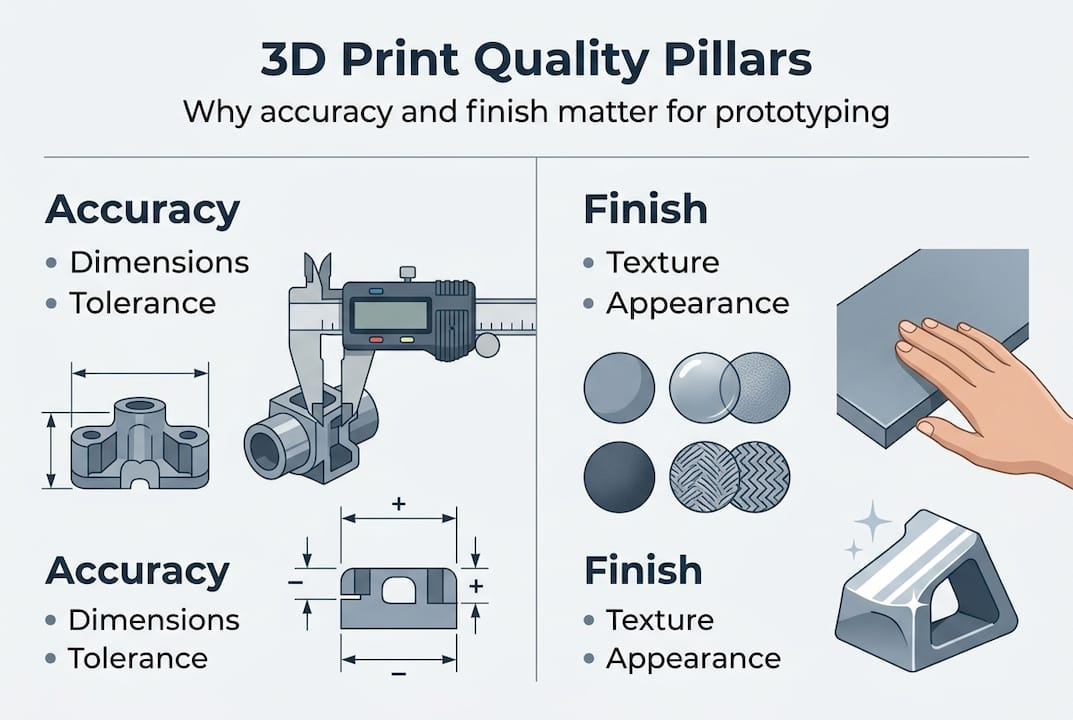
Dimensional accuracy is how closely the printed part matches the intended design. In engineering terms, you’re looking at tolerances, which represent how far off the actual dimensions can be from the CAD model before the part fails its function. For fit-critical assemblies, like snap-fit enclosures or interlocking mechanical components, tolerances tighter than 0.2mm are often essential. Good print accuracy for prototyping depends on machine calibration, material behavior during cooling, and how the model is oriented on the build platform.
Surface finish is measured using roughness average, or Ra, a standard metric that tells you how much texture exists on a part’s surface. A lower Ra value means a smoother surface. SLA printing achieves Ra≈2μm while FDM typically lands between 12 and 13μm, which is a dramatic difference that directly affects how much post-processing you’ll need and whether the part functions correctly in tight assemblies.
Material consistency refers to how uniformly the filament or resin deposits from layer to layer. Inconsistent extrusion creates voids, weak spots, and surface defects that compromise structural integrity. This parameter is often overlooked until a batch of parts fails quality inspection.
Here are the key quality metrics that matter for business applications:
- Layer adhesion strength: How well each layer bonds to the one below it
- Warping and dimensional distortion: Especially critical for large flat parts
- Overhang quality: How well unsupported sections hold their shape
- Infill density and pattern: Determines internal strength versus weight trade-off
- Wall thickness consistency: Critical for pressure-bearing or load-bearing components
Different printing technologies deliver dramatically different results across these metrics. FDM (Fused Deposition Modeling) is cost-effective and fast, but its layer-by-layer nature creates visible lines and weaker inter-layer bonds. SLA (Stereolithography) uses UV-cured resin and achieves much finer detail with superior surface finish. For a developer comparing technologies, the right choice comes down to which quality parameters matter most for the specific part. Knowing how to approach designing reliable prints from the start gives your team a significant upstream advantage.
Statistic callout: SLA surface finish (Ra≈2μm) is up to six times smoother than FDM output (Ra≈12–13μm), which can cut post-processing time significantly for parts requiring tight surface tolerances.
How quality affects prototype performance and outcomes
Defining quality parameters is one thing. Seeing how they play out in real prototype testing is where those parameters become urgent business concerns. Poor quality doesn’t just produce ugly parts. It produces parts that fail, and often at the worst possible moment.
Layer delamination, warping, and reduced strength are the most common mechanical failures tied directly to print quality decisions. Layer delamination happens when inter-layer adhesion is insufficient, often due to incorrect print temperatures or poor material selection. Warping occurs when cooling is uneven, causing internal stresses that pull the part away from the build plate. Both failures are preventable with correct settings and experience.

The flexural strength data is particularly important for structural components. A raster angle set incorrectly doesn’t just reduce strength by a few percent. It reduces it by more than 40%, which means a part that should handle 500N of force may fail at under 300N. For a prototype going through functional load testing, that’s the difference between a passing result and a catastrophic test failure.
Here’s a side-by-side comparison of how quality levels affect prototype outcomes:
| Quality factor | High quality print | Low quality print |
|---|---|---|
| Layer adhesion | Strong, consistent bonds | Delamination risk under load |
| Dimensional accuracy | Within 0.1–0.2mm | May exceed 0.5mm variance |
| Surface finish | Low Ra, minimal post-processing | High Ra, extensive sanding needed |
| Flexural strength | Near design specification | Up to 40%+ below specification |
| Iteration cycles | Fewer, faster | More, slower, costlier |
The business implications stack up fast. Each failed prototype test means another round of redesign, reprinting, and retesting. That cycle costs time and budget. For teams working toward a product launch or investor pitch, those delays can shift timelines by weeks or months.
“Quality in prototyping is not just about aesthetics. It’s about whether the part tells you truthful information about your product’s performance. A low-quality prototype gives you unreliable test data, and that’s worse than no prototype at all.”
Here’s a practical workflow for protecting your prototypes from quality-related failures:
- Verify material specs before printing. Confirm tensile strength, thermal resistance, and layer bonding characteristics match your application.
- Set correct raster angles based on the primary load direction of the part in use.
- Run a test print of a small representative section before committing to a full part.
- Inspect layer adhesion visually and with a basic flex test before any functional testing begins.
- Document print settings so successful configurations can be repeated reliably across batches.
Pro Tip: Before sending any functional prototype for investor review or load testing, always request a layer adhesion check on representative sample sections. This simple step catches the most common failure mode before it costs you a valuable opportunity. Reviewing a quality prototyping guide before your first print run can also flag issues early.
The path to durable prototype parts runs directly through deliberate quality choices at every step of the printing process, not just at the design stage.
Surface finish, aesthetics, and functionality: Why they matter
Surface finish tends to get categorized as a cosmetic concern. That’s a costly mistake. The texture of a printed surface directly affects how parts fit together, how they seal, how they feel in a user’s hand, and how much finishing labor your team needs to invest before a part is usable.
SLA achieves Ra≈2μm versus FDM’s 12–13μm, and that difference translates into real functional consequences. A part with a rougher surface creates more friction in sliding assemblies, requires more adhesive for bonding, and may not pass a sealing test for fluid-carrying components. For injection mold patterns, master models, or display prototypes for investor meetings, surface finish is every bit as critical as dimensional accuracy.
Here’s a practical breakdown of surface finish by application:
| Application type | Recommended finish (Ra) | Best technology |
|---|---|---|
| Investor display models | Below 4μm | SLA or post-processed FDM |
| Functional mechanical parts | 5–10μm | FDM with calibrated settings |
| Mold masters and tooling patterns | Below 3μm | SLA |
| Concept models for internal review | 10–15μm | Standard FDM |
| End-use consumer products | Below 6μm | SLA or post-processed FDM |
The post-processing question is directly tied to surface finish quality. A part printed with FDM at 12–13μm Ra needs sanding, priming, and sometimes painting before it’s presentable for external stakeholders. Each of those steps adds time and introduces variability. An SLA part with Ra≈2μm may need only a light polish, dramatically reducing prep time and ensuring more consistent results across a batch.
Benefits of prioritizing surface finish in product development:
- Reduces post-processing labor by minimizing sanding and filling requirements
- Improves dimensional accuracy of finished parts by removing the need for aggressive material removal
- Enhances perceived quality during client presentations and investor demos
- Ensures functional fit for assemblies with tight tolerances
- Lowers rejection rates in quality inspection
Pro Tip: Match your post-processing approach to the actual intended use of each part. An internal stress-test prototype doesn’t need a mirror finish, but a demo unit going to a potential partner or investor should look production-ready. Planning this distinction upfront saves hours of unnecessary finishing work.
Exploring high-quality filament prototypes gives a clear picture of how far optimized FDM can go when settings and materials are dialed in correctly. For teams starting with FDM who want to maximize surface quality without switching to SLA, a detailed filament printing guide is a practical starting point.
Business case: High-quality 3D printing for innovation and investment
The technical case for quality is clear. But the business case is what drives the decision for most development teams and product managers. High-quality 3D printing isn’t just a production preference. It’s a strategic investment that affects how fast you move, how much you spend, and how convincingly you can present your product to the market.
High-quality prints reduce iteration cycles, produce reliable prototypes for testing and investment pitches, and enable functional end-use parts, with SLA preferred for precision-critical applications despite its higher upfront cost. That last point matters because many teams default to the cheapest option early in development, then discover later that low-quality prototypes generated incorrect test data, leading to design decisions based on flawed information.
The business advantages of committing to quality from the start include:
- Fewer revision cycles: A prototype that accurately represents the final design reduces the number of iterations needed before production.
- More reliable test data: Structural tests and fit checks on high-quality parts give you data you can actually trust for engineering decisions.
- Stronger investor presentations: A professional, precise prototype signals that your team executes at a high level. Investors notice the difference between a rough print and a production-grade model.
- Faster time-to-market: When prototypes perform correctly the first time, the path from concept to production shortens considerably.
- Lower total development cost: Spending more on quality upfront consistently costs less than rerunning multiple rounds of low-quality prototype testing.
Statistic callout: Teams that commit to precision prototyping early in product development consistently report fewer total iteration rounds compared to teams that use low-cost, low-quality prints for initial functional testing. The savings compound as the project scales.
The shift toward functional end-use parts printed directly from files is also accelerating. Businesses no longer use 3D printing just for prototypes. They use it for jigs, fixtures, tooling, end-use components, and short-run production. In all of those contexts, quality directly determines whether the part can do its job reliably over time. Understanding what 3D printing can produce in a professional context helps teams identify where precision printing adds the most value in their workflow.
For teams evaluating providers, the ability to find the right print job for your specific application, rather than settling for a one-size-fits-all solution, is what separates effective use of 3D printing from expensive experimentation.
Our take: The hidden risks and rewards of prioritizing 3D print quality
Here’s what years of working with product development teams has made absolutely clear: the teams that cut corners on print quality at the start always end up spending more by the end. Not sometimes. Always. A low-quality prototype doesn’t save money. It delays the moment when you discover what’s actually wrong with your design, and by that point, you’ve already spent weeks moving in the wrong direction.
The more interesting lesson is about when quality matters most. For very early concept models used only for rough spatial visualization, moderate quality is perfectly acceptable. But the moment a prototype enters functional testing, stress analysis, or stakeholder review, quality becomes non-negotiable. A flawed part in an investor meeting doesn’t just lose that meeting. It raises questions about your execution capability that follow your product into future conversations.
Investing in precision from the point where your prototype carries any external weight, whether physical load or professional credibility, is consistently the decision our most successful clients make. And the foundation for that starts at the design stage. Solid reliable prototype design practices, combined with the right printing technology, eliminate most quality problems before they ever reach the printer.
Unlock high-quality 3D printing with CC3DLabs
Knowing the quality standards you need is step one. Finding a partner who can consistently deliver them is step two.
CC3DLabs, based near Philadelphia, specializes in precision professional 3D printing services for businesses, product developers, and engineering teams that cannot afford the cost of poor-quality prints. From on-demand prototypes built to tight tolerances, to batch production of functional parts, every project gets the attention to detail your development timeline depends on. The team also offers CAD support, design review, and multi-material capabilities so your concept doesn’t get lost in translation between file and finished part. Get a free online estimate today and see exactly what your next prototype could look like when quality isn’t a compromise. Ready to explore print capabilities for your project? Start there.
Frequently asked questions
What causes poor quality in 3D printing?
Incorrect print settings, poor material selection, and inadequate layer adhesion are the most common root causes, and any one of them can produce layer delamination, warping, and reduced strength in finished parts. Addressing these factors before printing, not after, is where quality control actually begins.
How does surface finish impact a 3D printed part’s usability?
A smoother surface finish improves functional fit, reduces friction in moving assemblies, and cuts post-processing time significantly. Because SLA achieves Ra≈2μm compared to FDM’s 12–13μm, the technology choice itself is often the biggest lever for surface quality.
Why should businesses invest in high-quality prototypes?
High-quality prototypes produce reliable test data, reduce the total number of revision cycles, and make a far stronger impression in investor and stakeholder settings. Research confirms that high-quality prints reduce iteration cycles and enable functional end-use applications that lower-quality prints simply cannot support.
Which 3D printing technology offers the best quality?
SLA printing consistently delivers the best surface finish and dimensional accuracy for precision prototypes, with Ra values around 2μm compared to FDM’s typical 12–13μm range. The trade-off is higher material and equipment cost, which is why SLA is best reserved for prototypes where surface finish and accuracy directly affect test outcomes or stakeholder presentation.