

TL;DR:
- Getting a 3D print quote requires a clean CAD file, clear project details, and understanding the cost factors involved. Accurate quotes depend on proper file formats, specified materials, quantities, and end-use information, with larger batch sizes lowering per-unit costs. Comparing quotes effectively involves confirming identical parameters and requesting detailed breakdowns to avoid surprises.
Getting a quote for custom 3D printing means submitting your CAD files and project details so a provider can calculate costs based on material, machine time, and post-processing requirements. The industry term for this process is a “print estimate request,” though most clients simply call it requesting a custom 3D print quote. Accurate quotes depend entirely on the quality of information you provide upfront. Providers like Cc3dlabs review file geometry, material suitability, and batch size before confirming any price. This guide covers what to prepare, how to submit your request, what drives pricing, and how to compare quotes with confidence.
What do you need to prepare before getting a quote for custom 3D print?
The single most important step before requesting a quote is preparing a proper 3D CAD file. Accurate quotes require CAD formats like STL, STEP, or 3MF with clean, watertight geometry. A 2D drawing or a photo gives a provider zero volume or geometry data to price from. If your file has open surfaces, inverted normals, or non-manifold edges, expect delays or a request to resubmit.
Beyond the file itself, you need to define your project parameters clearly before you reach out. Here is what to gather:
- Material type and grade. Specify whether you need PLA, PETG, ABS, ASA, TPU, or an engineering-grade filament. Each carries a different cost and performance profile.
- Color and finish. Note your target color and whether you need a raw print, light sanding, priming, or a painted finish.
- Quantity and batch size. State your exact quantity. Pricing changes significantly at volume thresholds.
- Functional requirements. Describe the end use. A bracket that holds 50 lbs needs different material and infill than a display model.
- Tolerances and fit. If the part mates with another component, specify the clearance or tolerance class.
- Deadline and delivery. Include your hard deadline and whether local pickup or shipping applies.
Pro Tip: Send a dimensioned drawing or reference image alongside your CAD file. It gives the reviewer context that geometry alone cannot communicate, especially for parts with critical mating surfaces.
Clarifying end-use application at the quoting stage is critical to selecting the correct materials and quality controls. Skipping this step leads to reprints, cost overruns, and missed deadlines.
How do you request a custom 3D print quote step by step?
Submitting a quote request is straightforward when you follow a clear sequence. Skipping steps creates back-and-forth that delays your estimate by days.
- Upload your 3D file. Use the provider’s online form or email. Cc3dlabs accepts STL, STEP, and 3MF files through its online quote request form. Compress multiple files into a single ZIP archive to avoid attachment issues.
- Select your material and technology. Choose the filament type and, if relevant, the print technology. Filament-based FDM is the most common and cost-effective option for functional parts and prototypes.
- Specify quantity tiers. Do not request a price for one quantity only. Ask for pricing at two or three volume levels so you can plan economically.
- Add post-processing instructions. State whether you need support removal only, sanding, priming, or a specific surface treatment. Providers price these separately.
- Note any special requirements. Include color matching references, insert hardware needs, or assembly requirements.
- Confirm your deadline. State whether your timeline is flexible or fixed. Rush orders carry a price premium.
- Wait for manual review. Most professional providers follow up with questions before confirming a final price. This is normal and necessary.
Pro Tip: Request pricing for 10, 50, and 200 units in the same submission. Batch pricing tiers reveal economies of scale that can shift your production strategy entirely.
One critical distinction: an instant online estimate and a confirmed professional quote are not the same thing. Final professional quotes often come in above automated calculator outputs because manual review catches wall thickness issues, support complexity, and failure risk that algorithms miss. Treat any instant number as a rough budget figure, not a binding price.
What factors drive custom 3D print pricing?
Custom 3D print pricing is not a single line item. It is a sum of several distinct cost components, each of which you can influence with better project planning.
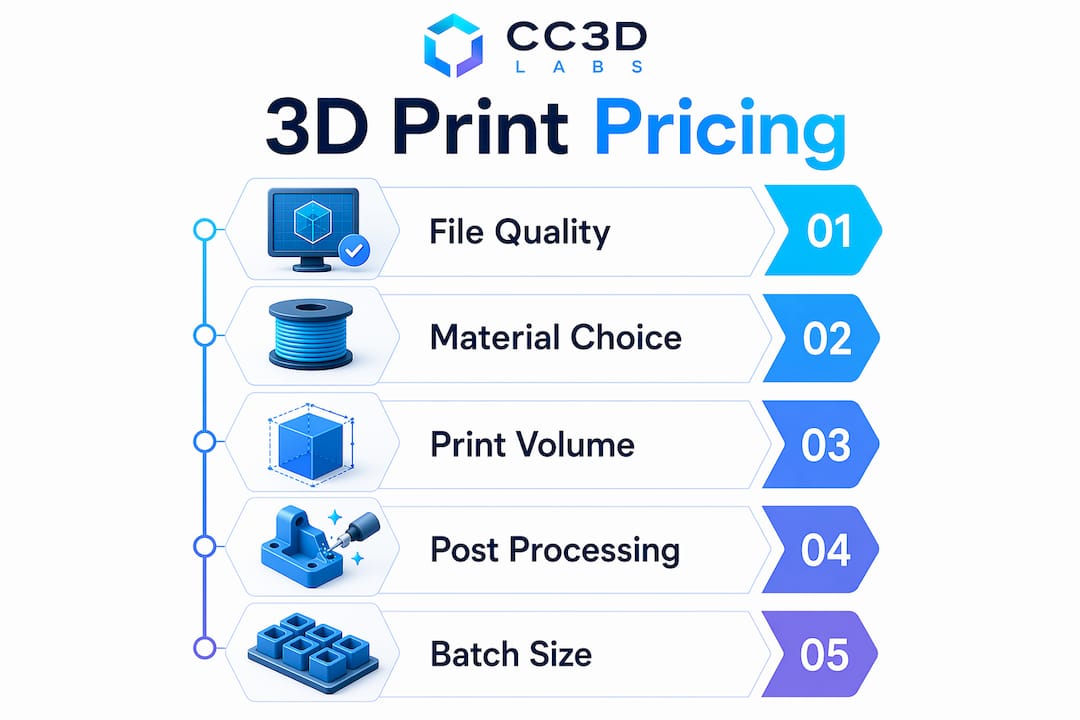
Pricing includes material volume, machine time, support burden, post-processing labor, and packaging. That last point surprises most first-time buyers. A small, geometrically complex part can cost more than a large simple block because it demands more machine time and cleanup labor.
Here are the primary cost drivers:
- Material volume and type. Denser, engineering-grade filaments cost more per gram. High-infill settings increase material consumption directly.
- Machine time. Print speed, layer height, and part orientation all affect how long the printer runs. Longer print times mean higher costs.
- Support structures. Overhanging geometry requires support material that must be removed and disposed of. Heavy support burden adds both material and labor cost.
- Post-processing. Sanding, priming, painting, and hardware insertion are billed separately. A raw print is always cheaper than a finished one.
- Setup and quality control. Some commercial services set minimum order values to cover base operational overhead; CC 3D Labs quotes each job individually. This covers file review, machine setup, and inspection.
- Rush orders. Expedited orders increase pricing substantially because they compress scheduling and raise the cost of any failure.
| Cost factor | What drives it up | How to reduce it |
|---|---|---|
| Material volume | High infill, dense filament | Optimize infill for function, not maximum strength |
| Machine time | Complex geometry, fine layer height | Simplify geometry where tolerances allow |
| Support burden | Steep overhangs, internal cavities | Reorient the part or redesign to minimize overhangs |
| Post-processing | Painted or primed finish | Accept raw finish for non-visible or functional parts |
| Rush premium | Short lead time | Plan orders at least two weeks ahead |
Batch size is the most powerful lever most buyers underuse. Many providers discount larger batches because setup and handling overhead spreads across more parts — at CC 3D Labs, volume pricing is quoted per project after a test print of your actual part. If your project allows any flexibility on quantity, run the numbers at multiple tiers before committing.
How do you compare, negotiate, and validate 3D printing quotes?
Comparing quotes from different providers is only useful when all quotes describe the same job. One quote that includes support removal and another that excludes it are not comparable, even if the headline numbers look similar.
“Clients often treat a quote request as a single price check instead of a planning tool. Requesting pricing across multiple quantity bands, 10, 50, and 200 units, gives you a real picture of your project economics and often reveals a tipping point where a larger order pays for itself.”
Follow these practices to compare and validate quotes with confidence:
- Confirm all parameters match. Verify that material, quantity, finish level, and lead time are identical across every quote you receive.
- Ask what is excluded. Shipping, packaging, and quality inspection are sometimes listed separately. A low headline price can carry significant add-ons.
- Request a breakdown. A credible provider will itemize material, machine time, post-processing, and overhead. Vague lump-sum quotes are a red flag.
- Ask about revision handling. If the first print has a defect, what is the policy? Reprints, credits, and refunds vary widely by provider.
- Verify lead time is realistic. A quote with an aggressive delivery date that the provider cannot guarantee creates project risk, not savings.
- Plan for approval time. Factor in your own internal review and approval cycle when evaluating whether a quoted lead time actually works.
Machine time and support burden are primary cost drivers. A provider who explains these factors in their quote breakdown is demonstrating transparency. One who cannot explain why a small part costs more than a large one is not a reliable partner for complex projects.
You can also reduce your own costs before the quote stage. Reviewing your 3D printing cost strategies before submitting files often reveals geometry changes that cut machine time without affecting part function.
Key Takeaways
Getting a precise custom 3D print quote requires clean CAD files, clear project specifications, and an understanding of the cost components that providers use to build their pricing.
| Point | Details |
|---|---|
| File format is non-negotiable | Submit STL, STEP, or 3MF files with watertight geometry; photos and 2D drawings cannot be priced. |
| Instant estimates are not final quotes | Automated calculators frequently underestimate the confirmed professional quote due to missed geometry risks. |
| Batch size drives per-unit cost | Larger batches usually bring per-unit cost down as setup overhead spreads across the run. |
| Rush orders carry a real premium | Expedited timelines increase pricing due to compressed scheduling and higher failure risk. |
| Compare quotes on identical parameters | Confirm material, finish, quantity, and lead time match before treating any two quotes as comparable. |
What I’ve learned from watching buyers misread quotes
Most pricing surprises I’ve seen come from one source: buyers treating the first number they receive as the final number. An instant calculator gives you a floor, not a ceiling. The manual review that follows almost always adds cost because it catches what the algorithm missed, wall thickness violations, unsupported overhangs, and geometry that will fail mid-print.
The second most common mistake is submitting a quote request for a single quantity. I’ve watched product developers lock into a 10-unit order, receive the quote, and then discover that 50 units would have cost only 30% more in total. That math changes a sourcing decision entirely. Always ask for pricing across at least two or three quantity bands before you commit.
The detail that most buyers skip is the end-use description. Telling a provider “I need this printed in plastic” is not useful. Telling them “this bracket mounts inside an engine bay and sees 90°C continuous heat” tells them to quote ASA or a high-temperature filament instead of PLA. That single sentence prevents a failed part and a reprint cost. If you want on-demand custom parts that actually perform in their intended environment, the spec sheet you send in is the most important document in the process.
— Justin
Cc3dlabs makes precise custom 3D print quotes straightforward
Cc3dlabs handles quote requests for prototypes, functional parts, and batch production runs from its facility near Philadelphia.
Submit your STL, STEP, or 3MF file through the Cc3dlabs 3D printing services page and receive a detailed estimate that covers material, machine time, post-processing, and shipping. The team reviews every file for printability before confirming a price, so the number you receive reflects the actual job, not an automated approximation. Cc3dlabs supports multi-color printing, engineering-grade filaments, and batch pricing with volume discounts. Rush orders and design support are available on request. Local pickup near Philadelphia and domestic or international shipping are both options.
FAQ
What file format do I need to get a 3D print quote?
STL, STEP, and 3MF are the standard formats accepted by professional 3D print services. The file must have clean, watertight geometry; 2D drawings and photos cannot be used for pricing.
Why is my final quote higher than the instant online estimate?
Final professional quotes are often higher than instant calculator outputs because manual review identifies wall thickness issues, support complexity, and failure risk that automated tools miss.
How does quantity affect custom 3D print pricing?
Larger quantities reduce per-unit cost through tiered discounts. Volume discounts vary widely by provider and part — at CC 3D Labs, batch pricing is quoted per project after a test print.
What information should I include in a quote request?
Include your 3D file, material preference, required quantity, finish level, end-use description, tolerances, and your deadline. The more detail you provide, the more accurate and faster your quote will be.
Is there a minimum order for custom 3D printing services?
Some professional services set minimum order values to cover machine setup, file review, and quality inspection overhead; CC 3D Labs quotes each job individually. Check the provider’s terms before submitting a small single-unit request.