
TL;DR:
- Custom batch manufacturing produces tailored products in defined groups with planned quality checks and changeovers. It offers flexibility, traceability, and precision for moderate-volume runs, serving industries like aerospace and medical devices. Proper design and process management optimize costs and ensure high-quality results for each batch produced.
Custom batch manufacturing is the production of tailored products in defined groups, or batches, under consistent conditions, with planned pauses between runs for quality checks and changeover. The industry term for the broader category is batch production, and the custom variant adds a layer of specification: every batch is built to a client’s exact requirements. This method occupies the middle ground between job shop production and continuous manufacturing, making it the go-to choice for manufacturers who need more than one-off parts but far fewer than mass-production volumes. Cc3dlabs works within this model daily, producing precise filament-based parts in defined runs for product developers, businesses, and designers.
What is custom batch manufacturing, exactly?
Custom batch manufacturing is defined as producing a specified quantity of customized products in a single production run, then stopping before the next batch begins. That pause is not downtime. It is a deliberate checkpoint for cleaning, recalibration, and quality verification. Batch manufacturing sits between job shop production, which handles one-off or very low-volume work, and continuous manufacturing, which never stops. The custom element means each batch is built to a client’s specifications, not a generic catalog standard.
The stop-and-start rhythm is what separates batch production from a continuous flow line. A pharmaceutical company producing a specific drug formulation, a food manufacturer running a seasonal recipe, or a product developer ordering 50 functional prototypes all use this model. Each batch gets its own identity, its own quality record, and its own set of parameters. That structure is what makes the method both flexible and traceable.
Pro Tip: Treat each batch as a discrete project with its own documentation file. This habit pays off immediately when a quality issue surfaces and you need to isolate the affected run without pulling the entire production history.
How does the custom manufacturing process work?
The custom manufacturing process follows six defined stages, and skipping any one of them is where most costly errors originate.
- Define specifications. The client and manufacturer agree on materials, tolerances, quantities, and functional requirements before any design work begins.
- CAD design and validation. Engineers translate requirements into a 3D model. This stage includes Design for Manufacturability (DFM) review, which checks whether the design can be produced efficiently with the chosen method.
- Select the manufacturing method. Options include additive manufacturing such as filament-based 3D printing, CNC machining, injection molding, or a combination. The choice depends on volume, material, and tolerance requirements.
- Quote and finalize specs. The manufacturer confirms lead times, costs, and any design adjustments identified during DFM review.
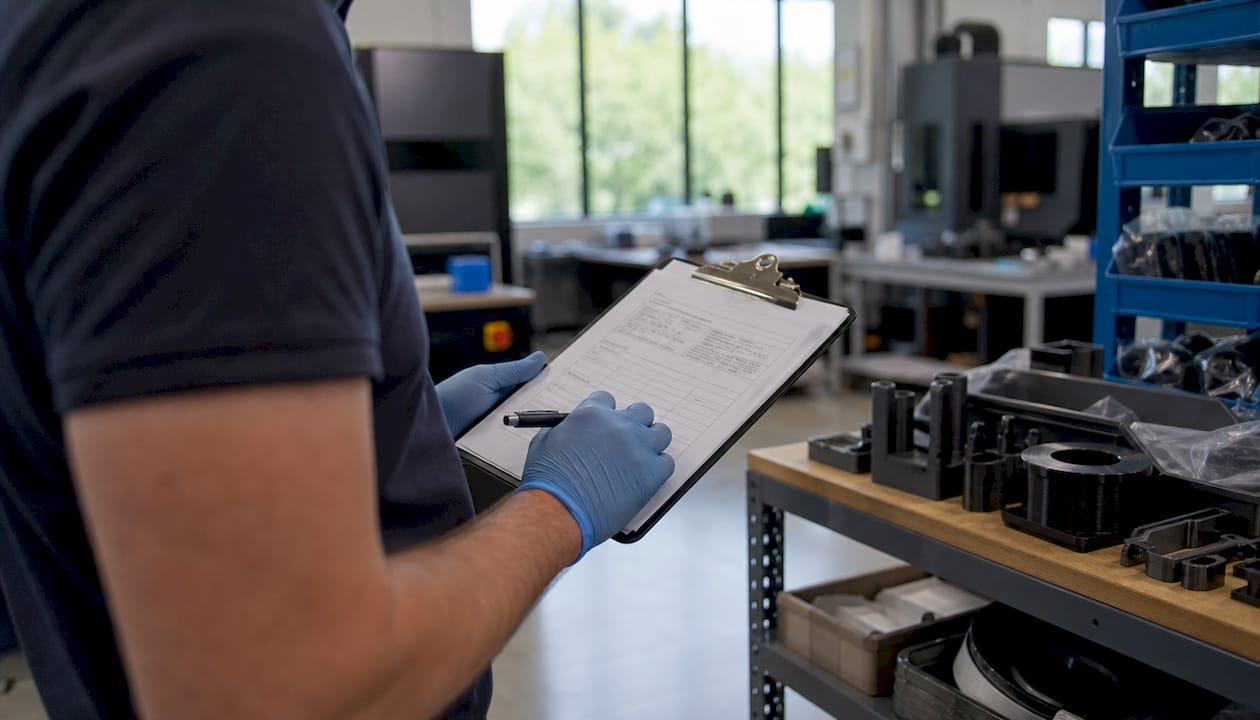
- In-process quality control. Inspections happen during the run, not only at the end. Measurements, visual checks, and functional tests are logged against the batch record.
- Final assembly and delivery. Finished parts are inspected against the original specification, packaged, and shipped or made available for local pickup.
Successful custom manufacturing depends on a close working relationship between the designer and the manufacturer. High communication levels prevent costly errors and keep the production aligned with the original intent. A designer who understands machining constraints, and a manufacturer who understands the product’s end use, produce better results than either party working in isolation.
Pro Tip: Request a DFM report before approving your final design. A good manufacturer will flag features that add cost without adding function, such as unnecessary undercuts or overly tight tolerances on non-critical surfaces.
How does custom batch compare to job shop and mass production?
Understanding where custom batch manufacturing fits requires a clear look at the three main production paradigms. Each one trades off volume, flexibility, and cost differently.
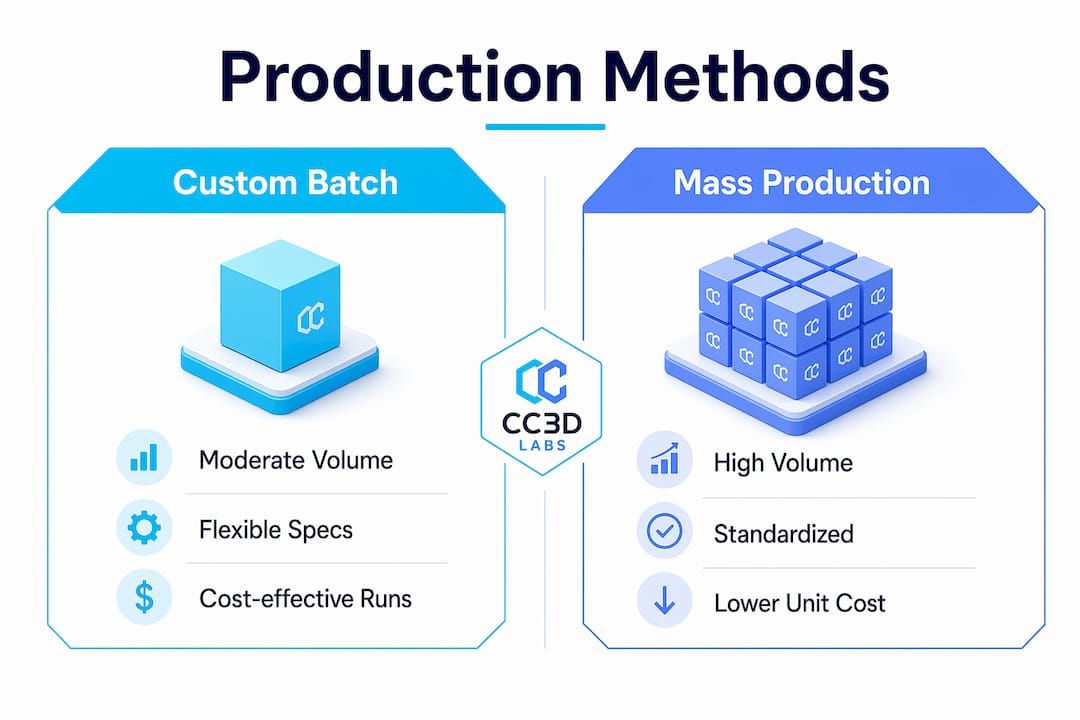
Batch production suits moderate-volume runs where product formulas or configurations vary between batches. Job shop production handles very low volumes with maximum customization, often one part at a time. Mass production runs the same product continuously at high volume with minimal variation.
| Production type | Typical volume | Flexibility | Per-unit cost | Best use case |
|---|---|---|---|---|
| Job shop | Very low (1–10 units) | Very high | Very high | One-off prototypes, bespoke parts |
| Custom batch | Low to moderate (10–5,000 units) | High | Moderate | Specialized products, regulated industries |
| Standard batch | Moderate (1,000–50,000 units) | Moderate | Lower | Consumer goods, food, pharma |
| Mass production | Very high (50,000+ units) | Low | Lowest | Commodity products, automotive |
Custom batch manufacturing spans a wide tolerance range depending on process: precision CNC machining can hold roughly ±0.005–0.02 mm, while FDM additive manufacturing typically holds ±0.2–0.5 mm — ample for most functional parts. That level of precision is not available in standard mass production without significant tooling investment. The trade-off is a higher per-unit cost, which is justified when the product requires exact specifications or regulatory traceability.
The key distinction between custom batch and standard batch is the degree of specification per run. Standard batch production uses a fixed formula repeated across many runs. Custom batch production adjusts parameters, materials, or configurations for each client order. That adjustment is where the value lives for product developers and niche manufacturers.
What are the advantages and applications of custom batch manufacturing?
Custom batch manufacturing delivers three core advantages: flexibility, traceability, and quality control. Each one matters more in some industries than others, but all three apply across the board.
Flexibility means a manufacturer can shift from producing a medical device housing to an aerospace bracket between runs without retooling an entire production line. Batch production enables rapid market response with less financial risk than mass production. A business can test a new product with a run of 200 units, gather real-world feedback, and adjust the design before committing to larger volumes.
Traceability is the feature that regulated industries cannot operate without. Batch manufacturing tracks each production run uniquely, which is critical in pharmaceuticals, food production, and medical device manufacturing. If a defect surfaces, the investigation targets one batch, not the entire production history. That focused scope minimizes recall costs and regulatory exposure.
Quality control benefits from the stop-and-start structure. Each pause between batches is an opportunity to verify that the process is still within specification before committing more material and labor to the next run.
“Batch records are vital quality control tools that allow targeted investigations and minimize production impact during defects. Documentation supports traceability and audits across regulated industries.”
— Unleashed Software, Batch Production Explained
The industries that rely most heavily on custom batch manufacturing include aerospace, medical devices, specialty food and pharma formulations, and niche consumer products. An aerospace supplier producing a run of 50 custom brackets needs documented traceability for each part. A medical device company producing a limited run of surgical guides needs both precision and a complete quality record. Custom batch manufacturing serves both requirements in a single workflow. The same principle applies in brake manufacturing quality control, where batch traceability directly affects safety outcomes.
What practical tips help optimize custom batch workflows?
Setup time is the biggest cost driver in low-volume custom batch manufacturing. DFM practices reduce repositioning during machining and cut idle machine time, which directly lowers labor costs per part. A design that requires five fixture changes costs more to produce than one requiring two, even if the material cost is identical.
The following practices consistently reduce cost and delay in custom batch production:
- Plan changeover time explicitly. Ignoring changeover time causes unexpected timeline extensions. Build cleaning, recalibration, and setup into the project schedule from day one, not as an afterthought.
- Maintain batch records throughout the run. Documentation is not a post-production task. Logging measurements and process parameters during the run gives you real-time data to catch drift before it becomes a defect.
- Choose the right technology for the volume. Additive manufacturing, including low-volume 3D printing, suits runs where tooling cost would make CNC or injection molding uneconomical. CNC machining suits runs where tight tolerances and material strength are non-negotiable.
- Standardize your incoming material checks. Batch failures often trace back to material variation, not process variation. A quick incoming inspection prevents a bad material lot from contaminating an entire run.
- Communicate design changes in writing. Verbal changes between batches are where errors enter. A written change order tied to the batch record keeps the production history clean and auditable.
Pro Tip: Ask your manufacturer to run a first-article inspection on the initial unit of each new batch. Catching a dimensional error on part one costs far less than discovering it on part forty.
Key Takeaways
Custom batch manufacturing is the most practical production method for manufacturers and designers who need precision, traceability, and flexibility without the volume commitments of mass production.
| Point | Details |
|---|---|
| Core definition | Custom batch manufacturing produces tailored products in defined runs with planned pauses for quality control and changeover. |
| Six-stage workflow | Every run moves from spec definition through CAD, method selection, quoting, in-process QC, and final delivery. |
| Traceability advantage | Each batch carries a unique record, enabling targeted investigations and minimizing recall scope in regulated industries. |
| DFM reduces cost | Design for Manufacturability review cuts setup complexity and idle machine time before production begins. |
| Technology fit matters | Additive manufacturing suits low-volume custom runs; CNC machining suits high-precision, moderate-volume requirements. |
Why custom batch manufacturing is underrated as a product launch strategy
Most product developers I work with arrive thinking they need to choose between a one-off prototype and a full production run. That binary thinking leaves a lot of value on the table. Custom batch manufacturing is the tool that lets you do neither and both at once.
A run of 50 to 500 units gives you real-world data, actual customer feedback, and a documented production process you can hand to a larger manufacturer later. The batch record you build during that first run becomes your quality baseline. Every subsequent run either confirms that baseline or tells you something changed. That is not just manufacturing discipline. It is product intelligence.
The integration of CAD modeling workflows with flexible production lines has made custom batch manufacturing more accessible than it was a decade ago. Digital design files move directly into production without the tooling delays that once made small runs expensive. Entrepreneurs who understand this can test and launch products faster than competitors still waiting for minimum order quantities from traditional suppliers.
The collaborative nature of custom batch work is also undervalued. A manufacturer who reviews your design before production starts is not just a vendor. That review catches problems that would otherwise show up as scrap, rework, or a failed product launch. The best custom batch relationships I have seen treat that DFM conversation as the most important meeting in the project.
— Justin
Cc3dlabs: precision 3D printing for custom batch production
Cc3dlabs, based near Philadelphia, specializes in filament-based custom 3D printing services built for exactly the kind of low-volume, high-specification runs that define custom batch manufacturing. Whether you need 10 functional prototypes or 500 production-grade parts, Cc3dlabs handles the full workflow from CAD review through final quality inspection.
The team at Cc3dlabs brings CAD modeling expertise and in-process quality control to every batch, so your parts arrive documented and verified. Multi-color printing, professional handheld 3D scanning (accuracy to ~0.1 mm), and design support are all available in a single service relationship. Get a free online estimate and see how a custom batch run can move your product from concept to verified production faster than traditional manufacturing routes.
FAQ
What is custom batch manufacturing in simple terms?
Custom batch manufacturing is the production of a specific quantity of tailored products in a single run, with planned stops between batches for quality checks and changeover. It sits between one-off job shop work and high-volume continuous production.
How does batch production differ from mass production?
Batch production runs defined quantities with pauses for recalibration and quality control, while mass production runs continuously at high volume with minimal variation. Batch production offers more flexibility and traceability at a higher per-unit cost.
What industries use custom batch manufacturing most?
Aerospace, medical devices, pharmaceuticals, specialty food production, and niche consumer products rely most heavily on custom batch manufacturing because they require both precision and documented traceability for each production run.
Why is DFM important in custom batch manufacturing?
Design for Manufacturability review reduces setup complexity and repositioning during machining, which directly lowers labor and machine idle costs. Running DFM before production starts is the single most effective way to reduce per-part cost in a custom batch run.
What is a batch record and why does it matter?
A batch record is a documented log of all process parameters, measurements, and quality checks for a single production run. It enables targeted investigations if a defect surfaces and supports regulatory audits without disrupting other production batches.