
TL;DR:
- 3D printing expands artistic possibilities by enabling complex internal and detailed structures impossible with traditional methods.
- The workflow involves digital modeling, repair, slicing, printing, and post-processing to turn ideas into physical art.
- It shifts artistic focus from manual craftsmanship to conceptual design, problem-solving, and material curation.
Art and technology have never truly been at odds. The chisel was technology. The printing press was technology. And now, 3D printing is the latest tool pushing creative boundaries far beyond what any traditional method allows. When artist Bathsheba Grossman began printing intricate mathematical sculptures in metal, she wasn’t abandoning artistry. She was expanding it into geometry that human hands simply could not carve. As complex geometries become printable for the first time, artists and designers everywhere are discovering that this technology doesn’t replace creative vision. It amplifies it.
Table of Contents
- Expanding creative boundaries: What 3D printing offers artists
- From concept to physical art: 3D printing workflow explained
- Materials and techniques: Choosing your palette
- Overcoming challenges: What artists need to know
- A new frontier: Why 3D printing makes art more human, not less
- Take your art further with expert 3D printing support
- Frequently asked questions
Key Takeaways
| Point | Details |
|---|---|
| Unprecedented creative freedom | 3D printing lets artists realize forms, textures, and details that are impossible with traditional methods. |
| Accessible innovation | Artists can quickly prototype, experiment, and collaborate using affordable digital tools and shared files. |
| Diverse material choices | Numerous 3D printing materials allow for customized artistic expression, from translucent resin to ceramic and metal. |
| Practical challenges exist | Artists must consider technical limits like print resolution and material properties, but new techniques help overcome them. |
| Art and technology synergy | When used thoughtfully, 3D printing enhances—not replaces—the artist’s hand and vision. |
Expanding creative boundaries: What 3D printing offers artists
Building on this, let’s uncover exactly what 3D printing allows artists to achieve that wasn’t possible before.
For centuries, sculptors worked within the limits of their materials and their hands. Stone could crack. Clay sagged. Wood split along the grain. Every medium imposed constraints that shaped, and sometimes stunted, the creative vision. 3D printing removes many of those physical barriers entirely.
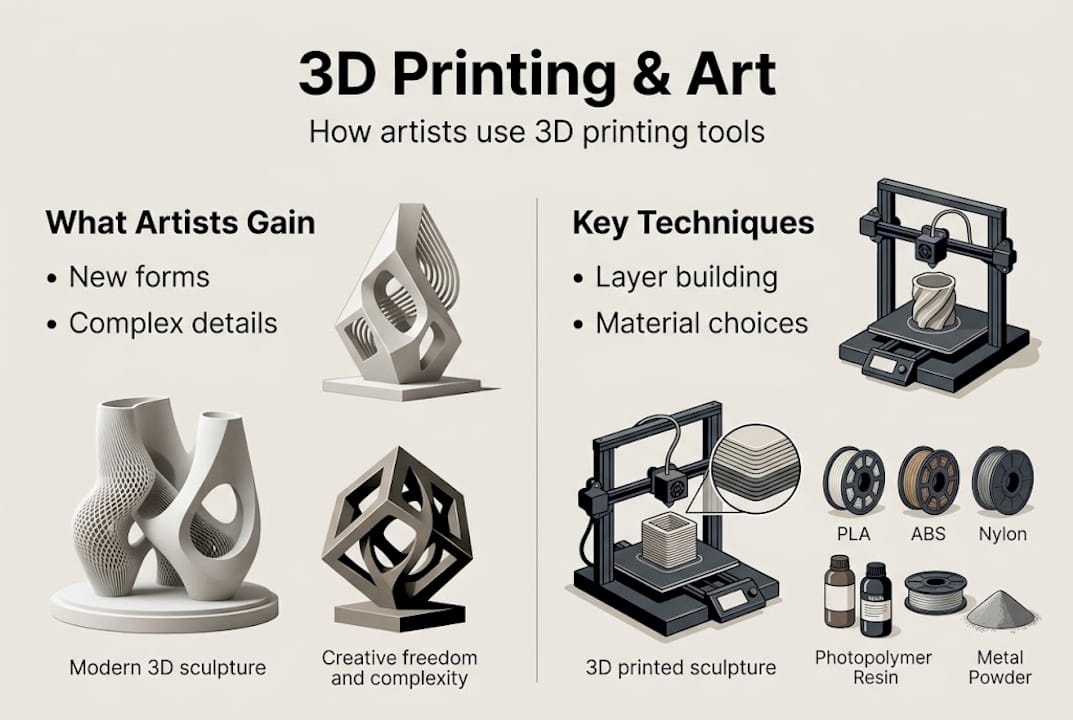
The core capability is this: you can now design and physically produce objects with internal structures, interlocking components, and surface details so fine they’d be invisible to a cutting tool. Think about a hollow sphere nested inside another hollow sphere, both fully enclosed, with geometric lattices connecting them. With traditional methods, that’s essentially impossible without assembly. With 3D printing, it comes off the build plate as a single, complete object.
Artists working in this space regularly produce:
- Interlocking chain-like structures printed as one continuous piece, no assembly required
- Thin ribbon geometries that spiral and twist in ways that would shatter under a carving tool
- Hollow organic forms with internal voids and controlled wall thickness
- Gradient surface textures that shift across the object from rough to smooth
- Mathematically precise repetitive patterns that would take weeks to reproduce manually
Compared to traditional sculptural methods, the contrast is striking:
| Feature | Traditional sculpture | 3D printed sculpture |
|---|---|---|
| Complex internal voids | Not possible | Fully achievable |
| Rapid iteration | Days to weeks | Hours |
| Geometric precision | Limited by tool and hand | Exact to CAD model |
| Reproducing a design | Manual rebuild required | Reprint the file |
| Material exploration | One material per session | Multiple options per design |
The ability to print artworks on demand also means artists can test ideas without committing to a final version. A sculptor can print a miniature maquette (a small-scale model) at 10% size, evaluate proportions, adjust the digital file, and reprint. This rapid prototyping loop used to require an assistant, a workshop, and weeks of labor.
The global market for 3D printed art and sculpture is projected to grow from $1.43 billion in 2024 to $5.12 billion by 2033, at a compound annual growth rate of 17.2%. That’s not a niche trend. That’s a wholesale transformation of how the creative economy thinks about physical objects.
These numbers tell a deeper story. Collectors, galleries, and institutions are buying in. The question for working artists and designers isn’t whether to engage with 3D printing. It’s how to use it well. Take a look at the range of 3D printed artworks already being produced across sculpture, jewelry, installation, and product design to understand just how wide the creative territory already is.
From concept to physical art: 3D printing workflow explained
Now that you know what’s possible, let’s look step-by-step at how artists turn digital visions into physical objects.
The workflow between idea and finished art object has never been more direct. But it does involve several distinct stages, each with its own tools and decisions. Understanding the full pipeline helps you avoid surprises midway through a project.
Here’s the standard process most artists follow:
- Concept and reference gathering. Sketch your idea, collect reference images, and define the intended size, material, and finish before opening any software. Clarity here saves hours later.
- Digital modeling. Build your 3D model using software suited to your background. Sculptors often prefer ZBrush for its organic, clay-like feel. Designers and architects lean toward Rhino or Fusion 360 for precision parametric geometry. Blender is a powerful free option that handles both organic and hard-surface modeling well. The workflow from digital modeling through slicing to finished print is well-documented and accessible to beginners who invest time in learning one tool deeply.
- Mesh repair and optimization. Export your model as an STL or OBJ file and run it through a mesh checker like Meshmixer or Netfabb. 3D printers need watertight files, meaning no holes or reversed normals in the geometry.
- Slicing. Import the repaired file into slicing software like Cura or PrusaSlicer. This converts your 3D model into the layer-by-layer instructions the printer reads. Here you set layer height, support structures, infill density, and print speed. These settings directly affect surface quality and strength.
- Printing. The printer builds the object layer by layer. Depending on size and complexity, this can take anywhere from two hours to several days. Don’t leave large prints unattended for the first hour to catch early adhesion issues.
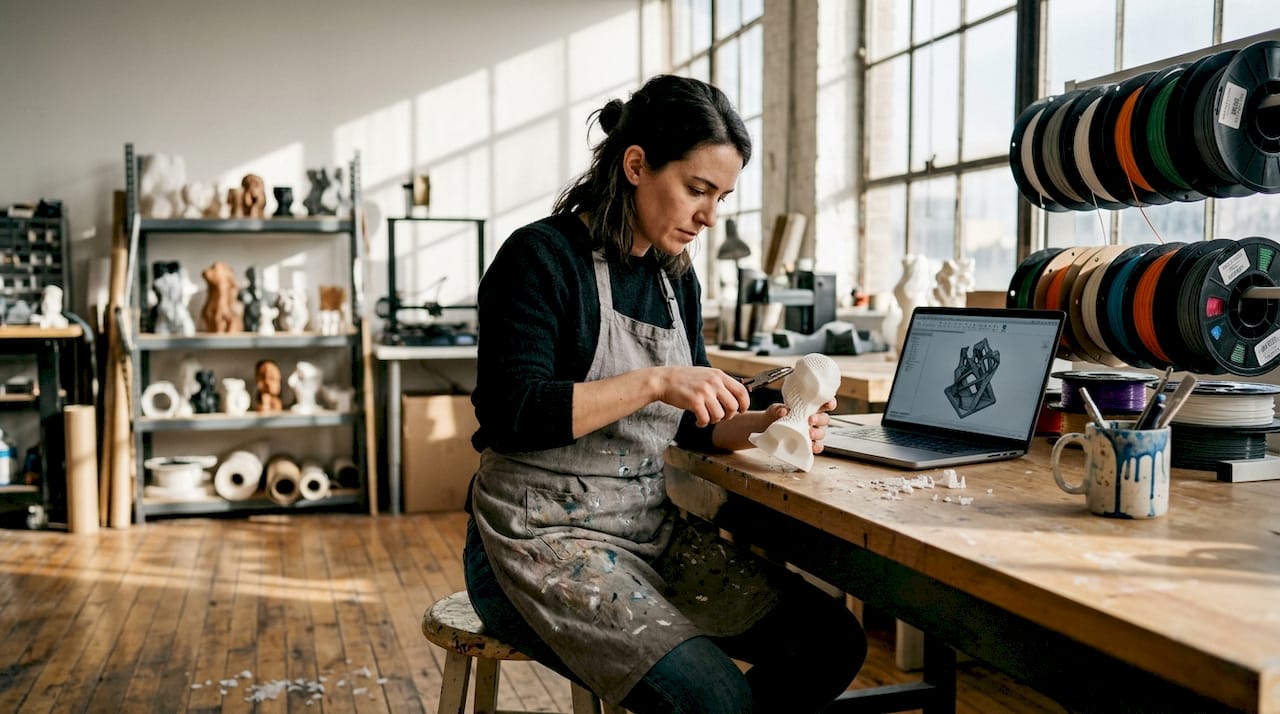
- Post-processing. This is where a lot of the artistry returns. Removing supports, sanding surfaces, priming, painting, applying patinas, or UV curing resin pieces all happen here. For artists wanting to capture real-world objects, starting with a high quality 3D scan of a physical reference can dramatically speed up the modeling stage.
Pro Tip: Use your first print of any new design as a “test maquette” rather than a finished piece. Print at reduced scale, 20 to 30 percent of final size, to check proportions, identify fragile areas, and test the support strategy before committing material and print time to a full-size run. This approach aligns with the iterative philosophy that separates good 3D artists from frustrated ones.
For artists who want a thorough technical foundation before starting, our step-by-step printing guide covers each stage in practical detail, with guidance tailored to creative projects rather than just functional parts.
Materials and techniques: Choosing your palette
With the workflow in mind, choosing the right materials becomes the next key step for any art project.
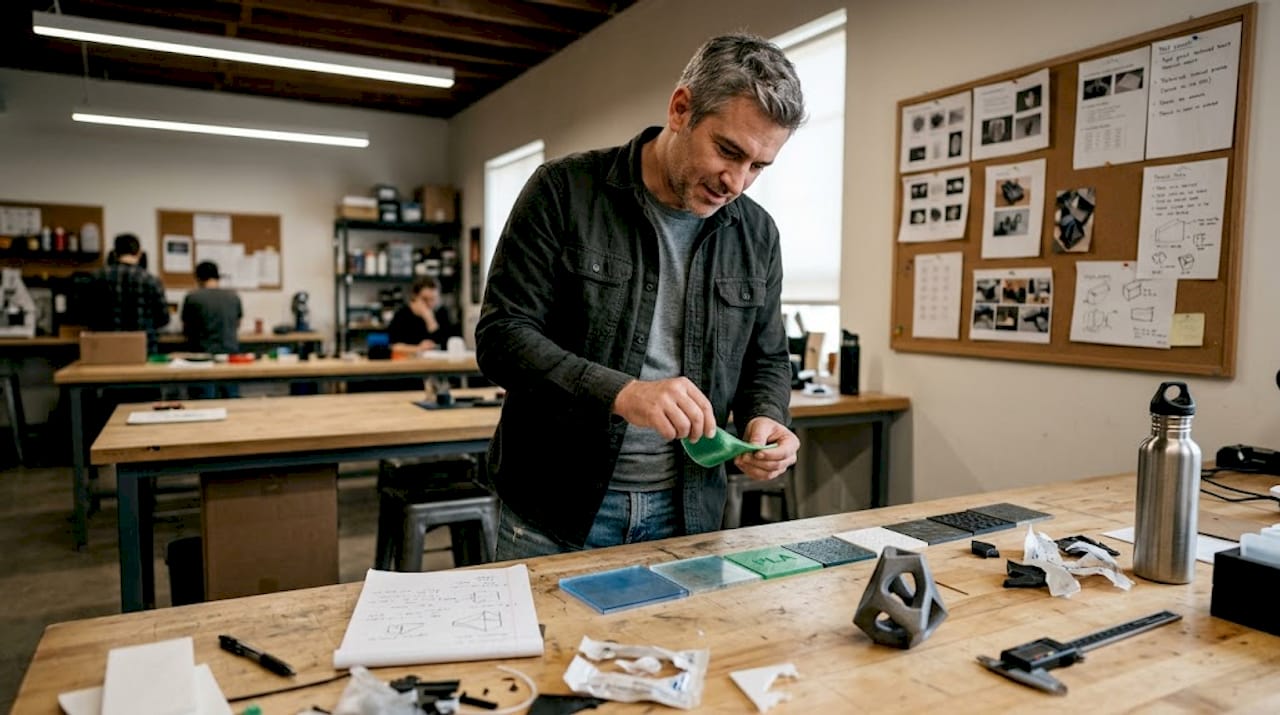
Material choice in 3D printing is not a technical afterthought. It is a creative decision that defines the final aesthetic, durability, and viewer experience of your work. The material options span a wide range including thermoplastics like PLA and ABS, photopolymer resins, ceramics, clay-based filaments, concrete composites, metal sintering powders, and full-color ink-based printing systems.
Here’s a practical breakdown:
| Material | Best for | Trade-offs |
|---|---|---|
| PLA | Indoor sculpture, detail-forward work | Brittle outdoors, limited heat resistance |
| ABS | Functional art, large prints | Prone to warping, needs enclosure |
| Resin (SLA/DLP) | Fine jewelry, miniature detail | Fragile, requires UV post-cure, chemical handling |
| Ceramic filament | Tactile, earthy aesthetic | Requires kiln finishing, slower printing |
| Metal (SLS/binder jet) | Permanent sculpture, high-end work | Expensive, requires professional equipment |
| Full-color ink systems | Multi-color figurines, portraits | Lower structural strength, porous surface |
Artists working primarily with gallery-displayed indoor pieces find PLA delivers the best balance of detail and ease. Those producing work meant to last outdoors should look at more durable materials, and our guide to material selection for outdoor art covers weather resistance, UV stability, and finish options in depth.
One of the most exciting developments for artists right now is dual-light resin printing. This technique uses two different light wavelengths to cure resin at varying speeds within the same print, creating gradient hardness and translucency effects that were previously impossible to achieve in a single print. Combined with full-color multi-material systems that can deposit different colored filaments or inks in the same pass, artists are producing pieces with color transitions, embedded textures, and surface effects that no paint brush could replicate at that scale.
Key factors to weigh when selecting your material:
- Resolution needs: Resin printers achieve layer heights as fine as 0.025mm, ideal for jewelry-scale detail. FDM printers using filament typically range from 0.1 to 0.3mm, which is excellent for larger sculptural work.
- Intended environment: Indoor gallery versus outdoor installation calls for completely different material strategies.
- Post-processing preferences: Some artists love the tactile process of sanding and painting PLA. Others want the ready-to-display clarity of a cured resin print with minimal finishing.
- Budget: Metal and ceramic professional printing requires either significant equipment investment or a professional service partner.
Pro Tip: Before committing to a full print run in a new material, print a small test tile, a flat 2×2 inch square with varied surface textures, using your intended settings. This tells you how the material accepts paint, sealant, or patina in minutes rather than after an eight-hour print.
Overcoming challenges: What artists need to know
But even with these advancements, 3D printing poses unique hurdles that artists should prepare for.
No tool is perfect. 3D printing comes with a specific set of limitations that can derail a project if you don’t plan around them. The key challenges include print resolution limits on fine surface detail, layer adhesion failures that cause prints to delaminate mid-build, scalability issues when moving from small to large works, material properties that restrict certain artistic freedoms, support structure removal that sometimes damages delicate surfaces, and warping caused by uneven cooling.
Common problems artists encounter and how to address them:
- Visible layer lines on finished surfaces: Sand progressively from 120 to 400 grit, then apply filler primer. For resin, a light UV-cured coating fills micro-layers before sanding.
- Support marks on visible surfaces: Orient the model during slicing so supports contact only hidden or easy-to-finish areas. Use tree supports in Cura rather than grid supports for organic shapes.
- Warping on large flat-based prints: Add a brim, print on a heated bed, and use an enclosure for ABS. For PLA, slow down the first few layers and ensure the bed is perfectly level.
- Fragile thin elements breaking post-removal: Identify these in your digital model before printing and either thicken them or consider printing the component in resin for higher inter-layer bonding.
For artists working on ambitious projects, our tips for avoiding print failures walk through the most common failure modes with practical solutions.
According to research on 3D printing waste reduction, 3D printing produces up to 90% less material waste compared to traditional subtractive methods like carving and milling. For artists thinking about their environmental footprint, this is a significant advantage.
The criticism that digital art lacks “soul” is worth addressing directly. Critics argue that if a machine builds the object, the artist hasn’t truly made it. But this misunderstands what artistry is. A photographer doesn’t lose creative credit because a lens forms the image. A printmaker doesn’t lose authorship because a press applies the ink. The decisions, vision, and intention behind a 3D printed work are entirely human. The expert perspectives on this tension increasingly recognize 3D printing not as a replacement for artistic skill, but as a medium with its own discipline, language, and learning curve.
A new frontier: Why 3D printing makes art more human, not less
Here’s the uncomfortable truth that traditional art communities rarely acknowledge: every new tool has been called soulless at first. Photography was accused of killing painting. Digital illustration was dismissed as “cheating.” 3D printing is simply the latest technology to face that familiar skepticism.
What actually happens with 3D printing is a shift in where the artistry lives. It moves from the hand to the mind. Concept, material logic, surface decision, scale thinking, iterative judgment. These are all deeply human acts. As global file sharing and rapid prototyping become standard in creative practice, artists are collaborating across continents on single pieces, sharing digital files the way musicians share stems.
The artists thriving with 3D printing aren’t abandoning craft. They’re redefining it. The tactile element returns in finishing, in material selection, in the decision to leave a layer line visible as a texture or sand it smooth. That’s curation. That’s artistic judgment.
Real artistry now lives in vision, problem-solving, and knowing which tool serves the idea, rather than in the physical stamina to chip stone for weeks.
Take your art further with expert 3D printing support
If you’re ready to push creative boundaries with expert guidance, here’s how to get started.
At CC 3D Labs, near Philadelphia, we work with artists and designers who have ambitious ideas and need a printing partner who understands both the technical and creative sides of making physical work. Whether you’re producing a single exhibition piece or a batch of limited-edition objects, our custom 3D printing services cover filament-based printing, multi-color output, CAD support, and metrology-grade scanning.
We’ve helped clients realize sculptures, jewelry prototypes, architectural models, and installation art, often with tight deadlines and specific material requirements. If you’re exploring what’s possible for your next project, browse our applications for artists or request a free online estimate to start the conversation. Your vision deserves a printing partner who takes it as seriously as you do.
Frequently asked questions
What types of art can be created with 3D printing?
Artists can create sculptures, installations, jewelry, decorative objects, and even functional art pieces, since complex geometries that are impossible to carve or cast traditionally become achievable through 3D printing.
Is 3D printed art environmentally friendly?
3D printing typically generates up to 90% less waste than subtractive methods like carving or milling, making it a more sustainable choice for artists who are conscious of material use.
What are the main limitations of 3D printing in art?
Print resolution, material constraints, support removal that can damage surfaces, and scalability for large works are the most common challenges artists encounter when working with this technology.
How does 3D printing change the role of the artist?
It shifts focus from physical labor to conceptual design, and enables rapid prototyping and global collaboration, meaning the artist’s vision and decision-making become the primary creative act.