
TL;DR:
- Online quoting speeds up 3D printing workflows and helps with rapid design decisions.
- Automated estimates are generally accurate for standard geometries but less reliable for complex features.
- Preparing models carefully and validating quotes with manual reviews can improve cost accuracy and project success.
Waiting three days for a quote when your prototype deadline is tomorrow is not a workflow problem. It’s a competitive disadvantage. Traditional manual quoting slows engineering cycles, creates budget uncertainty, and forces developers to guess at costs during the most critical design phases. Instant quoting systems automate pricing by analyzing uploaded STL files, material choices, print time, and part complexity in seconds. But speed comes with trade-offs. This guide breaks down how online estimates work, where they fall short, and the practical strategies you can use to get numbers you can actually build a budget around.
Table of Contents
- How online estimates transform 3D printing workflows
- Demystifying 3D printing cost calculation: What’s in an online quote?
- Recognizing the limits: When online quotes fall short
- How to get accurate online estimates: Practical engineering strategies
- The engineering reality: Instant quotes vs. true costs
- Level up your 3D printing workflow with trusted solutions
- Frequently asked questions
Key Takeaways
| Point | Details |
|---|---|
| Speed boosts workflow | Instant online estimates slash prototyping delays and empower rapid engineering iteration. |
| Check itemized costs | Always review the detailed breakdown—material, machine, labor, post-processing—for transparency and accuracy. |
| Know quoting limits | Complex geometries and post-processing often require manual review, so buffer for hidden costs. |
| Design for accuracy | Optimizing designs for quoting—minimizing supports and overhangs—produces more reliable instant estimates. |
| Benchmark for best value | Compare multiple quoting platforms and ask for engineer reviews to ensure cost and quality alignment. |
How online estimates transform 3D printing workflows
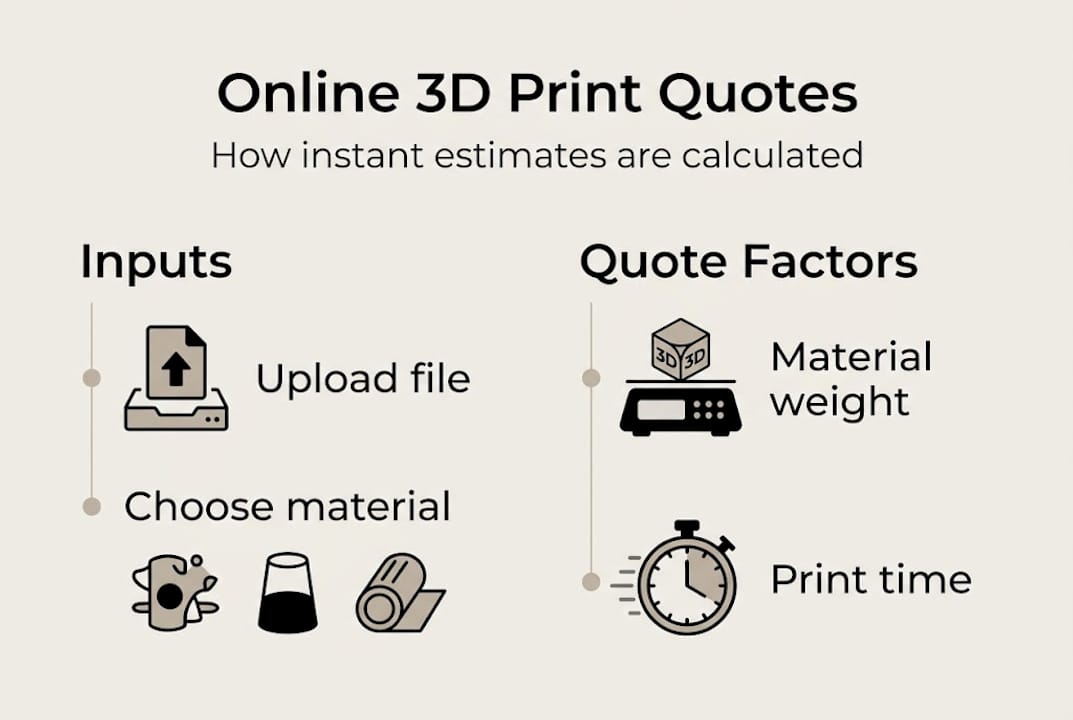
An online estimate, sometimes called an instant quote, is an automated pricing system that reads your 3D model file and returns a cost breakdown without human intervention. You upload a file, select a material and finish, and the platform calculates price based on volume, geometry, and machine parameters. The result arrives in seconds rather than days.
For product developers and engineers, this changes everything about early-stage design. You can test five material options in five minutes. You can compare a solid infill against a lightweight lattice structure and see the price difference immediately. Online estimators accelerate prototyping by providing immediate feedback on design changes, material trades, and quantity discounts. That feedback loop is what makes iterative design actually fast.
Manual quoting, by contrast, typically takes 24 to 72 hours per request. For a team running ten design iterations per week, that delay compounds fast. Shapeways instant quoting platforms have demonstrated that automated systems can reduce quote turnaround from days to under a minute for standard geometries. That is not a marginal improvement. It is a fundamentally different workflow.
Here are the most common use cases where online estimates deliver real value:
- Rapid prototyping: Get cost feedback before committing to a design revision
- Material comparison: Instantly compare PLA, PETG, ABS, and nylon pricing for the same geometry
- Functional part production: Estimate unit economics for small batch runs before scaling
- Design iteration: Adjust wall thickness, infill, or orientation and see cost impact in real time
- Budget planning: Establish rough cost ranges early in the product development cycle
Pairing this speed with a solid optimizing CAD workflow process means your files are quote-ready before you even hit submit. The engineers who get the most out of instant quoting are the ones who treat file preparation as part of the design process, not an afterthought.
Demystifying 3D printing cost calculation: What’s in an online quote?
Most engineers treat the quote number as a black box. Understanding what’s inside it gives you real leverage. STL file parsing for volume, surface area, and bounding box forms the foundation of every automated estimate. From there, the system estimates print time using slicing simulation or heuristics, then applies a cost formula.
The standard formula looks like this: Material cost (weight × $/g) + Machine cost (hourly rate × print time) + Labor + Overhead + Markup. Each variable carries its own uncertainty. Material weight depends on infill density. Machine time depends on layer height and print speed. Labor and overhead vary by provider.

Here is a simplified example of how those components stack up for a mid-complexity functional bracket (illustrative industry numbers, not CC 3D Labs pricing):
| Cost component | Basis | Example amount |
|---|---|---|
| Material | 45g × $0.08/g | $3.60 |
| Machine time | 2.5 hrs × $4.00/hr | $10.00 |
| Labor | Setup and removal | $5.00 |
| Overhead | Facility, utilities | $3.00 |
| Markup | 30% | $6.48 |
| Total estimate | $28.08 |
The quoting sequence for a custom part typically follows these steps:
- Upload STL file to the platform
- System parses geometry for volume, surface area, and bounding box
- Slicer simulation estimates print time and material usage
- Cost formula applies material, machine, labor, and overhead rates
- Markup is added and the estimate is returned to the user
- Optional: engineer review for flagged complex geometries
For a deeper look at how these numbers are assembled, the cost calculator guide breaks down the math behind each variable. Understanding itemized quoting breakdowns also helps you spot when a platform is bundling costs that should be line items.
Pro Tip: Always request an itemized cost breakdown rather than a single total. If a platform only shows you one number, ask for a manual review on any prototype that has thin walls, internal channels, or significant overhangs. Those features are where automated estimates lose accuracy fast.
Recognizing the limits: When online quotes fall short
Instant quoting is powerful, but it has a ceiling. Complex geometries can fail automated analysis entirely. Thin walls below 1.2mm, extreme overhangs, and internal lattice structures push most quoting algorithms into uncertain territory. The system either flags the file for manual review or, worse, returns a price that does not reflect the actual print difficulty.
Post-processing is the biggest blind spot. Post-processing costs can increase final invoices by 30 to 40 percent, and most instant quoting systems do not model this accurately. Support removal, sanding, painting, and inspection are labor-intensive steps that vary by part geometry in ways that are hard to automate.
Here is a quick comparison of instant quoting versus manual engineering review:
| Factor | Instant online quote | Manual engineering review |
|---|---|---|
| Speed | Seconds to minutes | 24 to 72 hours |
| Transparency | Variable | High |
| Accuracy (standard parts) | Good | Excellent |
| Accuracy (complex parts) | Poor to moderate | Excellent |
| Post-processing included | Rarely | Usually |
| Cost | Free or low | May carry a fee |
Common hidden costs that online estimates frequently miss include:
- Support structure material and removal labor
- Surface finishing (sanding, priming, painting)
- Dimensional inspection and quality documentation
- Failed print reprints (especially for complex geometries)
- Expedited turnaround fees
For tips for accurate instant quoting on complex parts, the key is knowing when to escalate. If your part has features that would give a human engineer pause, an automated system will not catch them reliably. Reviewing instant quoting system alternatives can also reveal platforms with more robust manual review pipelines built into their workflows.
The cost drivers in 3D print quotes are more nuanced than most automated systems capture, particularly when functional performance requirements enter the picture.
How to get accurate online estimates: Practical engineering strategies
Getting a reliable estimate is not just about picking the right platform. It is about preparing your model and your process so the automated system has everything it needs to return a meaningful number.
Here are the key steps for reliable instant quoting:
- Optimize your model first: Clean up non-manifold geometry, remove duplicate surfaces, and confirm wall thickness meets minimum print requirements before uploading
- Select platforms with itemized breakdowns: Prioritize platforms with itemized breakdowns and engineer review options, especially for prototypes and functional parts
- Request manual review for edge cases: If your part has overhangs greater than 45 degrees, thin walls, or complex internal geometry, flag it for human review
- Compare multiple estimators: Run the same file through two or three platforms and compare results. Significant variance signals a part that needs manual attention
- Use benchmark quoting calculators to cross-check: Independent calculators help you validate whether a platform’s estimate is in a reasonable range
Pro Tip: For prototypes, orient your model to minimize support structures before uploading. A part printed at a 45-degree angle often uses significantly less support material than one printed flat, and that directly reduces both material cost and post-processing labor. Small orientation decisions at the design stage translate into real savings in the estimate.
For functional parts, always benchmark your online quote against a manual review before committing to a production run. The CAD estimate form at CC 3D Labs allows you to submit files for review with specific functional requirements noted, which gives our team the context to catch cost variables an automated system would miss.
Also review quoting platform comparisons to understand which services offer the transparency and engineering support your project actually requires. Not all platforms are built for the same use cases, and choosing the wrong one for a functional part run can cost you more than the time you saved on quoting.
The engineering reality: Instant quotes vs. true costs
Here is something most online quoting platforms will not tell you: the number on your screen is a starting point, not a contract. We have seen engineers treat instant estimates as final budgets, only to face invoices that are 30 to 40 percent higher once post-processing and quality checks are factored in.
The math behind this is straightforward. Material is only 15 to 30% of total print cost. Machine time, labor, and failure rates (typically 5 to 10 percent for complex geometries) dominate the actual invoice. Instant quoting systems are optimized to calculate material and machine time accurately. They are not optimized for the human labor that happens after the print finishes.
The race-to-the-bottom pricing you see on some platforms is a red flag, not a deal. Providers who compete purely on quote price often cut corners on material quality, machine calibration, or post-processing thoroughness. For a display model, that might be acceptable. For a functional part that goes into a product, it is a liability.
Our recommendation for low-volume manufacturing tips is to always buffer your budget by at least 20 percent above the online estimate for functional part runs. For complex prototypes, budget for at least one reprint. Use the instant quote as a directional signal, then validate it with a manual review before finalizing your project budget. The engineers who do this consistently are the ones who hit their timelines without budget surprises. See how custom print job selection factors into getting the right service match for your specific application.
Level up your 3D printing workflow with trusted solutions
Applying these strategies is straightforward when you have a service provider who builds transparency into every quote. At CC 3D Labs, we offer both instant online estimates and detailed manual reviews for complex prototypes and functional parts.
Our 3D printing services are designed for product developers and engineers who need accurate numbers, not ballpark figures. Whether you are exploring printing prototypes and functional parts for the first time or managing a batch production run, our team provides itemized breakdowns that reflect real costs. Request a custom print quote today and see the difference that engineering-backed quoting makes for your project timeline and budget.
Frequently asked questions
How accurate are online estimates for 3D printing?
Online estimates are typically reliable for standard geometries but often underrepresent total costs for complex features or finishing work. Post-processing costs can increase final invoices by 30 to 40 percent above the initial automated quote.
What file formats are best for automated online quoting?
STL files are the standard for 3D print quotes because they provide the volume and geometry data needed for automated cost calculation. Parsing STL files for volume, surface area, and bounding box is the foundation of every instant quoting system.
Can online estimates factor in quantity discounts?
Yes, many instant quoting platforms adjust pricing automatically based on order quantity. Immediate feedback on quantity discounts is one of the strongest advantages of automated estimators for batch prototype planning.
How can I make my model easier to quote instantly?
Simplify your geometry by minimizing overhangs and support-heavy features, and choose an orientation that reduces material usage before uploading. Minimizing supports and overhangs early in the design process produces more reliable automated estimates and lower actual print costs.